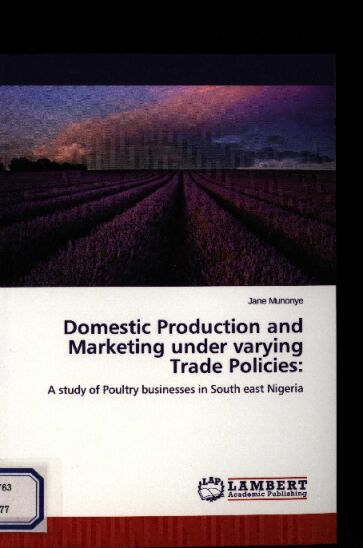
书名:Domestic production and marketing under varying trade policies
出版时间:2015
出版社:LAP LAMBERT Academic Publishing, a trademark of OmniScriptum GmbH & Co. KG,
摘要
The broad objective of the study is to examine domestic production and marketing under varying trade policies focusing on poultry businesses in southeast Nigeria from 1994 - 2009. The study adopted trend analysis of before (1994-2001) and since (2002-2009) the ban to examine the variations in poultry input; production; marketing and consumption. Only primary data were used in the study. The primary data were collected with the use of four sets of questionnaire administered to one hundred and seventy- seven respondents. The respondents were purposively selected from three southeast states: Anambra, Ebonyi and Imo. Data were analyzed using bar and pie charts, trend analysis, multiple regression and averages. The finding of the study showed that the trend of poultry inputs indicated an increasing trend since the ban with trend coefficient and correlation coefficient values of 7.90, 0.933; 6.22, 0.70 and 49.58, 0.88 for feed, drug and day old chicks respectively. The cost of feed was highly reduced since the ban. The quantity of feed demanded for domestic production was positively related to output. Average production times increased from 2.5 to 3.0 on-existing farms with standard deviation of 0.13. There is increased quantity produced by 76 percent of the respondents with a mean value of 808.05 and a standard deviation of 137.70 since the ban. Expansion of poultry products was increased in both mature broiler production and processing. There is increased resource use with a mean value of 310.48 and a standard deviation of 48.43. The trend of feed used since the ban indicated an increasing trend while the output produced before and since the ban indicated a decreasing trend. The trend of price and time showed an increasing trend with highest value in 2009 and least in 1994 with a correlation coefficient of 0.95 indicating a strong relationship between price and time. Factors affecting domestic production were all positively related to output except price of day old chicks which was negatively related. The interactive graph of price of imported and local poultry products indicated an increasing trend with trend coefficient value of 1.33x and correlation coefficient value of 0.52 indicating a not too strong relationship. Consumer perception of the ban is negatively related to price. Input cost constituted a major constraint by poultry producers. The study concluded that import ban on poultry products stimulated domestic production. The study recommended the following: reduction and subsidization of input by government, farmers should consolidate and emerge into agribusiness. Supply managed poultry businesses are recommended. Therefore a further research should be conducted on the impact of government support on domestic poultry production and marketing in the zone.
查看更多
目录
Dedication i
Acknowledgement ii
Abstract iv
Table of Contents v
List of Tables xii
List of Figures xv
List of Acronyms xviii
Chapter one: Introduction
1.1 Background Information 1
1.2 Problem Statement 4
1.3 Objectives of the study 7
1.4 Hypotheses 8
1.5 Justification 9
Chapter two: Literature review and theoretical framework
2.1 Literature Review 11
2.1.1 Agribusiness 11
2.1.2 Poultry as an Agribusiness 12
2.1.2.1 Breeding and Hatching of commercial day old chicks 14
2.1.2.2 Broiler and egg production 15
2.1.3 Poultry management 16
2.1.3.1 Handling of Poultry 16
2.1.3.2 Feather pecking and cannibalism 17
2.1.3.3 Hygiene and disinfection in poultry management 19
2.1.3.4 Poultry Financing 20
2.1.3.5 Disease incidence 20
2.1.3.6 Feed Availability 22
2.2 Agricultural Trade Policies 23
2.3 Domestic Production under varying trade policies 29
2.4 Nigerian Agricultural Development since Independence 35
2.5 Reasons for the under development of Agribusiness in Nigeria 36
2.6 Theoretical framework 38
2.7 Analytical Frame work 41
2.8 Lessons from literature 45 C1Chapter three: methodology
3.1 Study location 48
3.2 Sampling Technique 49
3.3 Data collection 51
3.4 Method of data analysis 51
3.5 Logical Frame work matrix 55
Chapter four: results and discussion
4.1 Socioeconomic characteristics of poultry business 56
4.1.1 Age distribution of respondents 56
4.1.2 Level of Education of respondents 57
4.1.3 Gender distribution of respondents 58
4.2 Trend analysis on resources (feed, dayold chicks and drugs) before and since the ban 59
4.2.1 Trend of input( feed) demanded before the ban 59
4.2.2 Average cost of feed before the ban 61
4.2.3 Trend of feed demanded since the ban 62
4.2.4 Average cost of feed since the ban 64
4.2.5 Trend of the quantity of drugs demanded before the ban 64
4.2.6 Trend of the quantity of drugs demanded since the ban 66
4.2.7 Trend of quantity of day old demanded before the ban 67
4.2.8 Trend of quantity of day old chicks demanded since the ban 69
4.2.9 Effects of input supplied on Domestic Production 70
4.2.10 Average quantity of feed used by the producers before and since the ban 72
4.2.11 Feed used before and since the ban 74
4.2.11 Trend of feed used before the ban 74
4.2.12 Trend of feed used since the ban 75
4.2.13 Cost of Day old chicks before and since the ban 76
4.2.13 Cost of day old chicks before the ban 76
4.2.14 Cost of day old chicks since the ban 78
4.2.15 Trend cost of Day old chicks before and since the ban 79
4.2.16 Estimated output of poultry produced before and since the ban 81
4.3 Examination of Production cycles before and since the ban 83
4.3.1 Number of times broilers are reared in a year before and since the ban 83
4.3.2 Increase in the quantity produced 84
4.3.3 Maximum month of maturity of broiler 85
4.3.4 Number of broiler reared before and since the ban 86
4.4 Expansion of poultry products before and since the ban 88
4.4.1 Expansion of poultry products before and since the ban 88
4.4.2 Quantity of expansion of poultry products before and since the ban 90
4.5 Estimation of factors affecting Domestic production before and since the ban 92
4.6 Ascertain the extent the marketers of imported poultry products substituted that with locally produced poultry products 94
4.6.1 Interactive graph of price of imported and local products before and since the ban 94
4.6.2 Interactive graph of quantity of poultry products imported and quantity of local before and since the ban 95
4.6.3 Trend of price of poultry products before the ban 96
4.6.4 Trend of price of poultry products since the ban 98
4.6.5 Marketing price of poultry products before and since the ban 100
4.6.6 Quantity of poultry products sold 101
4.6.7 Trend of price and time 102
4.7 Consumer's perceptions of the ban on poultry products importation 103
4.7.1 Regression estimates of consumer's perception 103
4.7.2 Comparison between price of local and imported poultry product 106
4.7.3 Consumer response to freshness, taste and cost of both imported and local poultry products 108
4.8 Constraints encountered by poultry producers 109
Chapter five: summary, conclusion and recommendations
5.1 Summary 111
5.2 Conclusion 114
5.3 Recommendations 116
5.4 Contribution to knowledge 117
References 120 Appendices
查看PDF
查看更多
馆藏单位
中国农科院农业信息研究所