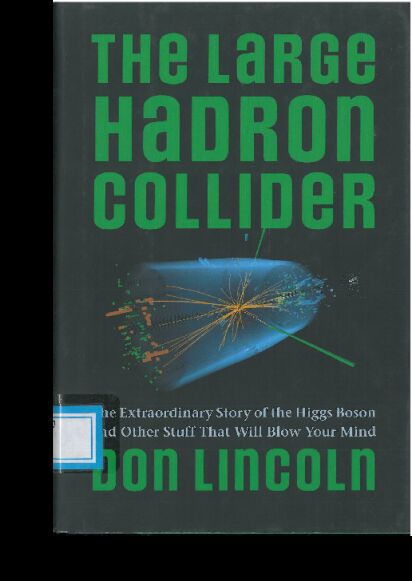
书名:The Large Hadron Collider
责任者:Don Lincoln. | Lincoln, Don,
ISBN\ISSN:9781421413518,1421413515
出版时间:2014
出版社:Johns Hopkins University Press,
摘要
Since 2008 scientists have conducted experiments in a hyperenergized, 17-mile supercollider beneath the border of France and Switzerland. The Large Hadron Collider (or what scientists call "the LHC") is one of the wonders of the modern world-a highly sophisticated scientific instrument designed to recreate in miniature the conditions of the universe as they existed in the microseconds following the big bang. Among many notable LHC discoveries, one led to the 2013 Nobel Prize in Physics for revealing evidence of the existence of the Higgs boson, the so-called God particle. Picking up where he left off in The Quantum Frontier, physicist Don Lincoln shares an insider's account of the LHC's operational history and gives readers everything they need to become well informed on this marvel of technology. Writing about the LHC's early days, Lincoln offers keen insight into an accident that derailed the operation nine days after the collider's 2008 debut. A faulty solder joint started a chain reaction that caused a massive explosion, damaged 50 superconducting magnets, and vaporized large sections of the conductor. The crippled LHC lay dormant for over a year, while technical teams repaired the damage.Lincoln devotes an entire chapter to the Higgs boson and Higgs field, using several extended analogies to help explain the importance of these concepts to particle physics. In the final chapter, he describes what the discovery of the Higgs boson tells us about our current understanding of basic physics and how the discovery now keeps scientists awake over a nagging inconsistency in their favorite theory.As accessible as it is fascinating, The Large Hadron Collider reveals the inner workings of this masterful achievement of technology, along with the mind-blowing discoveries that will keep it at the center of the scientific frontier for the foreseeable future.
查看更多
前言
September 2008 was an exciting time. In front of a billion sets of eyes, the CERN Large Hadron Collider was turned on. Beams were circulated and champagne flowed. The future looked bright indeed.
The drama intensified when, just a handful of days later, a design flaw in the LHC's electrical protection system led to an uncontrolled electric arc that pierced the vessel holding tons of liquid helium. The helium vented with so much force that it pushed magnets weighing 35 tons off their mounts and fractured the concrete floor into which they had been anchored. Over the course of a few minutes, more than 2 miles (3.2 kilometers) of the LHC tunnel was filled only with cold helium gas, with all trace of ordinary air pushed out of the way. Hours later, movies of the inside tunnel taken by the CERN fire brigade showed thick blocks of ice hanging off the walls and equipment.
The damage was extensive, and the design flaw was still part of the rest of the accelerator. Repairs were in order. After tens of millions of dollars and over a year of work, the LHC resumed operations at reduced beam energy and bright ness but still at levels high enough to exceed previous records. And, as they say, the rest is history.
In 2012, experiments at the LHC announced the discovery of the Higgs boson, a particle that had eluded detection for nearly half a century. The story arc of emotional highs, to despair, to triumph was complete. Hundreds of papers, covering the vast range of particle physics, had been written and published on data from the collider. Over a thousand students had worked on or achieved their doctorates. By any standard, the LHC was a success.
When I wrote my earlier book The Quantum Frontier, I sent it to the publisher in the first days of 2008, and thus the book was written even before the LHC turned on. It told the tale of the dreams of physicists but nothing of our accomplishments. That story was in the future.
But now that tale has been told, unfolded on that most public of stages. Unlike many other important discoveries in particle physics, the world has watched. More than once, announcements of progress in the story of the pursuit of the Higgs boson got above- the-fold coverage in international newspapers and on the main websites of online news sites. People cared.
So this brings us to the book you're holding. In the years since The Quantum Frontier was written, a lot has happened. Many want to know the inside scoop-what it is like to be at the very forefront of research. They want someone to tell them how it happened. They need to hear how it all went down, told by someone who was there-someone ... well ... like me. I was there. I sat in the meetings, heard the arguments, felt the elation and the heartbreaks. It has been a glorious time, and the story is one worth telling.
So here it is. This book necessarily has some overlap with the earlier book. The physics we have long known and the accelerators and detectors haven’t changed very much. For those topics for which I couldn’t think of a better way to say it, I have borrowed from my previous text.
But much of the book is entirely new. Obviously the saga of the startup and the discoveries weren‘t present before. The Higgs boson now warrants an entirely separate chapter, which explains the theory and the exciting search (including several different analogies, each designed to illuminate a different facet of this fascinating particle). With the discovery of the Higgs boson, the next burning question at the LHC is why its mass is so low. Nobody knows the answer to that question, but it is definitely the next hot topic for LHC physicists, so I explore it in some detail. In fact, in this new book, all of the possible new physics I describe and that we might encounter are tied to the unexplained enigma of the low mass of the Higgs boson. One possible new physical phenomenon we might encounter and could answer that question is extra dimensions of space, which (if true) could actually solve many mysteries. I didn’t include a discussion of this subject in The Quantum Frontier, but you’ll find it here.
Perhaps the most important thing is that we now have operational experience with the LHC. We have a much better idea of what the future might bring us. When the accelerator turns back on and collisions resume, we have a good idea of what to expect and the rate at which we will collect data. The LHC will dominate the energy research frontier for at least another 15 years, and in this book I sketch out what our plans for the future are. Of course, a discovery will inevitably alter those plans, but once you have read this book, you'll know what I know now.
The Large Hadron Collider is the biggest scientific facility ever built, requiring nearly ten thousand physicists and technical professionals to operate it and to understand the data. It was two full decades in planning and building, and it is an international endeavor, supported by most of the world's leading economies. It is likely if you’re reading this that universities and laboratories in your own country are participating and, through a tiny fraction of your annual taxes, you have personally contributed to this unparalleled scientific mission. You should know what you are getting for your money. And the answer is simple. Physicists are doing nothing less than coming to understand the deepest rules that govern matter and energy, space and time. So read on and share the enthusiasm of people asking and answering timeless questions. This is a very exciting moment in history.
查看更多
目录
Preface vii
Acknowledgments xi
1 Beginnings and Building Blocks 1
2 Stuff飞Ne Already Know 5
3 Accelerators and the LHC 24
4 Incredible Detectors 55
5 Teething Pains and Triumphs 105
6 The Dramatic Higgs Saga 123
7 Looking for Something New 159
8 The Future Is Bright! 207
Suggested Reading 213
Index 219
查看PDF
查看更多
馆藏单位
中科院文献情报中心