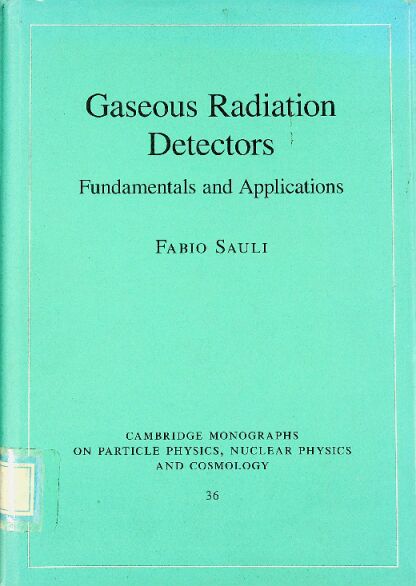
书名:Gaseous radiation detectors
ISBN\ISSN:9781107043015,1107043018
出版时间:2014
出版社:University Printing House,Cambridge University Press
前言
Widely used in high-energy and particle physics, gaseous radiation detectors are undergoing continuous development. The first part of this book provides a solid background for understanding the basic processes leading to the detection and tracking of charged particles, photons, and neutrons. Continuing then with the development of the multi-wire proportional chamber, the book describes the design and operation of successive generations of gas-based radiation detectors, as well as their use in experimental physics and other fields. Examples are provided of applications for complex events tracking, particle identification, and neutral radiation imaging. Limitations of the devices are discussed in detail. Including an extensive collection of data and references, this book is ideal for researchers and experimentalists in nuclear and particle physics.
查看更多
目录
Acronyms page ix
Preface xiii
1 Introduction 1
1.1 Historical background 1
1.2 Gaseous detectors: a personal recollection 4
1.3 Basic processes in gaseous counters 20
1.4 Outline of the book 23
2 Electromagnetic interactions of charged particles with matter 24
2.1 Generalities on the energy loss process 24
2.2 The Bethe–Bloch energy loss expression 28
2.3 Energy loss statistics 29
2.4 Delta electron range 40
3 Interaction of photons and neutrons with matter 43
3.1 Photon absorption and emission in gases 43
3.2 Photon absorption: definitions and units 44
3.3 Photon absorption processes: generalities 46
3.4 Photon absorption in gases: from the visible to the near ultra-violet domain 49
3.5 Photo-ionization: near and vacuum ultra-violet 53
3.6 Photo-ionization in the X-ray region 56
3.7 Compton scattering and pair production 62
3.8 Use of converters for hard photons detection 63
3.9 Transparency of windows 67
3.10 Detection of neutrons 68
4 Drift and diffusion of charges in gases 76
4.1 Generalities 76
4.2 Experimental methods 76
4.3 Thermal diffusion of ions 80
4.4 Ion mobility and diffusion in an electric field 82
4.5 Classic theory of electron drift and diffusion 87
4.6 Electron drift in magnetic fields 90
4.7 Electron drift velocity and diffusion: experimental 91
4.8 Electron capture 106
4.9 Electron drift in liquid noble gases 112
4.10 Transport theory 114
5 Collisional excitations and charge multiplication in uniform fields 129
5.1 Inelastic electron–molecule collisions 129
5.2 Excitations and photon emission 130
5.3 Ionization and charge multiplication 143
5.4 Avalanche statistics 149
5.5 Streamer formation and breakdown 153
6 Parallel plate counters 160
6.1 Charge induction on conductors 160
6.2 Signals induced by the motion of charges in uniform fields 161
6.3 Analytical calculation of charge induction 165
6.4 Signals induced by the avalanche process 172
6.5 Grid transparency 175
6.6 Applications of parallel plate avalanche counters (PPACs) 177
7 Proportional counters 182
7.1 Basic principles 182
7.2 Absolute gain measurement 188
7.3 Time development of the signal 188
7.4 Choice of the gas filling 191
7.5 Energy resolution 194
7.6 Scintillation proportional counters 198
7.7 Space-charge gain shifts 201
7.8 Geiger and self-quenching streamer operation 206
7.9 Radiation damage and detector ageing 207
8 Multi-wire proportional chambers 211
8.1 Principles of operation 211
8.2 Choice of geometrical parameters 215
8.3 Influence on gain of mechanical tolerances 216
8.4 Electrostatic forces and wire stability 218
8.5 General operational characteristics: proportional and
semi-proportional 221
8.6 Saturated amplification region: Charpak’s ‘magic gas’ 226
8.7 Limited streamer and full Geiger operation 230
8.8 Discharges and breakdown: the Raether limit 231
8.9 Cathode induced signals 234
8.10 The multi-step chamber (MSC) 245
8.11 Space charge and rate effects 249
8.12 Mechanical construction of MWPCs 252
9 Drift chambers 264
9.1 Single wire drift chambers 264
9.2 Multi-cell planar drift chambers 265
9.3 Volume multi-wire drift chambers 275
9.4 Jet chambers 280
9.5 Time expansion chamber 282
9.6 Determination of the longitudinal coordinate from current division 284
9.7 Electrodeless drift chambers 287
9.8 General operating considerations 290
9.9 Drift chamber construction 290
10 Time projection chambers 292
10.1 Introduction: the precursors 292
10.2 Principles of operation 293
10.3 TPC-based experiments 297
10.4 Signal induction: the pad response function 301
10.5 Choice of the gas filling 312
10.6 Coordinate in the drift direction and multi-track resolution 315
10.7 Positive ion backflow and gating 318
10.8 TPC calibration 323
10.9 Liquid noble gas TPC 324
10.10 Negative ion TPC 325
11 Multi-tube arrays 327
11.1 Limited streamer tubes 327
11.2 Drift tubes 329
11.3 Straw tubes 335
11.4 Mechanical construction and electrostatic stability 340
12 Resistive plate chambers 344
12.1 Spark counters 344
12.2 Resistive plate counters (RPCs) 346
12.3 Glass RPCs 353
12.4 Multi-gap RPCs 355
12.5 Simulations of RPC operation 360
13 Micro-pattern gaseous detectors 365
13.1 The micro-strip gas counter 365
13.2 Novel micro-pattern devices 373
13.3 Micro-mesh gaseous structure (Micromegas) 378
13.4 Gas electron multiplier (GEM) 383
13.5 MPGD readout of time projection chambers 392
13.6 Active pixel readout 395
13.7 MPGD applications 398
14 Cherenkov ring imaging 399
14.1 Introduction 399
14.2 Recalls of Cherenkov ring imaging theory 403
14.3 First generation RICH detectors 407
14.4 TMAE and the second generation of RICH detectors 410
14.5 Third generation RICH: solid caesium iodide (CsI) photocathodes 417
14.6 CsI-based RICH particle identifiers 423
14.7 Micro-pattern based RICH detectors 424
15 Miscellaneous detectors and applications 430
15.1 Optical imaging chambers 430
15.2 Cryogenic and dual-phase detectors 434
16 Time degeneracy and ageing 441
16.1 Early observations 441
16.2 Phenomenology of the radiation damages 443
16.3 Quantitative assessment of the ageing rates 449
16.4 Methods of preventing or slowing down the ageing process 451
16.5 Ageing of resistive plate chambers 455
16.6 Micro-pattern detectors 457
Further reading on radiation detectors 460
References 461
Index 494
查看更多
作者简介
Fabio Sauli is Research Associate for the Italian TERA Foundation, responsible for the development of medical diagnostic instrumentation for hadrontherapy. Prior to this, he was part of the Research Staff at CERN in the Gas Detectors Development group, initiated by Georges Charpak, before leading the group from 1989 until his retirement in 2006. He has more than 200 scientific publications and is an editor of several books on instrumentation in high energy physics. His achievements include inventing the Gas Electron Multiplier (GEM), which is widely used in advanced detectors.
查看更多
馆藏单位
中科院文献情报中心