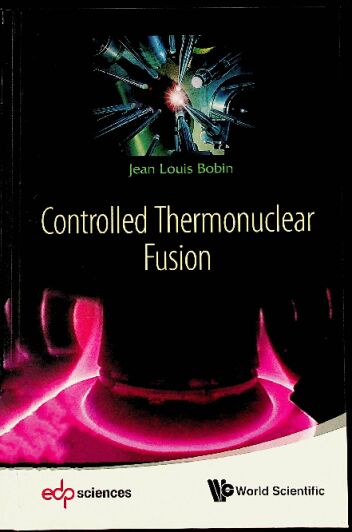
书名:Controlled thermonuclear fusion
ISBN\ISSN:9789814590686,9814590681,9789814579759,9814579750
出版时间:2014
出版社:World Scientific ;,EDP Sciences
前言
Nuclear fusion powers the stars.Making this energy source work on Earth is an old challenge.In 1933,Lord Rutherford stated:"Anyone who looks for a source of power in the transformation of the atom is talking moonshine." It will be seen further down that indeed the beam target scheme Rutherford had in mind cannot be on the path towards an energy source. However, other ways that might succeed do exist. Controlled thermonuclear fusion would then deliver energy from an endless source—a dream for the future of mankind.In order to realize the dream, scientists all over the world deliberately started inventing and developing new devices based on the results of fundamental research. Looking back at the history of technologies, we see examples that are to the contrary. On the one hand,the first industrial revolution is associated with the steam reciprocal engine,a technology that was developed empirically for centuries.The science(i.e.thermodynamics) came afterwards.It provided explanations and guiding principles for improvements. On the other hand, the science of electricity was developed first,followed by techniques in power supply and communication. In both cases, the development was a result of private investment and initiative. States played rather ancillary roles, granting concessions and permits.During the 20th century,state-owned companies in mining,transportation, power supply,etc.,were established for ideological reasons long after the occurrence of industrial revolutions.The situation has been quite different in the realm of nuclear technologies. The birth of the nuclear industry took place during World War 2. After an initial stage devoted to nuclear weapons,research began on reactors best suited for power plants, first in national laboratories in which part of the activity is classified. Progressively after the war, principles and developments of civilian technologies were made public and also implemented thanks to private companies. However, after a rapid start, nuclear power plants developed slowly. Protests against nuclear power are not the only reason. So far, nuclear reactors have proved to be competitive only if the produced electric power exceeds 1 GW.In an economy without large-scale planning, the demand is lower and is best satisfied with fossil fuels that require locally smaller investments (Box 1). Only in France,a centralized country,a publicoperator(the state-owned Electricitéde France(EDF))was able to complete a program ending with electric generation being 80% nuclear. Actually,it was a public response to the first oil shock(1973). Governments are also expected to play a major role in a possible"nuclear renaissance".
Box 1. Nuclear gigantism The larger the size of a single reactor, the more profitable is a fssion power plant.As time elapsed,the rated electric power of the second-generation PWR(pressurized water reactor)increased from 500MW to 1300MW. In the third-generation EPR(European Pressurized Reactor), the rated power will be 1600 MW.In order to build a nuclear reactor,a huge investment has to be allocated in a short time. Only communities that are large enough can afford it.Local demand is often at a smallerlevel,typically500MW,an amount coal and gas power plants can economically deliver if environmental issues are ignored.In the history of energy technologies, many breakthroughs occurred after inventions or discoveries that were not primarily intended at creating energy sources.On the contrary,since the beginning of the 1950s,research on controlled fusion deliberately aim at future power plants. An inter- national scientific community supported by the richest nations is at work. Scientists have the inuition that it will indeed be possible to eventually
查看更多
目录
Acknowledgments v
Foreword xi
Units xv
1. Some Basic Physics1
1.Atoms1
2.Nuclei3
3.Nuclear reactions5
Reference7
2. Thermonuclear Reactions 9
1.Fusion reactions 9
2.Hydrogen — the fuel of the Sun and other stars 11
3.Deuterium reactions 12
4. The thermonuclear regime 15
5. The ignition and sustainability of a thermonuclear reaction 17
6. The steady regime: the Lawson criterion 21
7.The explosive regime23
References 25
3. Plasmas 27
1.The plasma state 27
2.Coulomb collisions in a plasma 30
3.Plasma creation 32
4.The magnetized plasma 33
5. Charged particle diffusion across a magnetic field 36
6. Plasma oscillations 37
7. Nonlinear waves and turbulence 39
8.Natural and fusion plasmas 40
References 41
4. Some Features of Magnetic Confinement 43
1.The basic 43
2.Current-carrying plasmas 44
3.Stability 46
4. Closed configurations 48
5. Equilibrium and stability of a current-carrying plasma ring 50
6. Charged particle trajectories in a current-carrying plasma ring 53
7.More instabilities in the torus 55
8.Compact tori 57
9.Stellarators 58
References 59
5. Tokamaks 61
1. The description and operation of a tokamak 61
2.Bigger and bigger,why? 63
3.Auxiliary heating 65
4.Three generations of tokamaks 71
5.Assessing tokamaks 74
References78
6. ITER and Satellite Programs 79
1.A unifying project 79
2.How ITER looks like 82
3.ITER and safety 86
4.The question of materials 87
5. IFMIF (International Fusion Material Irradiation Facility) 91 6.Controversies 93
References 94
7. Some Features of Inertial Confinement—The Role of Lasers 95
1.Control of a micro-explosion 96
2. Dynamics of the compression 98
3. Interaction of a laser beam with a solid target 101
4.Instabilities 104
5.Indirect drive 106
6.Target design 109
7.Compression experiments 112
References 115
8. Big Drivers for Inertial Fusion
1. Laser energy and thermonuclear gain:the megajoule milestone 117
2.High-power lasers 120
3.Megajoule lasers 126
4.Beam to target 129
5.Spontaneous or triggered ignition? 133
6.An alternative solution: particle beams 136
7.The"Z-pinch"is back 139
References 143
9. Off The Main Trails 145
1.Fissile blankets 145
2.Hybrids with magnetic or inertial confinement 147
3.Cold fusion catalyzed by muons 152
4.Fuels beyond deuterium-tritium 154
References 158
10. The Fusion Reactor 159
1.Achilles and the tortoise,a paradox revisited 159
2.Conditions for a power plant 161
3.Energy cycles 165
4.Fusion in the nuclear fuel cycle 169
5.A glimpse of the future 171
6.A touch of economy 174
7.Tritium breeding and resources 176
References 178
Epilogue 179
Glossary 183
Acronyms 191
Selected Bibliography 193
Index 195
查看PDF
查看更多
馆藏单位
中科院文献情报中心