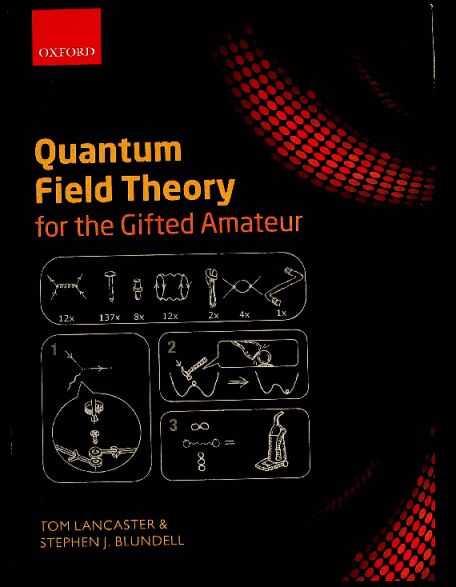
书名:Quantum field theory for the gifted amateur
责任者:Tom Lancaster | Stephen J. Blundell.
ISBN\ISSN:9780199699322,0199699321,9780199699339,019969933X
出版时间:2014
出版社:Oxford University Press
前言
Quantum field theory is arguably the most far-reaching and beautiful physical theory ever constructed, with aspects more stringently tested and verified to greater precision than any other theory in physics. Unfortunately, the subject has gained a notorious reputation for difficulty, with forbidding looking mathematics and a peculiar diagrammatic language described in an array of unforgiving, weighty textbooks aimed firmly at aspiring professionals. However, quantum field theory is too important, too beautiful, and too engaging to be restricted to the professionals. This book on quantum field theory is designed to be different. It is written by experimental physicists and aims to provide the interested amateur with a bridge from undergraduate physics to quantum field theory. The imagined reader is a gifted amateur, possessing a curious and adaptable mind, looking to be told an entertaining and intellectually stimulating story, but who will not feel patronised if a few mathematical niceties are spelled out in detail. Using numerous worked examples, diagrams, and careful physically motivated explanations, this book will smooth the path towards understanding the radically different and revolutionary view of the physical world that quantum field theory provides, and which all physicists should have the opportunity to experience.
查看更多
目录
0 Overture 1
0.1 What is quantum field theory? 1
0.2 What is a field? 2
0.3 Who is this book for? 2
0.4 Special relativity 3
0.5 Fourier transforms 6
0.6 Electromagnetism 7
I The Universe as a set of harmonic oscillators 9
1 Lagrangians 10
1.1 Fermat’s principle 10
1.2 Newton’s laws 10
1.3 Functionals 11
1.4 Lagrangians and least action 14
1.5 Why does it work? 16
Exercises 17
2 Simple harmonic oscillators 19
2.1 Introduction 19
2.2 Mass on a spring 19
2.3 A trivial generalization 23
2.4 Phonons 25
Exercises 27
3 Occupation number representation 28
3.1 A particle in a box 28
3.2 Changing the notation 29
3.3 Replace state labels with operators 31
3.4 Indistinguishability and symmetry 31
3.5 The continuum limit 35
Exercises 36
4 Making second quantization work 37
4.1 Field operators 37
4.2 How to second quantize an operator 39
4.3 The kinetic energy and the tight-binding Hamiltonian 43
4.4 Two particles 44
4.5 The Hubbard model 46
Exercises 48
II Writing down Lagrangians 49
5 Continuous systems 50
5.1 Lagrangians and Hamiltonians 50
5.2 A charged particle in an electromagnetic field 52
5.3 Classical fields 54
5.4 Lagrangian and Hamiltonian density 55
Exercises 58
6 A first stab at relativistic quantum mechanics 59
6.1 The Klein–Gordon equation 59
6.2 Probability currents and densities 61
6.3 Feynman’s interpretation of the negative energy states 61
6.4 No conclusions 63
Exercises 63
7 Examples of Lagrangians, or how to write down a theory 64
7.1 A massless scalar field 64
7.2 A massive scalar field 65
7.3 An external source 66
7.4 The φ 4 theory 67
7.5 Two scalar fields 67
7.6 The complex scalar field 68
Exercises 69
III The need for quantum fields 71
8 The passage of time 72
8.1 Schrödinger’s picture and the time-evolution operator 72
8.2 The Heisenberg picture 74
8.3 The death of single-particle quantum mechanics 75
8.4 Old quantum theory is dead; long live fields! 76
Exercises 78
9 Quantum mechanical transformations 79
9.1 Translations in spacetime 79
9.2 Rotations 82
9.3 Representations of transformations 83
9.4 Transformations of quantum fields 85
9.5 Lorentz transformations 86
Exercises 88
10 Symmetry 90
10.1 Invariance and conservation 90
10.2 Noether’s theorem 92
10.3 Spacetime translation 94
10.4 Other symmetries 96
Exercises 97
11 Canonical quantization of fields 98
11.1 The canonical quantization machine 98
11.2 Normalizing factors 101
11.3 What becomes of the Hamiltonian? 102
11.4 Normal ordering 104
11.5 The meaning of the mode expansion 106
Exercises 108
12 Examples of canonical quantization 109
12.1 Complex scalar field theory 109
12.2 Noether’s current for complex scalar field theory 111
12.3 Complex scalar field theory in the non-relativistic limit 112
Exercises 116
13 Fields with many components and massive electromagnetism 117
13.1 Internal symmetries 117
13.2 Massive electromagnetism 120
13.3 Polarizations and projections 123
Exercises 125
14 Gauge fields and gauge theory 126
14.1 What is a gauge field? 126
14.2 Electromagnetism is the simplest gauge theory 129
14.3 Canonical quantization of the electromagnetic field 131
Exercises 134
15 Discrete transformations 135
15.1 Charge conjugation 135
15.2 Parity 136
15.3 Time reversal 137
15.4 Combinations of discrete and continuous transformations 139
Exercises 142
IV Propagators and perturbations 143
16 Propagators and Green’s functions 144
16.1 What is a Green’s function? 144
16.2 Propagators in quantum mechanics 146
16.3 Turning it around: quantum mechanics from the propagator and a first look at perturbation theory 149
16.4 The many faces of the propagator 151
Exercises 152
17 Propagators and fields 154
17.1 The field propagator in outline 155
17.2 The Feynman propagator 156
17.3 Finding the free propagator for scalar field theory 158
17.4 Yukawa’s force-carrying particles 159
17.5 Anatomy of the propagator 162
Exercises 163
18 The S-matrix 165
18.1 The S-matrix: a hero for our times 166
18.2 Some new machinery: the interaction representation 167
18.3 The interaction picture applied to scattering 168
18.4 Perturbation expansion of the S-matrix 169
18.5 Wick’s theorem 171
Exercises 174
19 Expanding the S-matrix: Feynman diagrams 175
19.1 Meet some interactions 176
19.2 The example of φ 4 theory 177
19.3 Anatomy of a diagram 181
19.4 Symmetry factors 182
19.5 Calculations in p-space 183
19.6 A first look at scattering 186
Exercises 187
20 Scattering theory 188
20.1 Another theory: Yukawa’s ψ † ψφ interactions 188
20.2 Scattering in the ψ † ψφ theory 190
20.3 The transition matrix and the invariant amplitude 192
20.4 The scattering cross-section 193
Exercises 194
V Interlude: wisdom from statistical physics 195
21 Statistical physics: a crash course 196
21.1 Statistical mechanics in a nutshell 196
21.2 Sources in statistical physics 197
21.3 A look ahead 198
Exercises 199
22 The generating functional for fields 201
22.1 How to find Green’s functions 201
22.2 Linking things up with the Gell-Mann–Low theorem 203
22.3 How to calculate Green’s functions with diagrams 204
22.4 More facts about diagrams 206
Exercises 208
VI Path integrals 209
23 Path integrals: I said to him, ‘You’re crazy’ 210
23.1 How to do quantum mechanics using path integrals 210
23.2 The Gaussian integral 213
23.3 The propagator for the simple harmonic oscillator 217
Exercises 220
24 Field integrals 221
24.1 The functional integral for fields 221
24.2 Which field integrals should you do? 222
24.3 The generating functional for scalar fields 223
Exercises 226
25 Statistical field theory 228
25.1 Wick rotation and Euclidean space 229
25.2 The partition function 231
25.3 Perturbation theory and Feynman rules 233
Exercises 236
26 Broken symmetry 237
26.1 Landau theory 237
26.2 Breaking symmetry with a Lagrangian 239
26.3 Breaking a continuous symmetry: Goldstone modes 240
26.4 Breaking a symmetry in a gauge theory 242
26.5 Order in reduced dimensions 244
Exercises 245
27 Coherent states 247
27.1 Coherent states of the harmonic oscillator 247
27.2 What do coherent states look like? 249
27.3 Number, phase and the phase operator 250
27.4 Examples of coherent states 252
Exercises 253
28 Grassmann numbers: coherent states and the path integral for fermions 255
28.1 Grassmann numbers 255
28.2 Coherent states for fermions 257
28.3 The path integral for fermions 257
Exercises 258
VII Topological ideas 259
29 Topological objects 260
29.1 What is topology? 260
29.2 Kinks 262
29.3 Vortices 264
Exercises 266
30 Topological field theory 267
30.1 Fractional statistics à la Wilczek: the strange case of anyons 267
30.2 Chern–Simons theory 269
30.3 Fractional statistics from Chern–Simons theory 271
Exercises 272
VIII Renormalization: taming the infinite 273
31 Renormalization, quasiparticles and the Fermi surface 274
31.1 Recap: interacting and non-interacting theories 274
31.2 Quasiparticles 276
31.3 The propagator for a dressed particle 277
31.4 Elementary quasiparticles in a metal 279
31.5 The Landau Fermi liquid 280
Exercises 284
32 Renormalization: the problem and its solution 285
32.1 The problem is divergences 285
32.2 The solution is counterterms 287
32.3 How to tame an integral 288
32.4 What counterterms mean 290
32.5 Making renormalization even simpler 292
32.6 Which theories are renormalizable? 293
Exercises 294
33 Renormalization in action: propagators and Feynman diagrams 295
33.1 How interactions change the propagator in perturbation theory 295
33.2 The role of counterterms: renormalization conditions 297
33.3 The vertex function 298
Exercises 300
34 The renormalization group 302
34.1 The problem 302
34.2 Flows in parameter space 304
34.3 The renormalization group method 305
34.4 Application 1: asymptotic freedom 307
34.5 Application 2: Anderson localization 308
34.6 Application 3: the Kosterlitz–Thouless transition 309
Exercises 312
35 Ferromagnetism: a renormalization group tutorial 313
35.1 Background: critical phenomena and scaling 313
35.2 The ferromagnetic transition and critical phenomena 315
Exercises 320
IX Putting a spin on QFT 321
36 The Dirac equation 322
36.1 The Dirac equation 322
36.2 Massless particles: left- and right-handed wave functions 323
36.3 Dirac and Weyl spinors 327
36.4 Basis states for superpositions 330
36.5 The non-relativistic limit of the Dirac equation 332
Exercises 334
37 How to transform a spinor 336
37.1 Spinors aren’t vectors 336
37.2 Rotating spinors 337
37.3 Boosting spinors 337
37.4 Why are there four components in the Dirac equation? 339
Exercises 340
38 The quantum Dirac field 341
38.1 Canonical quantization and Noether current 341
38.2 The fermion propagator 343
38.3 Feynman rules and scattering 345
38.4 Local symmetry and a gauge theory for fermions 346
Exercises 347
39 A rough guide to quantum electrodynamics 348
39.1 Quantum light and the photon propagator 348
39.2 Feynman rules and a first QED process 349
39.3 Gauge invariance in QED 351
Exercises 353
40 QED scattering: three famous cross-sections 355
40.1 Example 1: Rutherford scattering 355
40.2 Example 2: Spin sums and the Mott formula 356
40.3 Example 3: Compton scattering 357
40.4 Crossing symmetry 358
Exercises 359
41 The renormalization of QED and two great results 360
41.1 Renormalizing the photon propagator: dielectric vacuum 361
41.2 The renormalization group and the electric charge 364
41.3 Vertex corrections and the electron g-factor 365
Exercises 368
X Some applications from the world of condensed matter 369
42 Superfluids 370
42.1 Bogoliubov’s hunting license 370
42.2 Bogoliubov’s transformation 372
42.3 Superfluids and fields 374
42.4 The current in a superfluid 377
Exercises 379
43 The many-body problem and the metal 380
43.1 Mean-field theory 380
43.2 The Hartree–Fock ground state energy of a metal 383
43.3 Excitations in the mean-field approximation 386
43.4 Electrons and holes 388
43.5 Finding the excitations with propagators 389
43.6 Ground states and excitations 390
43.7 The random phase approximation 393
Exercises 398
44 Superconductors 400
44.1 A model of a superconductor 400
44.2 The ground state is made of Cooper pairs 402
44.3 Ground state energy 403
44.4 The quasiparticles are bogolons 405
44.5 Broken symmetry 406
44.6 Field theory of a charged superfluid 407
Exercises 409
45 The fractional quantum Hall fluid 411
45.1 Magnetic translations 411
45.2 Landau Levels 413
45.3 The integer quantum Hall effect 415
45.4 The fractional quantum Hall effect 417
Exercises 421
XI Some applications from the world of particle physics 423
46 Non-abelian gauge theory 424
46.1 Abelian gauge theory revisited 424
46.2 Yang–Mills theory 425
46.3 Interactions and dynamics of W µ 428
46.4 Breaking symmetry with a non-abelian gauge theory 430
Exercises 432
47 The Weinberg–Salam model 433
47.1 The symmetries of Nature before symmetry breaking 434
47.2 Introducing the Higgs field 437
47.3 Symmetry breaking the Higgs field 438
47.4 The origin of electron mass 439
47.5 The photon and the gauge bosons 440
Exercises 443
48 Majorana fermions 444
48.1 The Majorana solution 444
48.2 Field operators 446
48.3 Majorana mass and charge 447
Exercises 450
49 Magnetic monopoles 451
49.1 Dirac’s monopole and the Dirac string 451
49.2 The ’t Hooft–Polyakov monopole 453
Exercises 456
50 Instantons, tunnelling and the end of the world 457
50.1 Instantons in quantum particle mechanics 458
50.2 A particle in a potential well 459
50.3 A particle in a double well 460
50.4 The fate of the false vacuum 463
Exercises 466
A Further reading 467
B Useful complex analysis 473
B.1 What is an analytic function? 473
B.2 What is a pole? 474
B.3 How to find a residue 474
B.4 Three rules of contour integrals 475
B.5 What is a branch cut? 477
B.6 The principal value of an integral 478
Index
查看更多
馆藏单位
中科院文献情报中心