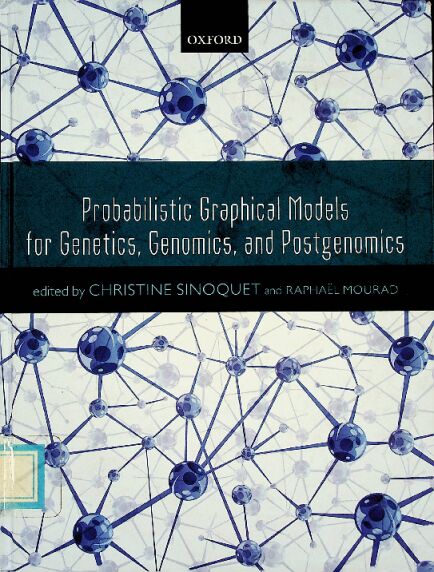
书名:Probabilistic graphical models for genetics, genomics and postgenomics
责任者:Christine Sinoquet | Raphael Mourad.
出版时间:2014
出版社:Oxford University Press
摘要
Nowadays bioinformaticians and geneticists are faced with myriad high-throughput data usually presenting the characteristics of uncertainty, high dimensionality and large complexity.
These data will only allow insights into this wealth of so-called 'omics' data if represented by flexible and scalable models, prior to any further analysis. At the interface between statistics and machine learning, probabilistic graphical models (PGMs) represent a powerful formalism to discover complex networks of relations.
These models are also amenable to incorporating a priori biological information. Network reconstruction from gene expression data represents perhaps the most emblematic area of research where PGMs have been successfully applied. However these models have also created renewed interest in genetics in the broad sense, in particular regarding association genetics, causality discovery, prediction of outcomes, detection of copy number variations, and epigenetics. This book provides an overview of the applications of PGMs to genetics, genomics and postgenomics to meet this increased interest.
查看更多
目录
Abbreviations xix
List of Contributors xxiii
Part I. INTRODUCTION
1. Probabilistic Graphical Models for Next-generation Genomics and Genetics 3
1.1. Fine-grained Description of Living Systems 4
1.1.1. DNA and the Genome 4
1.1.2. Genes and Proteins 5
1.1.3. Phenotype and Genotype 5
1.1.4. Molecular Biology, Genetics, Genomics, and Postgenomics 6
1.2. Higher Descript ion Levels of Living Systems 6
1.2.l. Complexity in Cells 7
1.2.2. Genetics, Epigenetics, and Copy Number Polymorphism 9
1.2.3. Epigenetics with Additional Prior Knowledge on the Genome 11
1.2.4. Transcriptomics 11
1.2.5. Transcriptomics with Prior Biological Knowledge 13
1.2.6. Integrating Data from Several Levels 13
1.2.7. Recapitulation 16
1.3. An Era of High-th roughput Genomic Technologies 16
1.3.1. Genotyping 16
1.3.2. Copy Number Polymorphism 19
1.3.3. DNA Methylation Measurements 19
1.3.4. Gene Expression Data 20
1.3.5. Quantitative Trait Loci 21
1.3.6. The Challenge of Handling Omics Data 23
1.4. Probabilistic Graphical Models to Infer Novel Knowledge from Omics Data 23
1.4.1. Gene Network Inference 24
1.4.2. Causality Discovery 24
1.4.3. Association Genetics 26
1.4.4. Epigenetics 26
1.4.5. Detection of Copy Number Variations 26
1.4.6. Prediction of Outcomes from High-dimensional Gen omic Data 26
2. Essentials to Understand Probabilistic Graphical Models: A Tutorial about Inference and Learning 30
2.1. Introduction 32
2.2. Reminders 32
2.3. Various Classes of Probabilistic Graphical Models 38
2.3.1. Markov Chains and Hidden Markov Models 38
2.3.2. Markov Random Fields 39
2.3.3. Variants around the Concept of Markov random field 41
2.3.4. Bayesian networks 4 1
2.3.5. Unifying Model and Model Extension 45
2.4. Probabilistic Inference 46
2.4.1. Exact Inference 46
2.4.2. Approximate Inference 51
2.5. Learning Bayesian networks 57
2.5.1. Parameter Learning 58
2.5.2. Structure Learning 61
2.6. Learning Markov random fields 69
2.6.1. Parameter Learning 69
2.6.2. Structure Learning 72
2.7. Causal Networks 75
2.8. List of General Monographs and Focused Chapter Books 77
Part II. GENE EXPRESSION
3. Graphical Models and Multivariate Analysis of Microarray Data 85
3.1. Introduction 85
3.2. The Model 87
3.3. Model Fitting 88
3.3.1. Maximum Likelihood Estimation when the Zero Pattern is Known 89
3.3.2. Determining the Pattern of Zeroes i.n the Inverse Covariance Matri.x 90
3.4. Hypothesis Testing 92
3.4.1. Null Distributions by Permutation 92
3.4.2. A Multivariate Test Statistic 93
3.4.3. Partitioning of the Test Statistic 94
3.4.4. Testing Strategies 95
3.5. Example 96
3.6. Discussion and Conclusions 99
4. Comparison of Mixture Bayesian and Mi.xture Regression Approaches to Infer Gene Networks 105
4.1. Introduction 106
4.2. Methods 107
4.2.l. Mixture Bayesia n Network 107
4.2.2. Mixture Regression Approach 108
4.2.3. Data 110
4.3. Results 112
4.3.1. Comparison of Mixtures 112
4.3.2. Mixture Modeling of Changes in Gene Relationships 112
4.3.3. Interpretatio n of Mixtures 114
4.3.4. Inference of Large Networks 116
4.4. Conclusions 116
5. Network Inference in Breast Cancer with Gaussian Graphical Models and Extensions 121
5.1. I ntroduction 122
5.2. Modeling of Gene Networks by Gaussian Graph ical Networks 123
5.2.1. Simple Gaussian graphical network 123
5.2.2. Extensions Motivated by Regulatory Network Model ing 127
5.3. Application to Estrogen Receptor Status in Breast Cancer 134
5.3.1. Con text 134
5.3.2. Biological Prior Definition 135
5.3.3. Network Inference from Biological Prior: Application and Interpretation 139
5.4. Concl usions and Discussion 141
Part III. CAUSALITY DISCOVERY
6. Utilizing Genotypic Information as a Prior for Learning Gene Networks 149
6.1. Introduction 149
6.2. Methods 151
6.2.1. eQTL Data sets 151
6.2.2. LCMS Method for Learning a Prior Matrix of Causal Relationships 151
6.2.3. Bayesian Network Structure Learning 154
6.2.4. Integrating the Prior Matrix 155
6.2.5. Stochastic Causal Tree Method 156
6.3. Conclusion 161
7. Bayesian Causal Phenotype Network Incorporating Genetic Variation and Biological Knowledge 165
7.1. Introduction 166
7.2. Joint Inference of Causal Phenotype Nerwork and Causal QTLs 167
7.2.1. Standard Bayesia n Network Model 168
7.2.2. HCGR Model 169
7.2.3. Systems Genetics and Causal Inference 170
7.2.4. QTL Mapping Conditional on Phenotype N etwork Structure 172
7.2.5. Joint Inference of Phenotype Network and Causal QTLs 173
7.3. Causal Phenotype Network l ncorporating Biological Knowledge 174
7.3.1. Model 175
7.3.2. Sketch of MCMC 178
7.3.3. Summ ary of Encoding of Biological Knowledge 180
7.4. Simulations 183
7.5. Analysis of Yeast Cell-Cycle Genes 185
7.6. Conclusion 188
8. Structural Equation Models for Studying Causal Phenotype Networks in Quantitative Genetics 196
8.1. I ntroduction 196
8.2. Classical Linear Mixed-effects Models in Quantitative Genetics 197
8.3. Mixed-effects Structural Equation Models 202
8.4. Data-driven Search for Phenotypic Causal Relationships 204
8.4.1. General Overview 204
8.4.2. Search Algorithms 206
8.5. Inferring Causal Structures in Genetics Applications 207
8.5.1. Genotypic information as Instrumental Variable 207
8.5.2. Accounting for Polygenic Confounding Effects 208
8.6. Concluding Remarks 210
Part IV. GENETIC ASSOCIATION STUDIES
9. Modeling Linkage Disequilibrium and Performing Association Studies through Probabilistic Graphical Models: a Visiting Tour of Recent Advances 217
9.1. introduction 218
9.2. Modeling Li nkage Disequilibriu m 219
9.2.1. General Panorama 221
9.2.2. Decomposable Markov Random Fields 221
9.2.3. Bayesian Network-based Approaches without Latent Variables 223
9.2.4. Bayesian Network-based Approaches with Latent Va riables 224
9.2.5. Recapitulation 226
9.3. Single-SNP Approaches for Genome-wide Association Studies 228
9.3.1. Integration of Confounding Factors 228
9.3.2. GWAS Multilocus Approach 230
9.3.3. Strengths and Limitations 235
9.4. Identifying Epistasis at the Genome Scale 237
9.4.1. Bayesia n Network-based Approaches 237
9.4.2. Markov Blanket-based Method 239
9.4.3. Recapitu lation 240
9.5. Discussion 241
9.6. Perspectives 242
10. Modeling Linkage Disequilibrium with Decomposable Graphical Models 247
10.l. Introduction 248
10.2. Methods 249
10.2.1. Decomposable Graphical Models 249
10.2.2. Estim ating Decomposable Graph ical Models 251
10.2.3. Application to Diploid Data by Phase Imputation 254
10.2.4. Estimation on the Genome-Wide Scale 256
10.3. Application s 258
10.3.1. Phasing 258
10.3.2. Unconditional Simulation 260
10.3.3. Phenotypes and Covariates 261
10.3.4. Admixture Mapping 263
10.4. Application to Sequence Data 265
11. Scoring, Searching and Evaluating Bayesian Network Models of Gene-phenotype Association 269
11.1. Introduction 270
11.2. Background 270
11.2.1. Epistasis 270
11.2.2. Genome-wide association studies I 1.3. A Bayesian Network Model 271
11.3 A Bayesian Network Model 272
11.4. Scoring Candidate Models 273
11.4.1. Bayesia n Network Scoring Criteria 273
11.4.2. Experi ments 275
11.5. Searching over the Space of Models 278
11.5.1. Experiment s 280
11.6. Determining Whether a Model is Sufficiently Noteworthy 280
11.6.1. The Bayesian Network Posterior Probability (BNPP) 282
11.6.2. Prior Probabilities 285
11.6.3. Experiments 287
11.7. Discussion a nd Further Research 290
12. Graphical Modeling of Biological Pathways in Genome-wide Association Studies 294
12.1. Introduction 295
12.2. MRF Modeling of Gene Pathways 296
12.3. A Bayesian Framework 300
12.3.1. Prior Specification and Likelihood Function 300
12.3.2. Posterior Distribution 302
12.3.3. Making Inference Based on the Posterior Distribution 304
12.3.4. Numerical Studies 305
12.3.5. Real Data Example-Crohn 's Disease Data 309
12.4. Discussion 312
13. Bayesian, Systems-based, Multilevel Analysis of Associations for Complex Phenotypes: from Interpretation to Decision 318
13.1. Introduct ion 319
13.2. Bayesian network-based Concepts of Association and Relevance 320
13.2.1. Association and Strong Relevance 320
13.2.2. Stable Distribution s, Markov Blankets and Markov Bou ndaries 322
13.2.3. Further relevance types 323
13.2.4. Necessary Subsets and Sufficient Supersets in Strong Relevance 326
13.2.5. Relevance for Multiple Targets 327
13.3. A Bayesian View of Relevan ce for Complex Phenotypes 328
13.3.1. Estimating the Posteriors of Complex Features 330
13.3.2. Sufficiency of the Data for Full M ultivariate Analysis 332
13.3.3. Rate of Learning: Effect of Featu re and Model Complexity 333
13.3.4. Bayesian network-based Bayesian Multi level Analysis of Relevance 336
13.3.5. Posteriors for Multiple Target Variables 339
13.3.6. Subtypes of Strong and Weak Relevance 340
13.3.7. Interaction -redundancy Scores Based on Posteriors of Strong Relevance 342
13.4. Bayes Optimal Decisions about Multivariate Relevance 344
13.4.1. Optima.I Decision about Univariate Relevance 344
13.4.2. Optima.I Bayesian Decision to Control FDR 345
13.4.3. General Bayes Optimal Decision about M ultivaria te Relevance 348
13.5. Knowledge Fusion: Relevance of Genes and Annotat ions 350
13.6. Conclusion 352
14. Bayesian Networks in the Study of Genome-wide DNA Methylation 363
14.1. lntroduction to Epigenetics 364
14.2. Next-ge neration Sequencing and DNA Methylation 365
14.2.1. Assaying Genome-wide DNA Methylation 366
14.2.2. The methyl -Seq Method 368
14.3. A Bayesian network for methyl-Seq Analysis 370
14.3.1. Notation 371
14.3.2. A Generative Model 371
14.3.3. Parameter Learning and Inference of Posterior Probabilities 372
14.4. Genomic Structure as a Prior on Methylation Status 375
14.5. Application:Methyltyping the Human Neutrophil 379
14.5.1. Unmethylated Clusters 379
14.6. Conclusions 381
15. Latent Variable Models for Analyzing DNA Methylation387
15.1. Introduction 388
15.2. Latent Variable Methods for DNA Methylation in Low-dimensional Settings 390
15.2.1. Discrete Latent Variables 39 1
15.2.2. Con t inuous Latent Variables 392
15.3. Latent Variable Methods for DNA Methylation in High-dimen sional Settings 396
15.3.1. Model-based Clustering: Recursively Partit ioned Mixture Models 396
15.3.2. Semi-Supervised Recursively Partitioned Mixture Models 399
15.4. Conclusion 401
Part VI. DETECTION OF COPY NUMBER VARIATIONS
16. Detection of Copy Number Variations from Array Comparative Genomic Hybridization Data Using Linear-chain Conditional Random Field Models 409
16.1. Introduction 410
16.2. aCGH Data and Analysis 411
16.2.1. aCGH Data 4 11
16.2.2. Existing Algorithms 412
16.3. Linear-chain CRF Model for aCGH Data 4 13
16.3.1. Feature Fun ctions 415
16.3.2. Parameter Estimation 417
16.3.3. Eval uation Methods 421
16.4. Experimental Results 421
16.4.1. A Real Example 421
16.4.2. SimuJated Data 424
16.5. Conclusion 425
Part VII. PREDICTION OF OUTCOMES FROM HIGH-DIMENSIONAL GENOMIC DATA
17. Prediction of ClinicaJ Outcomes from Genome-wide Data 431
17.1. Introduction 431
17.2. Challenges with Genome-wide Data 432
17.3. Background 433
17.3.1. The Na ive Bayes Model 433
17.3.2. Bayesian Model Averaging 434
17.3.3. Alzheimer's Disease 434
17.4. The Model-Averaged Naive Bayes (MANB) AJgorithm 435
17.4.1. Overview of the MAN B Algorithm 435
17.4.2. Details of the MANB AJgorithm 436
17.5. Evaluation Protocol 438
17.5.1. Data set 438
17.5.2. Protocol 438
17.6. Results 439
17.7. Conclusion 440
Index 447
查看更多
作者简介
Raphaël Mourad received his PhD from the University of Nantes in september 2011. His first postdoc (2011-2012) was at the Lang Li lab, Center for Computational Biology and Bioinformatics, Indiana University Purdue University of Indianapolis (IUPUI). He notably worked on the genome-wide analysis of chromatin interactions. His second postdoc (2012-2013) was at the Carole Ober Laboratory and Dan Nicolae Laboratory, Department of Human Genetics, University of Chicago. He worked on whole-genome sequencing data in asthma. As from november 2013, he started a third postdoc at the LIRMM, in Montpellier (France) which deals with the bioinformatics of HIV.
查看更多
馆藏单位
中科院文献情报中心