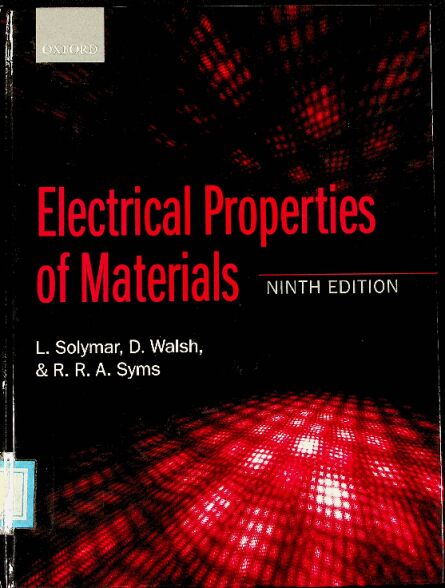
书名:Electrical properties of materials
责任者:L. Solymar | D. Walsh | R. R. A. Syms. | Syms, Richard R. A.
ISBN\ISSN:9780198702771,9780198702788
出版时间:2014
出版社:Oxford University Press
前言
The major change relative to all of the previous editions is that Professor Richard Syms of Imperial College has joined us as an author. There are new topics added and old topics updated, but the style remains as light as ever. Topics that needed considerable updating are semiconductor technology, semiconductor devices, nanoelectronics, plasma etching, ferroelectric materi- als, and spintronics.
We have been aware of many physical phenomena of interest, which we have failed to include in the past because, in our opinion at the time, their application prospects were not strong enough. Some of these have now come to the fore and we have included them; they are dielectrophoresis, Raman spectroscopy, thermoelectricity, and pyroelectricity.
We believe that one of the most important applications of the electrical properties of materials is in the field of memory elements. We have previ- ously described these in the respective chapters, e.g. semiconductor memories in the chapter on semiconductor devices and magnetic memories in the chapter on magnetism. We felt that this time, in order to emphasise their similarities and differences, we needed to collect them into a separate chapter, which has turned out to be an appendix. We have also added another appendix describing the two major directions m medical imaging: computed tomography (CT) and magnetic resonance imaging (MRI).
We have to express here our gratitude to our wives who were willing to put up with the long hours we spent bringing this edition up to date.
查看更多
目录
Data on specific materials in text xiii
Introduction xv
1 The electron as a particle
1.1 Introduction 1
1.2 The effect of an electric field—conductivity and Ohm's law 2
1.3 The hydrodynamic model of electron flow 4
1.4 The Hall effect 5
1.5 Electromagnetic waves in solids 6
1.6 Waves in the presence of an applied magnetic field: cyclotron resonance 13
1.7 Plasma waves 16
1.8 Johnson noise 19
1.9 Heat 21
Exercises 23
2 The electron as a wave
2.1 Introduction 25
2.2 The electron microscope 28
2.3 Some properties of waves 29
2.4 Applications to electrons 31
2.5 Two analogies 33
Exercises 34
3 The electron
3.1 Introduction 36
3.2 Schrodinger's equation 38
3.3 Solutions of Schrbdinger's equation 39
3.4 The electron as a wave 40
3.5 The electron as a particle 41
3.6 The electron meeting a potential barrier 41
3.7 Two analogies 44
3.8 The electron in a potential well 45
39 The potential well with a rigid wall 47
3.10 The uncertainty relationship 47
3.11 Philosophical implications 48
Exercises 50
4 The hydrogen atom and the periodic table
4.1 The hydrogen atom 53
4.2 Quantum numbers 58
4.3 Electron spin and Pauli's exclusion principle 59
4.4 The periodic table 59
Exercises 64
5 Bonds
5.1 Introduction 66
5.2 General mechanical properties of bonds 67
5.3 Bond types 69
5.3.1 Ionic bonds 69
5.3.2 Metallic bonds 70
5.3.3 The covalent bond 70
5.3.4 The van der Waals bond 73
5.3.5 Mixed bonds 74
5.3.6 Carbon again 74
5.4 Feynman's coupled mode approach 75
5.5 Nuclear forces 80
5.6 The hydrogen molecule 81
5.7 An analogy 82
Exercises 82
6 The free electron theory of metals
6.1 Free electrons 84
6.2 The density of states and the Fermi-Dirac distribution 85
6.3 The specific heat of electrons 88
6.4 The work function 89
6.5 Thermionic emission 89
6.6 The Schottky effect 92
6.7 Field emission 95
6.8 The field-emission microscope 95
6.9 The photoelectric effect 97
6.10 Quartz-halogen lamps 97
6.11 The junction between two metals 98
Exercises 99
7 The band theory of solids
7.1 Introduction 101
7.2 The Kronig-Penney model 102
7.3 The Ziman model 106
7.4 The Feynman model 109
7.5 The effective mass 112
7.6 The effective number of free electrons 114
7.7 The number of possible states per band 115
7.8 Metals and insulators 117
7.9 Holes 117
7.10 Divalent metals 119
7.11 Finite temperatures 120
7.12 Concluding remarks 121
Exercises 122
8 Semiconductors
8.1 Introduction 123
8.2 Intrinsic semiconductors 123
8.3 Extrinsic semiconductors 128
8.4 Scattering 132
8.5 A relationship between electron and hole densities 134
8.6 III-V and II-VI compounds 136
8.7 Non-equilibrium processes 140
8.8 Real semiconductors 141
8.9 Amorphous semiconductors 143
8.10 Measurement of semiconductor properties 143
8.10.1 Mobility 143
8.10.2 Hall coefficient 146
8.10.3 Effective mass 146
8.10.4 Energy gap 147
8.10.5 Carrier lifetime 151
8.11 Preparation of pure and controlled-impurity single-crystal semiconductors 151
8.11.1 Crystal growth from the melt 151
8.11.2 Zone refining 152
8.11.3 Modern methods of silicon purification 154
8.11.4 Epitaxial growth 154
8.11.5 Molecular beam epitaxy 156
8.11.6 Metal-organic chemical vapour deposition 156
8 11.7 Hydride vapour phase epitaxy (HYPE) for nitride devices 157
Exercises 158
9 Principles of semiconductor devices
9.1 Introduction 161
9.2 The p-n junction in equilibrium 161
9.3 Rectification 166
9.4 Injection 168
9.5 Junction capacity 170
9.6 The transistor 171
9.7 Metal-semiconductor junctions 176
9.8 The role of surface states; real metal-semiconductor junctions 178
9.9 Metal-insulator-semiconductor junctions 180
9.10 The tunnel diode 183
9.11 The backward diode 186
9.12 The Zener diode and the avalanche diode 186
9.12.1 Zener breakdown 187
9.12.2 Avalanche breakdown 187
9.13 Varactor diodes 188
9.14 Field-effect transistors 189
9.15 Heterostructures 194
9.16 Charge-coupled devices 198
9.17 Silicon controlled rectifier 200
9.18 The Gunn effect 201
9.19 Strain gauges 204
9.20 Measurement of magnetic field by the Hall effect 205
9.21 Gas sensors 205
9.22 Microelectronic circuits 206
9.23 Plasma etching 210
9.24 Recent techniques for overcoming limitations 212
9.25 Building in the third dimension 213
9.26 Microelectro-mechanical systems (MEMS) 215
9.26.1 A movable mirror 215
9.26.2 A mass spectrometer on a chip 216
9.27 Nanoelectronics 218
9.28 Social implications 222
Exercises 223
10 Dielectric materials
10.1 Introduction 225
10.2 Macroscopic approach 225
10.3 Microscopic approach 226
10.4 Types of polarization 227
10.5 The complex dielectric constant and the refractive index 228
10.6 Frequency response 229
10.7 Anomalous dispersion 230
10.8 Polar and non-polar materials 231
10.9 The Debye equation 233
10.10 The effective field 234
10.11 Acoustic waves 236
10.12 Dielectric breakdown 240
10.12.1 Intrinsic breakdown 240
10.12.2 Thermal breakdown 240
10.12.3 Discharge breakdown 241
10.13 Piezoelectricity, pyroelectricity, and ferroelectricity 241
10.13.1 Piezoelectricity 241
10.13.2 Pyroelectricity 247
10.13.3 Ferroelectrics 248
10.14 Interaction of optical phonons with drifting electrons 249
10.15 Optical fibres 250
10.16 The Xerox process 252
10.17 Liquid crystals 252
10.18 Dielectrophoresis 254
Exercises 256
11 Magnetic materials
11.1 Introduction 259
11.2 Macroscopic approach 260
11.3 Microscopic theory (phenomenological) 260
11.4 Domains and the hysteresis curve 264
11.5 Soft magnetic materials 268
11.6 Hard magnetic materials (permanent magnets) 270
11.7 Microscopic theory (quantum-mechanical) 273
11.7.1 The Stern-Gerlach experiment 278
11.7.2 Paramagnetism 278
11.7.3 Paramagnetic solids 280
11.7.4 Antiferromagnetism 281
11.7.5 Ferromagnetism 281
11.7.6 Ferrimagnetism 282
11.7.7 Garnets 282
11.7.8 Helimagnetism 282
11.8 Magnetic resonance 282
11.8.1 Paramagnetic resonance 282
11.8.2 Electron spin resonance 283
11.8.3 Ferromagnetic, antiferromagnetic, and ferrimagnetic resonance 283
11.8.4 Nuclear magnetic resonance 283
11.8.5 Cyclotron resonance 284
11.9 The quantum Hall effect 284
11.10 Magnetoresistance 286
11.11 Spintronics 287
11.11.1 Spin current 287
11.11.2 Spin tunnelling 289
11.11.3 Spin waves and magnons 290
11.11.4 Spin Hall effect and its inverse 290
11.11.5 Spin and light 290
11.11.6 Spin transfer torque 291
11.12 Some applications 291
11.12.1 Isolators 291
11.12.2 Sensors 292
11.12.3 Magnetic read-heads 292
11.12.4 Electric motors 293
Exercises 293
12 Lasers
12.1 Equilibrium 295
12.2 Two-state systems 295
12.3 Lineshape function 299
12.4 Absorption and amplification 301
12.5 Resonators and conditions of oscillation 301
12.6 Some practical laser systems 302
12.6.1 Solid state lasers 303
12.6.2 The gaseous discharge laser 304
12.6.3 Dye lasers 305
12.6.4 Gas-dynamic lasers 306
12.6.5 Excimer lasers 307
12.6.6 Chemical lasers 307
12.7 Semiconductor lasers 307
12.7.1 Fundamentals 307
12.7.2 Wells, wires, and dots 312
12.7.3 Bandgap engineering 316
12.7.4 Quantum cascade lasers 318
12.8 Laser modes and control techniques 319
12.8.1 Transverse modes 319
12.8.2 Axial modes 320
12.8.3 Q switching 321
12.8.4 Cavity dumping 321
12.8.5 Mode locking 321
12.9 Parametric oscillators 322
12.10 Optical fibre amplifiers 323
12.11 Masers 324
12.12 Noise 326
12.13 Applications 326
12.13.1 Nonlinear optics 327
12.13.2 Spectroscopy 327
12.13.3 Photochemistry 327
12.13.4 Study of rapid events 328
12.13.5 Plasma diagnostics 328
12.13.6 Plasma heating 328
12.13.7 Acoustics 328
12.13.8 Genetics 328
12.13.9 Metrology 328
12.13.10 Manipulation of atoms by light 328
12.13.11 Optical radar 329
12.13.12 Optical discs 329
12.13.13 Medical applications 329
12.13.14 Machining 330
12.13.15 Sensors 330
12.13.16 Communications 331
12.13.17 Nuclear applications 331
12.13.18 Holography 332
12.13.19 Raman scattering 334
12.14 The atom laser 335
Exercises 336
13 Optoelectronics
13.1 Introduction 338
13.2 Light detectors 339
13.3 Light emitting diodes (LEDs) 341
13.4 Electro-optic, photorefractive, and nonlinear materials 345
13.5 Volume holography and phase conjugation 346
13.6 Acousto-optic interaction 351
13.7 Integrated optics 353
13.7.1 Waveguides 354
13.7.2 Phase shifter 354
13.7.3 Directional coupler 355
13.7.4 Filters 357
13.8 Spatial light modulators 357
13.9 Nonlinear Fabry-Perot cavities 359
13.10 Optical switching 362
13.11 Electro-absorption in quantum well structures 364
13.11.1 Excitons 364
13.11.2 Excitons in quantum wells 365
13.11.3 Electro-absorption 365
13.11.4 Applications 367
Exercises 369
14 Superconductivity
14.1 Introduction 371
14.2 The effect of a magnetic field 373
14.2.1 The critical magnetic field 373
14.2.2 The Meissner effect 374
14.3 Microscopic theory 375
14.4 Thermodynamical treatment 376
14.5 Surface energy 381
14.6 The Landau-Ginzburg theory 382
14.7 The energy gap 389
14.8 Some applications 393
14.8.1 High-field magnets 393
14.8.2 Switches and memory elements 394
14.8.3 Magnetometers 394
14.8.4 Metrology 395
14.8.5 Suspension systems and motors 395
14.8.6 Radiation detectors 395
14.8.7 Heat valves 396
14.9 High- T, superconductors 396
14.10 New superconductors 401
Exercises 403
15 Artificial materials or metamaterials
15.1 Introduction 404
15.2 Natural and artificial materials 405
15.3 Photonic bandgap materials 407
15.4 Equivalent plasma frequency of a wire medium 408
15.5 Resonant elements for metamaterials 410
15.6 Polarizability of a current-carrying resonant loop 411
15.7 Effective permeability 412
15.8 Effect of negative material constants 414
15.9 The 'perfect' lens 417
15.10 Detectors for magnetic resonance imaging 422
Epilogue 424
Appendix I: Organic semiconductors 427
Appendix II: Nobel laureates 434
Appendix III: Physical constants 436
Appendix IV: Variational calculus. Derivation of Euler's equation 438
Appendix V: Thermoelectricity 440
Appendix VI: Principles of the operation of computer memories 444
Appendix VII: Medical imaging 463
Appendix VIII: Suggestions for further reading 471
Answers to exercises 474
Index 477
查看更多
馆藏单位
中科院文献情报中心