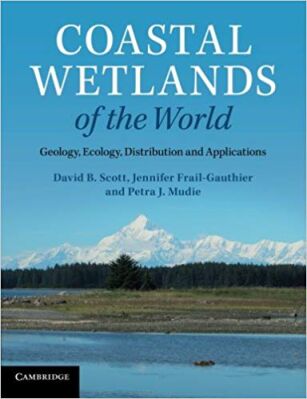
书名:Coastal wetlands of the world
责任者:David B. Scott | Jennifer Frail-Gauthier and Petra J. Mudie. | Mudie, Petra J.
ISBN\ISSN:9781107628250,1107628253,9781107056015,1107056012
出版时间:2014
出版社:Cambridge University Press
摘要
Salt marshes and mangrove forests, the intertidal wetlands of the world's coastlines, provide key ecological services to all areas of the globe. This cutting-edge, richly illustrated book introduces the essential elements of coastal wetlands and their applications. The book opens by introducing coastal oceanography, the physical features of wetlands, their ecology, and human impacts upon them, giving all students the necessary background for wetlands studies. It then presents detailed case studies from around the world with extensive illustrations, supplying a wider, global-scale picture of wetlands geomorphology and biodiversity. The final chapters discuss some unique applications of coastal wetlands, including geological monitoring, uses in biotechnology and agriculture, and various experimental mesocosms. This is ideal as supplementary reading to support students on a wide range of earth and life science courses, from environmental science, ecology and palaeoecology to geomorphology and geography. It will also be a valuable interdisciplinary reference for researchers.
Presents an integrated approach to wetlands combining geology and ecology, and including both salt marshes and mangrove forests.
Provides case histories from all continents except Antarctica, richly illustrated with images from real field studies, which are also accessible online in colour where available.
Explains the applications of wetlands studies to other fields such as pre-historical impacts of coastline changes, development of crops amidst shrinking global water resources, and conducting wetlands mesocosm experiments.
查看更多
前言
Coastal Wetlands of the World follows the book by Scott, Medioli and Schafer (2001) on Monitoring in Coastal Environments. We are motivated to write this new book based on concern about the status of mangroves and salt marshes all over the world, from pole to pole, and by the fact that few students have the chance to look at our changing shorelines from both a geological and an ecological perspective. Coastal wetlands are being destroyed and degraded at alarming rates, and only a fraction remains. These wetlands protect us from storm buffering and have extremely high primary production, making them important storehouses of carbon and energy, habitats that nurture juvenile stages of commercially important fishes and that filter our waste water – yet we continue to damage them faster than we can preserve them. In some areas, less than a third of natural wetlands remain along the coast, and very few are entirely unaffected by direct human impacts. Furthermore, all our coastal wetlands are changing in response to indirect human impacts: global warming, sea level rise and increasing numbers of severe coastal storms. These impacts are further magnified in the Arctic, where the pace of climate warming is four times faster than other places on Earth, and where disappearing sea ice is encouraging rapid expansion of oil and gas exploration, with the associated risks of long-lasting pollution damage. Arctic people say that ‘The Earth is faster now’ – and it appears that traditional methods of coastal living are no longer viable. It is likely that circumpolar regions are already irreversibly changed – and the spill-over impacts on global air and ocean systems is already being felt by people in crowded cities of warm temperate regions.
We take an interdisciplinary approach to Coastal Wetlands of the World – there literally is something for everyone between the covers of this book. It was initially written for undergraduate students, focussing on classical studies that are the baselines for evaluating recent changes, but it soon became clear that more detail was needed to guide readers towards the proliferation of new scientific literature. As a result, we have included innumerable up-todate references that will also help graduate students, naturalists and coastal-resource managers obtain a fresh view of tidal wetlands research across a wide spectrum of disciplines. Geologists, ecologists, conservationists, environmentalists, archeologists, historians and social scientists can all learn something new and clearly understand the issues at hand, for any area of the world. The book’s global focus and ample illustrations are also intended to draw the student beyond their familiarity with a limited neighbourhood marshland toward a much bigger picture of wetlands geomorphology and biodiversity on a global scale.
Why yet another book covering coastal wetlands and ecosystems? Our literature search of the most widely used texts showed a large imbalance in coverage of the world’s continents, despite the shrinking size of our Internet-linked Global Village. We have attempted to fill in large gaps for under-reported regions of Mexico, South America, Africa, Eastern Europe and China, and we provide the only systematic and focussed coverage of global tidal wetlands. Most other wetlands books are broken into vari-authored chapters and/or report on either marshes or mangroves, presenting a somewhat schizophrenic perspective to the reader, as though the world has sharp boundaries. In contrast, our readers are provided a seamless virtual tour from the northern tip of continental North America to the southern tip of New Zealand. From geology to biology to ecology to human impacts, we introduce wetlands from a generic stand point (Chapters 1–6). We then dive into information about coastal wetlands across all continents, giving specific historical case studies, and earmarking new research and paradigm shifts in traditional concepts about drivers of coastal climate changes. The last section of our book focusses on unique applications of coastal wetlands studies, including a chapter on paleoseismology, paleoclimate and forecasting (updated and much expanded in the range of proxies from Monitoring in Coastal Environments), and an outline of how coastal wetlands are used as experimental mesocosms to better understand and replace what is lost. We are the first to cover both traditional knowledge and cuttingedge subcellular and genetic knowledge of the potential for salt-tolerant plants to combat crises of soil salinization in agricultural crops. The development of new salt-tolerant crops is a major part of the new Green Revolution needed to feed the world’s rapidly expanding human population – simultaneously representing major carbon credits and conserving our fast-dwindling global freshwater resources. Education is the first step in the coastal crisis facing everyone ‘living on the edge’ – the more that can be taught about tidal wetlands, the more our global population can see the dire need to save what remains and wisely restore what we have destroyed.
We are indebted to many people and organizations who have helped in the writing of this book, answered multiple questions about places less familiar to us and provided illustrative materials. Invaluable help with diagrams comes from Rob Gauthier, Alexandre PelletierMichaud, Gary Grant and Matthew Chedrawe, and we are indebted to Ken Wallace for photo-compilations and design. The extended family of Petra Mudie have provided photocoverage from all continents where there are tidal wetlands (thanks to Anita and Hilton Whittle, Helen Pease and Peter Mudie) and we sincerely thank all those who graciously provided other beautiful photos of wetlands and animals, as acknowledged in the figure captions. Finally, we are most grateful to Laura Clark and others at Cambridge University Press, who provided encouragement, guidance, and answered no less than 100 questions to help get this book from our heads into a beautiful printed volume.
查看更多
目录
Preface page xi
List of acronyms and abbreviations xiii
1 Introduction: what is covered in this coastal wetlands book? 1
Box 1.1 The Ramsar Convention: international wetlands conservation 2
2 Physical aspects: geological, oceanic and climatic conditions 5
2.1 What are coastal wetlands (saltwater wetlands)? 5
Box 2.1 Important tidal reference points 6
2.2 Where are they found? 7
Box 2.2 Measuring and defining saltiness 8
2.3 How are salt marshes formed? 8
2.4 Physical conditions that shape wetlands 12
Box 2.3 Salt marsh tidal zones 13
2.5 Impacts of storms and extreme climate events 14
3 Zonations and plants: development, stressors and adaptations 17
3.1 Sediment stabilization and salt marsh development 17
3.2 Salt marsh zones and physical stressors 19
3.3 Plant adaptations and species diversity 20
Box 3.1 Comparison of plant photosynthesis and metabolism 24
3.4 Mangrove forest diversity and adaptations 25
3.5 Pollen archives of wetland vegetation development 26
4 Animals in coastal wetlands: zonation, adaptations and energy flow 30
4.1 Animals that inhabit salt marshes 30
Box 4.1 Tidal wetland foraminifera 32
4.2 Salt marsh zonations, stressors and adaptations 34
Box 4.2 Animals of polar and subarctic marshes 35
4.3 Mangrove animals 37
4.4 Energy flow in coastal wetlands: animal–plant interactions 38
4.4.1 Primary production 38
4.4.2 Secondary production: consumers versus detritivores 41
4.4.3 Mangrove energy flow 42
5 Human intervention causing coastal problems 44
5.1 Human population growth and landscape alteration 44
5.2 Land reclamation 46
5.3 Accelerated global warming 48
5.4 Arctic sea ice tipping point 49
5.5 Biological invasions 52
5.6 Wetland drainage and conversion for farming 53
Box 5.1 Mosquito life cycle: vectors of fatal or debilitating diseases 54
5.7 Pollution by excess nitrogen and oil spills 55
6 Coastal wetlands worldwide: climatic zonation, ecosystems and biogeography 57
6.1 Climate zones and coastal wetland ecosystems 57
6.2 Biogeographic variation 64
Box 6.1 Phytosociological classification of coastal wetland according to Thannheiser and Haachs 68
6.3 Subregional salinity variations: effects on plant assemblages 68
6.4 What in the world to expect next? 71
7 Examples of North American salt marshes and coastal wetlands 72
7.1 Arctic Coast: Mackenzie Delta region of the Beaufort Sea 72
Box 7.1 Vanishing Arctic villages and sea ice; pop-up pingos 73
7.2 Subarctic salt marshes: West versus East Coast 77
7.2.1 West Coast: Cook Inlet on the ‘Pacific Ring of Fire’ 78
7.2.2 West Coast: impacts of avalanches and glacial surges in Southern Alaska 80
7.2.3 East Coast: Hudson Plains and James Bay 83
7.3 Temperate marshes: West versus East Coast 87
7.3.1 Temperate wetlands of Western North America: Alaska to Mexico 87
7.3.1.1 Willapa Bay, Washington State 88
7.3.1.2 Netarts Bay, Oregon 90
7.3.1.3 Humboldt Bay and Eel River, Northern California 91
7.3.1.4 San Francisco Bay: transition from cool to warm temperate regions 92
7.3.1.5 Los Peñasquitos Lagoon case history, Southern California 95
7.3.1.6 Tijuana Estuary: California–Mexico boundary salt marsh reserve 101
7.3.2 Temperate wetlands of Eastern North America: Nova Scotia to Chesapeake Bay 103
7.3.2.1 Chezzetcook Marsh, Southeastern Canada 103
7.3.2.2 Bay of Fundy, Southeastern Canada 106
Box 7.2 Tidal power and estuarine wetlands 109
7.3.2.3 New England–Chesapeake Bay, Northeastern United States 110
7.4 North American subtropical marshes 113
7.4.1 Carolina and Georgia salt marshes: Cape Hatteras to Northern Florida 113
7.4.2 Florida mangroves 117
7.4.3 The Deep South: Mississippi Delta and Louisiana wetlands 120
7.4.4 Subtropical coastal wetlands of Baja California peninsula, Mexico 123
7.5 Tropical wetlands of North America and the Caribbean Islands 129
8 Examples of South American coastal wetlands 132
8.1 South America’s tropical coastal wetlands: composition, importance and changes 134
8.2 South American subtropical and temperate East Coast 138
8.2.1 Brazilian south coast 139
8.2.2 Patos Lagoon: the world’s largest ‘choked’ lagoon 140
8.2.3 Argentina to Tierra del Fuego and Mar Chiquita wetlands 142
Box 8.1 What’s in a name? 143
8.2.4 San Blas, Argentina 145
8.2.5 Bahia Bustamante, near Commodore Rivadavia 146
8.3 South American West Coast temperate region 146
8.3.1 Valdivia, Chile 147
Box 8.2 Measuring magnitude of earthquakes 148
8.3.2 Bahia Quillaipe: a beautiful bay full of sea anemones and worms 148
8.4 South American subarctic salt marshes: oil spill and ozone damage 149
8.4.1 Bahía Lomas, Tierra del Fuego, Antarctic Chile 149
8.4.2 Rio Chico, Tierra del Fuego, Argentina 151
9 Africa: selected marsh and mangrove areas 153
9.1 Location and biodiversity: introduction to Africa as a pantropical bridge 153
Box 9.1 Panmangal 3-D zonation 155
9.2 West Coast geomorphology: deltas, lagoons and anthropogenic changes 156
9.2.1 Niger Delta: largest in Africa but strongly altered by petroleum industry 156
9.2.2 Sierra Leone–Côte d’Ivoire barrier lagoons: prehistory and industrial impacts 158
9.3 Tropical West Coast estuary: The Gambia case history 161
9.3.1 Background history shapes the future: from Mandinka Empire to small British colony 161
9.3.2 The shared Gambia River: longest estuary in Africa 163
9.3.3 The mangrove vegetation and its services 163
9.3.4 Gambian mangrove and estuarine animals 166
9.3.5 Gambian oyster industry 171
9.3.6 What to expect in the future? 172
9.4 Nile River Delta case history: early civilizations and recent destruction 172
9.4.1 Background environment and historical geology 172
9.4.2 Holocene and historical records of Nile Delta change 174
9.4.3 The Nile Delta in the future 177
9.5 South African wetlands: the Indian Ocean influence 177
9.6 Other important East African coastal wetlands and some cautionary notes 181
Box 9.2 Sinai Desert ‘hard bottom’ mangroves 182
10 Europe and Asia: a view of what remains 186
10.1 European temperate regions: waddens, estuaries and the Low Countries 187
10.2 European Mediterranean: vanishing oceans and sinking cities 190
10.2.1 Rhône Delta and Camargue Marshes, France: violet salt and pink flamingos 190
10.2.2 The Po Estuary and sinking of Venice Lagoon into the Adriatic Sea 192
10.3 Southeast Europe and Southwest Asia: Mediterranean–Indian Ocean transition 193
Box 10.1 Ancient Troy, Trojan legends and salt marshes 196
10.3.1 Northern Black Sea: tiny tides and giant mud volcanoes 197
10.3.2 Danube Delta: the largest and best-preserved wetland in Central Europe 199
Box 10.2 Characteristics of tidal freshwater marshes 200
10.3.3 The Tigris–Euphrates Rivers case history: what happened to the Gardens of Babylon? 202
10.4 Southern and Southeastern Asia: Indo-Pacific and Polynesian subregion of Oceania 208
10.4.1 Ganges River Delta: The Green Delta and Beautiful Gardens 210
10.4.2 The Mekong Delta: a biological treasure trove 215
10.4.3 Other Southeast Asian mangrove regions: more biodiversity 222
10.4.4 East Asia: China, River of Sorrow and macrotidal mudflats 224
Box 10.3 Conservation statuses along East China coasts 228
11 Australasia: wetlands of Australia and New Zealand 231
11.1 Australia: tropical mangroves to warm temperate salt marshes 231
11.1.1 Tropical Northeastern Australia: behind the Barrier Reef 234
11.1.2 Tropical Northern Australia: saltwater crocodiles and flying foxes 237
11.1.3 Southwestern Australia: Shark Bay stromatolites and Leschenault Inlet Estuary 238
11.1.4 Temperate Southeastern Australia: southern mangroves and paleotsunamis 240
Box 11.1 Opening a can of worms 241
11.2 New Zealand coastal wetlands: the outer edge of the colonized Pacific World 242
12 Applications in geological monitoring: paleoseismology and paleoclimatology 248
12.1 How wetland archives are used in paleoseismology and paleotempestology 248
12.2 Paleoearthquakes and earthquake prediction 250
12.2.1 Alaskan case histories 250
Box 12.1 About time: dating of sediments for paleoenvironmental studies 252
Box 12.2 Paleoecological transfer functions: qualitative versus quantitative methods 257
12.2.2 Cascadia and the ‘Orphan Tsunami’ case history 258
12.2.3 The Peruvian earthquake and Hawaiian tsunami 260
12.2.4 Australia: tsunamis or not? 261
12.3 Paleoclimate and paleo-sea levels 262
12.3.1 Los Peñasquitos Lagoon case history: mangroves and immigrations 263
12.3.2 Australasian and Southeast Asian examples 264
12.3.3 Caveat: the present limits of climate applications 267
13 Applications in conservation of plant biodiversity and agriculture 269
13.1 Salt of the Earth 269
13.2 Biodiversity of salt marshes and mangrove swamps 270
13.2.1 Traditional uses of coastal wetlands 270
13.2.2 Historical uses of coastal wetland plants 271
13.3 Agriculture and soil salinity: past and future problems 273
13.4 Salt marsh biodiversity: emerging studies of halophyte genomes and ionomes 276
14 Using mesocosms as a way to study coastal wetlands 279
14.1 Why make experimental studies in coastal wetlands? 279
Box 14.1 The value of indoor salt marsh mesocosms: example from Halifax, Nova Scotia, Canada 282
14.2 Examples of coastal mesocosms: introduction 285
14.3 Restoration and construction 286
14.4 Experiments testing physical parameters 290
14.5 Experiments testing biological parameters 292
14.6 Experiments and mesocosms testing other parameters 293
15 Conclusions and future directions 297
References 302
Index 339
Colour plate section is found between pages 178 and 179
查看PDF
查看更多
作者简介
Petra Mudie is an Adjunct of the Graduate Studies Faculty at Dalhousie University, Adjunct Professor of Memorial University of Newfoundland, and a Scientist Emeritus with Geological Survey of Canada Atlantic. Her previous work includes heading up a Halophyte Research laboratory at the Scripps Institute of Oceanography including surveys of coastal wetlands from Canada to Mexico, working on environmental marine geology for the Canadian Government until 2001, and subsequently leading an international program, studying palynological records of the history of climate and sea level change in the Black Sea-Eastern Mediterranean Corridor. She is the author of over 80 papers in science journals. Dr Mudie and Professor Scott have collaborated on salt marsh and Arctic paleoenvironmental studies for nearly 40 years, co-supervising many graduate students.
查看更多
馆藏单位
中科院文献情报中心