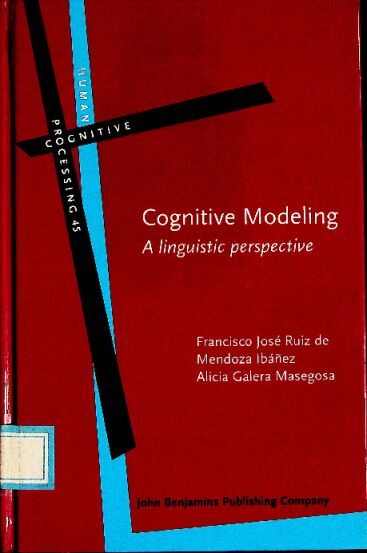
书名:Cognitive modeling
责任者:Francisco Jose Ruiz de Mendoza Ibanez | Alicia Galera Masegosa | University of La Rioja | Logrono.
出版时间:2014
出版社:John Benjamins Publishing Company
摘要
This monograph studies cognitive operations on cognitive models across levels and domains of meaning construction. It explores in what way the same set of cognitive operations, either in isolation or in combination, account for meaning representation whether obtained on the basis of inferential activity or through constructional composition. As a consequence, it makes explicit links between constructional and figurative meaning. The pervasiveness of cognitive operations is explored across the levels of meaning construction (argument, implicational, illocutionary, and discourse structure) distinguished by the Lexical Constructional Model. This model is a usage-based approach to language that reconciles insights from functional and cognitive linguistics and offers a unified account of the principles and constraints that regulate both inferential activity and the constructional composition of meaning. This book is of value to scholars with an interest in linguistic evidence of cognitive activity in meaning construction. The contents relate to the fields of Cognitive Grammar, Cognitive Semantics, Construction Grammar, Functional Linguistics, and Inferential Pragmatics.
查看更多
目录
Acknowledgements IX
CHAPTER 1
Introduction 1
1. Aims and scope of the book 1
2. Methodology and data 9
3. A note on cognitive reality 12
4. The structure of the book 14
CHAPTER 2
Theoretical pre-requisites 17
1. Introduction: In search for a unified framework of analysis 17
1.1 Standards of adequacy 18
1.2 The Equipollence Hypothesis 29
2. An overview of the Lexical Constructional Model 30
2.1 Levels of description and explanation 30
2.2 Interaction within and across levels 33
2.3 Constraints on subsumption 35
2.4 The Lexical Constructional Model in the context of Cognitive Semantics and Construction Grammar(s) 36
3. Figurative thought and figurative uses of language 38
3.1 Metaphor and metonymy 38
3.2 Overstatement: Hyperbole and auxesis 45
3.3 Understatement, meiosis and litotes 46
3.4 Irony 48
3.4.1 Verbal irony: An overview 48
3.4.2 Verbal irony vs. situational irony 54
3.4.3 Sarcasm 54
3.5 Paradox and oxymoron 56
CHAPTER 3
Cognitive models 59
1. Introduction 59
2. Cognitive model types 60
2.1 Frames, domains, and spaces 60
2.2 Primary, low-level and high-level cognitive models 63
2.3 Propositional vs. situational cognitive models 66
2.3.1 High and low-level propositional models 67
2.3.2 High and low-level situational models 68
2.4 Scalar versus non-scalar cognitive models 72
3. Cognitive models and a typology of states of affairs 75
4. Cognitive models and the Lexical Constructional Model 81
CHAPTER 4
Cognitive operations 85
1. Introduction 85
2. Formal operations 86
2.1 Cueing 86
2.2 Selection 87
2.3 Abstraction 89
2.4 Integration 89
2.5 Substitution 91
3. Content operations: A preliminary exploration 92
3.1 Expansion and reduction 92
3.2 Correlation 93
3.3 Comparison 93
3.4 Echoing 94
3.5 Strengthening and mitigation 94
3.6 Parameterization 94
3.7 Saturation 95
4. Patterns of combination of cognitive operations 96
4.1 Metaphoric complexes 96
4.1.1 Metaphoric amalgams 96
4.1.2 Metaphoric chains 104
4.2 Metaphtonymy 107
4.2.1 Metonymic expansion of the metaphoric source 108
4.2.2 Metonymic expansion of the metaphoric target 111
4.2.3 Metonymic reduction of the metaphoric source 112
4.2.4 Metonymic reduction of one of the correspondences of the metaphoric target 115
4.3 Metonymic complexes 117
4.3.1 Double metonymic expansion 118
4.3.2 Double metonymic reduction 120
4.3.3 Metonymic reduction plus metonymic expansion 123
4.3.4 Metonymic expansion plus metonymic reduction 127
4.4 Other patterns of metaphor-metonymy combinations 134
4.4.1 Metonymic chains within metaphoric mappings 134
4.4.2 Metonymic developments within metaphoric complexes 136
5. Constraining principles on cognitive operations 139
5.1 Constraints on formal operations 139
5.1.1 Principle of Conceptual Consistency 139
5.1.2 Conceptual Combination Principle 140
5.2 Constraints on content operations 140
5.2.1 The Extended Invariance Principle 140
5.2.2 The Correlation Principle 142
5.2.3 The Mapping Enforcement Principle 144
5.2.4 Principle of Scalar Symmetry 144
5.2.5 Principle of Scalar Pragmatic Adjustment 145
CHAPTER 5
Content operations across levels of representation 147
1. Domain expansion and domain reduction 147
1.1 Domain expansion and reduction at the lexical level 147
1.2 Non-lexical domain expansion and reduction at level 1 149
1.3 Domain expansion and reduction at the implicational level 152
1.4 Domain expansion and reduction at the illocutionary level 155
1.5 Domain expansion and reduction at the discourse level 157
2. Correlation 159
2.1 Correlation and primary metaphor. The metaphor-metonymy distinction 159
2.2 Correlation and actuality implications 162
2.3 Correlation at the implicational and illocutionary levels 163
3. Comparison 166
3.1 Comparison by resemblance 166
3.1.1 Resemblance metaphors 166
3.1.2 Simile and resemblance operations 169
3.1.3 Resemblance operations and iconicity 170
3.2 Comparison by contrast 172
3.2.1 Paradox and oxymoron 173
3.2.2 Contrasting at discourse level 175
4. Echoing 177
4.1 Echoing at the argument-structure level 177
4.2 Echoing at the implicational and illocutionary levels: Irony 181
4.3 Echoing at the implicational level: Other pragmatic effects 188
4.3.1 The Don't (You) X NP construction 188
4.3.2 The Do I Look Like I X? construction 194
4.3.3 The X is not Y construction 196
4.4 Echoing at discourse level 197
5. Strengthening and mitigation 197
5.1 Hyperbole revisited 199
5.2 Understatement revisited 203
6. Parameterization and generalization 205
6.1 Parameterization at the lexical level 206
6.2 Parameterization at discourse level 209
6.2.1 Specification 209
6.2.2 Exemplification 209
6.2.3 Evidentialization 210
6.2.4 Time 210
6.2.5 Location 212
6.3 Parameterization at the illocutionary level 213
7. Saturation 213
7.1 Saturation at argument-structure level 214
7.2 Saturation at discourse level 216
7.2.1 Comment 217
7.2.2 Specification 217
7.2.3 Addition 218
7.2.4 Cause 219
7.2.5 Condition 219
7.2.6 Concession 220
7.2.7 Consecution 221
CHAPTER 6
Conclusions 223
References 227
Name index 245
Subject index 249
查看PDF
查看更多
馆藏单位
中科院文献情报中心