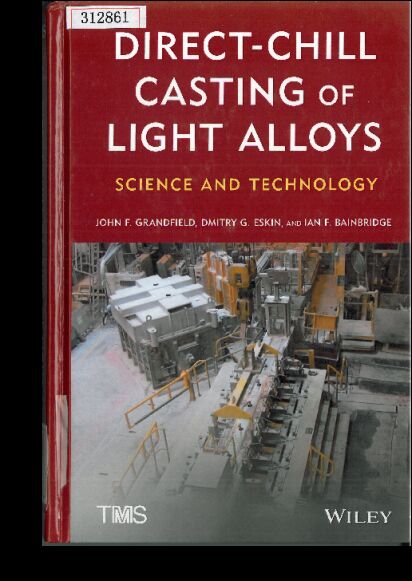
书名:Direct-chill casting of light alloys
责任者:John F. Grandfield...[et al](Eds.) | Grandfield, John F.
出版时间:2013
出版社:John Wiley & Sons, Inc.
前言
Light alloys and the technology of their production play an indispensible role in modern industrial society. Even with the advent of new materials such as nanocomposites and advanced ceramics, aluminium and magnesium remain two of the most important structural materials, second only to steel.
Direct-chill ( DC ) casting is the main technology for producing billets and ingots of light alloys, and its history over the last 60 years shows that, with many innovations, it will hold this position for the foreseeable future.
Several books on DC casting of Al and Mg alloys have been published in the USSR from the 1950s to the 1980s and are quoted in this monograph. No such books have ever been published in the Western world despite numerous papers in journals and conference proceedings. Recently (2008), a book on physical metallurgy of DC casting of Al alloys has been published by one of the co-authors (DGE), but it touched only slightly on the technology.
A complete reference work on DC casting of light metals has been needed for some time.
With this book we have attempted to thoroughly cover the science and technology of DC casting of light metal alloys and ancillary processes. The work is intended as a resource for students, researchers, and those who build and operate DC casting installations.
For operators of DC casting units, the book has been structured as a problem-solving guide and identifies which science and technology can be applied to which problems. The sections on safety and environment, defects, and on DC casting economics are designed to aid cast houses to achieve safe, profitable, and sustainable commercial operations.
The history of the development of cast house equipment provides equipment suppliers with invaluable information on ideas that have been tried but not yet commercialised.
Customers buying DC cast products can also benefi t from this work as many quality issues are covered.
Researchers active in the field of solidification processing will find analysis of complex phenomena involved in DC casting as well as an overview of the modern metallurgical and technological means to improve the quality of the castings.
Thank you to those companies that provided images of their equipment: Wagstaff, HYCAST, STAS, ABB, odt Engineering, Pyrotek, Mecatherm, Furnace Engineering, and ZMAG. The cover shows VDC4 at the Bell Bay Aluminium Smelter. Bell Bay, Tasmania, Australia, built in 1955, was the first smelter in the southern hemisphere. Bell Bay has been continually upgraded, and VDC4 is fully automated and equipped with the most modern melt treatment equipment. Two of the authors (JFG & IFB) have had a long and enjoyable association with Bell Bay.
The authors would also like to thank a number of individuals who have collaborated with us on various projects and expanded our knowledge of DC casting: John Jacoby (WGC), Clark Weaver, Peter Whiteley, Philip Baker, Paul McGlade, Alan Clark, Stephen Instone, David Irwin, Sam Brumale, Christian Simensen, Cheryl Richards, Dag Mortensen, Hallvard Fjaer, Mark Turski, Phil Austen, Laurens Katgerman, Willy Zeller, Qiang Du, Ravi Nadella, Suyitno, Mehdi Lalpoor, and numerous others.
Thank you to our families who supported and encouraged us.
查看更多
目录
PREFACE AND ACKNOWLEDGEMENTS xi
1 DIRECT-CHILL CASTING: HISTORICAL AND INDUSTRIAL PERSPECTIVE 1
1.1 Industrial Perspective 1
1.2 Historical Development 2
References 27
2 LIQUID METAL SUPPLY, ALLOY PREPARATION, AND MELT TRANSPORT 30
2.1 Plant Layout, Metal Scheduling, and Liquid Supply 31
2.2 Alloying Elements and Master Alloys 33
2.3 Furnace Technology 37
2.3.1 Mixing Technology 40
2.3.2 Temperature Control 41
2.4 Melt Transport to and from the Furnace 43
2.4.1 Furnace Filling 43
2.4.2 Scrap Charging and Melting 44
2.4.3 Furnace Cleaning 46
2.4.4 Molten Metal Transportation from Furnace to Caster 46
2.5 Chemical Analysis 49
2.6 Magnesium Melt Protection and Handling 50
2.7 Safety 52
References 53
3 MELT REFINING AND IMPURITY CONTROL 56
3.1 Impurity Sources 58
3.1.1 Aluminium 58
3.1.2 Magnesium 61
3.2 Effect of Impurities 62
3.2.1 Dissolved Hydrogen 62
3.2.2 Dissolved Metallic Impurity Elements Including Alkali Metals 63
3.2.3 Inclusions 65
3.3 Impurity Removal 65
3.3.1 Dissolved Metal Impurities 67
3.3.2 Hydrogen Removal: Degassing 67
3.3.3 Inclusion Load Minimisation 73
3.3.4 Inclusion Removal 74
3.3.5 Alkali Metal Removal 81
3.3.6 Magnesium Flux Refi ning 83
3.3.7 Flux-Free Refi ning of Magnesium 85
3.4 Measurement of Impurities 85
3.4.1 Inclusion Measurement 85
3.4.2 Hydrogen Measurement 89
3.4.3 Alkali Content Measurement 91
3.5 Temperature Measurement 91
3.6 System Layouts, Safety, and Cost Considerations 92
References 94
4 GRAIN REFINEMENT 103
4.1 Historical Overview 103
4.2 Fundamentals of Grain Refi nement 104
4.3 Mechanisms of Grain Refi nement in Aluminium and Magnesium Alloys 112
4.3.1 Grain Refi nement through Phases Formed by Alloying Elements during Solidifi cation 113
4.3.2 Grain Refi nement by Added Insoluble Particles 115
4.3.3 Grain Refi nement by Indigenous Insoluble Particles 121
4.3.4 Grain Refi nement by Multiplication of Solidifi cation Sites 125
4.4 Technology of Grain Refi nement in DC Casting 128
4.4.1 Grain Refi ning of Aluminium Alloys by Al–Ti–B and Al–Ti–C Master Alloy Rods 128
4.4.2 Grain Refi nement Using Master Alloys Added in the Furnace 136
4.4.3 Addition of Grain Refi ners as Salts, Fluxes, Compounds, and Gases 137
References 139
5 SOLIDIFICATION PHENOMENA AND CASTING DEFECTS 144
5.1 Effect of Cooling Rate and Melt Temperature on Solidifi cation of Aluminium Alloys 144
5.2 Microsegregation 148
5.3 Effects of Process Parameters on the Dendrite Structure 149
5.4 Effect of Process Parameters and Alloy Composition on the Occurrence of Specifi c Structure Defects 155
5.5 Macrosegregation 158
5.5.1 Mechanisms of Macrosegregation 158
5.5.2 Effects of Process Parameters on Macrosegregation during DC Casting 165
5.5.3 Effect of Composition on Macrosegregation: Macrosegregation in Commercial Alloys 169
5.6 Hot Tearing 173
5.6.1 Thermal Contraction during Solidifi cation 174
5.6.2 Mechanical Properties in the Semi-Solid State 177
5.6.3 Mechanisms and Criteria of Hot Tearing 181
5.6.4 Application of Hot-Tearing Criteria to DC Casting of Light Alloys 191
5.6.5 Effects of Process Parameters on Hot Tearing and Shape Distortions during DC Casting 196
5.7 Cold Cracking 204
5.7.1 Mechanical Properties of As-Cast Alloys and Mechanisms of Cold Cracking 206
5.7.2 Cold-Cracking Criteria 210
5.7.3 Methods to Prevent Cold Cracking 218
5.8 Defects Related to the Technology of DC Casting 219
References 226
6 DC CASTING TECHNOLOGY AND OPERATION 235
6.1 Introduction 235
6.2 Mould Technology 236
6.2.1 Mould Heat Transfer 237
6.2.2 Water Cooling Heat Transfer 244
6.2.3 Mould Design: General Development 249
6.2.4 Electromagnetic DC Casting 253
6.2.5 Extrusion Billet Mould Technology Variants and Evolution 255
6.2.6 Gas-Pressurised Hot-Top Mould Operation 258
6.2.7 Mould Dimensions 259
6.2.8 Casting Parameters 266
6.2.9 Rolling Slab Moulds and Cast Start Technology 271
6.2.10 HDC Casting 273
6.2.11 Lubrication and Mould Friction 279
6.3 Other Equipment 281
6.3.1 Mould Table 281
6.3.2 Starting Head Base and Starting Heads 284
6.3.3 Molten Metal Delivery to the Moulds 289
6.3.4 Molten Metal Level Control 293
6.3.5 Casting Machine 298
6.3.6 Ancillary Equipment and Pit Engineering 300
6.4 Water System 303
6.4.1 General Description 303
6.4.2 Water Requirements 305
6.5 Control Systems 306
6.5.1 General Requirements 306
6.5.2 Automated Systems 307
6.6 Equipment Failure-Related Defects 310
6.7 Safety Considerations 311
References 314
7 POST-CASTING PROCESSING 321
7.1 Introduction 321
7.2 General 321
7.3 Inspection and Sawing 322
7.4 Homogenisation and Stress Relieving 323
7.5 Sawing and Packaging 328
7.6 Safety Issues 329
References 329
8 MODELLING AND SIMULATION 331
8.1 Introduction and History 331
8.2 Physical Modelling 333
8.2.1 Flow Modelling 333
8.2.2 Water Spray Heat Transfer 333
8.3 Non-Dimensional Number Analysis 334
8.4 Mathematical Modelling Methods 337
8.5 Modelling Requirements 339
8.5.1 Model Formulation 339
8.5.2 Boundary Condition and Property Data 339
8.5.3 Validation and Experimental Verifi cation 341
8.5.4 Post Processing 343
8.5.5 Resources: People, Hardware, and Software 343
8.6 Flow Modelling of Metal Delivery Systems 344
8.7 Macrosegregation Modelling during DC Casting of Aluminium Alloys 346
8.7.1 Background 346
8.7.2 Example of Macrosegregation Simulation 349
8.8 Stress and Cracking Modelling 351
8.8.1 Hot Tearing during DC Casting 352
8.8.2 Cold Cracking during DC Casting 360
8.9 Modelling of Mould Processes 363
8.9.1 Mould Distortion, Ingot Shape Modelling, and Control 363
8.9.2 Air-Gap Formation and Surface Segregation 368
8.9.3 Gas-Pressurised Mould Meniscus Modelling 368
8.10 Modelling of Magnesium DC Casting 369
8.11 Final Remarks on Application of Models 370
Acknowledgement 371
Appendix 8.A Analytical Solutions to DC Casting 371
References 375
9 ECONOMIC CONSIDERATIONS 383
9.1 DC Product Markets and Margins 384
9.2 Financial Measures 386
9.2.1 Examples of the Application of Financial Measures 387
9.3 Throughput, Audit, Key Performance Indicator (KPI), and Benchmarking Analysis 395
References 399
INDEX 400
查看PDF
查看更多
馆藏单位
机械工业信息研究院