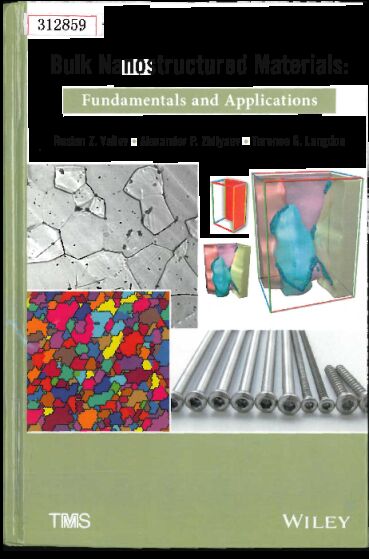
书名:Bulk nanostructured materials
责任者:Ruslan Z. Valiev...[et al](Eds.) | Valiev, Ruslan Z.
出版时间:2014
出版社:John Wiley & Sons, Inc.
前言
In recent years, the development of bulk nanostructured materials (BNM) has become one of the most topical directions in modern materials science. Nanostructuring of various materials paves the way to obtaining unusual properties that are very attractive for different structural and functional applications. In this research topic, the use of both “bottom-up” and “top-down” approaches for BNM processing/synthesis routes has received considerable attention. In the “bottom-up” approach, bulk nanomaterials are fabricated by assembling individual atoms or by consolidating nanoparticulate solids. The “top-down” approach is different because it is based on grain refinement through heavy straining or shock wave loading. During the last two decades, grain refinement by severe plastic deformation (SPD) techniques has attracted special interest since it offers new opportunities for developing different technologies for the fabrication of commercial nanostructured metals and alloys for various specific applications. Very significant progress was made in this area in recent years. The generation of new and unusual properties has been demonstrated for a wide range of different metals and alloys: examples include very high strength and ductility, record-breaking fatigue endurance, increased superplastic forming capabilities, as well as multifunctional behavior when materials exhibit enhanced functional (electric, magnetic, corrosion, etc.) and mechanical properties.
The innovation potential of this research area is outstanding, and now a transition from laboratory-scale research to industrial applications is starting to emerge. In addition, the subject of BNM is now entering the textbooks on materials science and related subject areas and therefore it is very important to have a single treatise that comprises the fundamental as well as applied aspects of bulk nanomaterials. At the same time, although the processing of BNM by assembling individual atoms/particles has been described in several books, there is at present no international monograph devoted exclusively to bulk nanomaterials produced by severe plastic deformation.This omission forms the background for the present work. Equally, it is now apparent that research on BNM has developed so rapidly in recent years that the terminology needs some clarification, and it is necessary to provide a clearer definition of the terms widely used within this field. This information is given in Chapter 1.
查看更多
目录
PREFACE xiii
ACKNOWLEDGMENTS xv
1.Introduction 1
2.Description of Severe Plastic Deformation (SPD): Principles and Techniques 6
2.1 A Historical Retrospective of SPD Processing 6
2.2 Main Techniques for Severe Plastic Deformation 8
2.3 SPD Processing Regimes for Grain Refinement 15
2.4 Types of Nanostructures from SPD 16
PART ONE HIGH-PRESSURE TORSION 23
3.Principles and Technical Parameters of High-Pressure Torsion 25
3.1 A History of High-Pressure Deformation 25
3.2 Definition of the Strain Imposed in HPT 28
3.3 Principles of Unconstrained and Constrained HPT 32
3.4 Variation in Homogeneity Across an HPT Disk 33
3.4.1 Developing a Pictorial Representation of the Microhardness Distributions 33
3.4.2 Macroscopic Flow Pattern During HPT 38
3.4.3 Occurrence of Nonhomogeneity in the Microstructures Produced by HPT 52
3.5 Influence of Applied Load and Accumulated Strain on Microstructural Evolution 67
3.6 Influence of Strain Hardening and Dynamic Recovery 71
3.7 Significance of Slippage During High-Pressure Torsioning 76
3.8 Models for the Development of Homogeneity in HPT 81
4.HPT Processing of Metals, Alloys, and Composites 88
4.1 Microstructure Evolution and Grain Refinement in Metals Subjected to HPT 88
4.1.1 Microstructure and Grain Refinement in fcc and bcc Pure Metals 88
4.1.2 Allotropic Transformation in HCP Metals as Mechanism of Grain Refinement 97
4.1.3 Significance of the Minimum Grain Size Attained Using HPT 103
4.1.4 Microtexture and Grain Boundary Statistics in HPT Metals 107
4.2 Processing of Solid Solutions and Multiphase Alloys 112
4.2.1 High-Pressure Torsion of Solid Solutions 112
4.2.2 Grain Refinement During Processing of Multiphase Alloys 119
4.2.3 Amorphization and Nanocrystallization of Alloys by HPT 126
4.3 Processing of Intermetallics by HPT 130
4.4 Processing of Metal Matrix Composites 136
5.New Approaches to HPT Processing 152
5.1 Cyclic Processing by Reversing the Direction of Torsional Straining 152
5.2 Using HPT for the Cold Consolidation of Powders and Machining Chips 173
5.3 Extension of HPT to Large Samples 180
PART TWO EQUAL CHANNEL ANGULAR PRESSING 191
6.Development of Processing Using Equal-Channel Angular Pressing 193
6.1 Construction of an ECAP/ECAE Facility 193
6.2 Equal-Channel Angular Pressing of Rods, Bars, and Plate Samples 195
6.3 Alternative Procedures for Achieving ECAP: Rotary Dies, Side-Extrusion, and Multipass Dies 198
6.4 Developing ECAP with Parallel Channels 201
6.5 Continuous Processing by ECAP: From Continuous Confined Shearing, Equal-Channel Angular Drawing and Conshearing, to Conform Process 204
7.Fundamental Parameters and Experimental Factors in ECAP 215
7.1 Strain Imposed in ECAP 215
7.2 Processing Routes in ECAP 219
7.3 Shearing Patterns Associated with ECAP 221
7.4 Experimental Factors Influencing ECAP 223
7.4.1 Influence of the Channel Angle and the Angle of Curvature 223
7.4.2 Influence of the Pressing Speed and Temperature 229
7.5 Role of Internal Heating During ECAP 232
7.6 Influence of a Back Pressure 234
8.Grain Refinement in Metallic Systems Processed by ECAP 239
8.1 Mesoscopic Characteristics After ECAP 240
8.2 Development of an Ultrafine-Grained Microstructure 244
8.3 Factors Governing the Ultrafine Grain Size in ECAP 253
8.4 Microstructural Features and Texture After ECAP 256
8.5 Influence of ECAP on Precipitation 262
8.6. Pressing of Multiphase Alloys and Composites 266
8.6.1 Multiphase Alloys 267
8.6.2 Metal Matrix Composites 270
8.7 Consolidation by ECAP 275
8.8 Post-ECAP Processing 277
PART THREE FUNDAMENTALS AND PROPERTIES OF MATERIALS AFTER SPD 289
9.Structural Modeling and Physical Properties of SPD-Processed Materials 291
9.1 Experimental Studies of Grain Boundaries in BNM 293
9.2 Developments of Structural Model of BNM 309
9.3 Fundamental Parameters and Physical Properties 312
9.3.1 Curie Temperature and Magnetic Properties 313
9.3.2 Debye Temperature and Diffusivity 315
9.3.3 Electroconductivity 320
9.3.4 Elastic Properties and Internal Friction 323
10. Mechanical Properties of BNM at Ambient Temperature 331
10.1 Strength and “Superstrength” 332
10.2 Plastic Deformation and Ductility 338
10.3 Fatigue Behavior 345
10.4 Alternative Deformation Mechanisms at Very Small Grain Sizes 350
11.Mechanical Properties at High Temperatures 357
11.1 Achieving Superplasticity in Ultrafine-Grained Metals 359
11.1.1 Superplasticity after Processing by HPT 360
11.1.2 Superplasticity after Processing by ECAP 364
11.2 Effects of Different ECAP Processing Routes on Superplasticity 370
11.3 Developing a Superplastic Forming Capability 375
11.4 Cavitation in Superplasticity After SPD 378
11.5 Future Prospects for Superplasticity in Nanostructured Materials 380
12.Functional and Multifunctional Properties of Bulk Nanostructured Materials 387
12.1 Corrosion Behavior 388
12.2 Wear Resistance 390
12.3 Enhanced Strength and Conductivity 393
12.4 Biomedical Behavior of Nanometals 396
12.5 Enhanced Magnetic Properties 398
12.6 Inelasticity and Shape-Memory Effects 402
12.7 Other Functional Properties 405
12.7.1 Enhanced Reaction Kinetics 405
12.7.2 Radiation Resistance 407
12.7.3 Thermoelectric Property 408
PART FOUR INNOVATION POTENTIAL AND PROSPECTS FOR SPD APPLICATIONS 415
13.Innovation Potential of Bulk Nanostructured Materials 417
13.1 Nanotitanium and Ti Alloys for Medical Implants 417
13.2 Nanostructured Mg Alloys for Hydrogen Storage 420
13.3 Micro-Devices from BNM 423
13.4 Innovation Potential and Application of Nanostructured Al Alloys 423
13.5 Fabrication of Nanostructured Steels for Engineering 425
14.Conclusions 434
Index 436
查看PDF
查看更多
馆藏单位
机械工业信息研究院