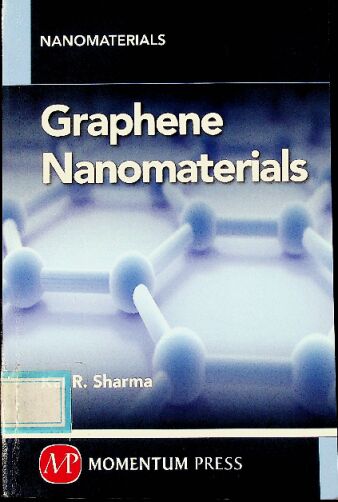
书名:Graphene nanomaterials
责任者:Kal R. Sharma. | Sharma, Kal R.
出版时间:2014
出版社:Momentum Press,
前言
Graphene has been discovered as a distinct allotrope of carbon (2010 Physics Nobel Prize). It has a two-dimensional unique hexagonal lattice structure made of planar sheets of sp'-hybridized carbon atoms different from the Bravais lattices known in materials science. Graphene Nanoma-terials describes the discovery, prospects, characterization methods, appli-cations, stability considerations, fabrication methods, and properties of graphene. It possesses interesting electronic, optical, mechanical, and thermal properties. A number of interesting applications are expected for single-layer graphene in the areas of computing, energy, and medicine. Interest in development of graphene is increasing worldwide including investments in the European Union, Russia, Korea, and the United States (National Nanotechnology Initiative). It has the potential to effect fur-ther increases in microprocessor speeds beyond 30 pHz. It has other inter-esting performance properties. Identified in 2004, the number of patents on graphene is 7,351 and rising rapidly. Less than 24,000 atoms/25-nm nanosheet form is metastable. Thirty-nine different nanostructuring methods were reviewed in an earlier book including epitaxy, lithography, deposition, exfoliation, and so forth. One or more atom layers in thick-ness, graphene has superior field emitter properties, is 100 times stronger than steel, flexible as rubber, tougher than diamond, and is 13 times more conductive than copper. Electron mobility in graphene has been found to be 200,000 cm2 V-1 s-1.
According to a recent Lux report, the projected market value of graphene by 2018 is $180 million. According to the British Broadcasting Corporation (BBC), by 2020, the market value of graphene will be $675 million. The Lux report did not include an economically scalable model of fabrication of graphene in their estimates. A number of scalable meth-ods to make graphene are discussed in Chapter 5. The cost of production of graphene is expected to come down as the technologists move past the learning curve. It costs $60 per square inch of graphene on a copper substrate. Expectations are high for the costs to come down to $1 per square inch for industrial electronic applications and 10 cents per square inch for use in touch-screen displays. Different methods of fabrication of graphenes are ellaborated. In processes where operating costs are high, an optimal cost solution may exist. The different processes to make graphene that are discussed are roll-to-roll transfer process in an atmospheric plug flow reactor, dispersion using N-methyl-2-pyrrolidone, exfoliation from a carbonizing catalyst, ion implantation and layer thickness control, chem-ical method, large-area synthesis by phase separation, unzipping carbon nanotubes, and chemical–thermal method, nanoribbon alternation, elec-trophoretic deposition and reduction, flash cooling, gas intercalation and exfoliation, graphene shell formation, and coal tar pitch as the source. The diffusion time calculations in intercalation and exfoliation processes are shown for both Fick and hyperbolic diffusion models. It is shown how to handle surface reactions, sublimation transport, autocatalysis, and layer transfer.
The characterization methods described are Raman spectros-copy, helium ion microscopy, small-angle X-ray scattering, transmis-sion electron microscopy, surface electron microscopy, scanning probe microscopy, microwave spectroscopy, Auger electron microscopy, X-ray diffraction, and others. Application development of graphene nanoma-terials is discussed in detail for the following: supercapacitors, desalina-tion, light-emitting diodes, thermal management, transparent electrodes, solar cells, batteries, anticorrosion coating, bionic materials, electro-magnetic shielding, oil spills, superconductors, rapid DNA sequencing, magnetic sensors, nanorobots, and nanoscale thermometers. Chemical modification and Rusnano initiative are also discussed. Two-dimensional nanosheets cannot be generated without an epitaxial substrate, which can be used to provide atomic bonding in the third dimension (Landau–Peierls argument). Different stability considerations are discussed in detail that include thermodynamic stability—free energy of reaction, scroll sta-bility, surface reactivity, interfacial stability, edge stability, metastability, and defects.
The magnetic, surface, electrical, and mechanical properties of graphenes are discussed. Quantum hail effect, electrorheological prop-erties, hexagonal onion rings, and role in catalysts of graphenes are also examined.
查看更多
目录
Preface xiii
Chapter 1 Discovery and Prospects 1
Chapter 2 Characterization 13
Chapter 3 Applications 47
Chapter 4 Stability 95
Chapter 5 Fabrication Methods 123
Chapter 6 Properties 159
About the Author 179
Notes 181
References 187
Index 195
查看更多
馆藏单位
中科院文献情报中心