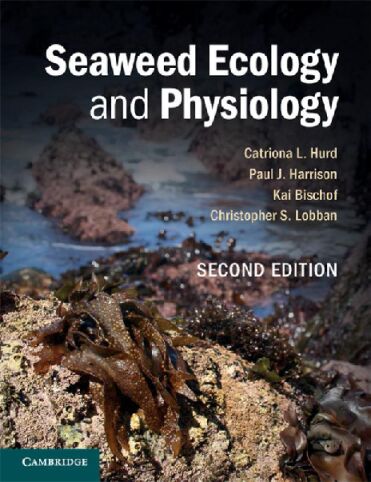
书名:Seaweed ecology and physiology
责任者:Catriona L. Hurd … [et al.].
出版时间:2014
出版社:Cambridge University Press,
摘要
In coastal seas, from the tropics to the poles, seaweeds supply the energy required to support diverse coastal marine life and provide habitat for invertebrates and fish. Retaining the highly successful approach and structure of the first edition, this is a synthesis of the role of seaweeds in underpinning the functioning of coastal ecosystems worldwide. It has been fully updated to cover the major developments of the past twenty years, including current research on the endosymbiotic origin of algae, molecular biology including 'omics', chemical ecology, invasive seaweeds, photobiology and stress physiology. In addition to exploring the processes by which seaweeds, as individuals and communities, interact with their biotic and abiotic environment, the book presents exciting new research on how seaweeds respond to local and global environmental change. It remains an invaluable resource for students and provides an entry into the scientific literature of a wide range of topics.
Features contributions from leaders in the field, retaining the highly successful approach and structure of the first edition.
Provides relevant background and concepts, synthesising important developments of the past 20 years using the primary literature on seaweed ecology and physiology.
Outlines exciting new research on how seaweeds respond to local and global environmental change, engaging readers in real-world applications of fundamental principles in seaweed physiological ecology.
查看更多
前言
There have been very significant advances in many areas of phycology since the last edition nearly 20 years ago. In particular, the advances in our understanding of the endosymbiotic origin of algal plastids, and molecular aspects and genetics, stand out. The wealth of new literature alone in all the areas has warranted adding two new co-authors, Catriona Hurd, who focuses on water motion and seaweed physiological ecology, especially in the southern hemisphere, and Kai Bischof, who is well known for his research on photobiology and stress physiology. Hence, the previous edition’s chapter on “Temperature and salinity” has been expanded to include other environmental stressors such as UV radiation, ocean acidification, oxidative stress responses and the interactions between stressors.
Seaweed Ecology and Physiology is a textbook for senior undergraduates and a reference book for researchers. The rapid growth of knowledge in this field is both exciting and daunting. Our goal was to select papers that help put together a coherent story on a wide variety of ecological and physiological aspects. This book provides an entry to the literature, not a systematic literature review. With two of our coauthors having experience in the tropics and the temperate southern hemisphere, we have tried to avoid the typical temperate northern hemisphere bias.
The previous large introductory chapter on morphology, life histories, and morphogenesis has been divided into two chapters because of the many advances in these areas. We have included an encapsulation of algal structure and life histories, but we still expect that students using this book will have learned these subjects in more detail or will be learning about them concurrently in a general phycology course. The chapter on mariculture has been expanded because of the continuing increased interest in aquaculture, multi-trophic aquaculture and biomitigation, and algal biotechnology.
Finally, we have invited six renowned phycologists to give their personal perspectives on currently active areas of research. These essays are included as six boxes in the most appropriate chapters. We hope that this book has been greatly enhanced by the personal stories of how these essayists became interested in their research topics and how their career path sometimes took unexpected/unplanned turns.
Many colleagues contributed to this book in a variety of ways. Various chapters of the book have been critically read by Ricardo Scrosati, Mike Hawkes, Richard Taylor, Dave Schiel, Christine Maggs, Svenja Heesch, Christopher Hepburn, Giselle Walker, Patrick Martone, Chuck Amsler, Ivan Gómez, Dieter Hanelt, Christian Wiencke, Alwyn Rees, Morten Pedersen, Matt Bracken, John Berges, Britta Eklund, Murray Brown, Charles Yarish, Wendy Nelson and Thierry Chopin. We thank Mike Guiry for checking the taxonomy using AlgaeBase.
CLH especially thanks Rochelle Dewdney for her invaluable help in compiling references, checking species names, and acquiring copyrights.
查看更多
目录
List of contributors page xi
Preface xiii
1 Seaweed thalli and cells 1
1.1 Introduction: the algae and their environments 1
1.1.1 Seaweeds 1
1.1.2 Environmental-factor interactions 5
1.1.3 Laboratory culture versus field experiments 8
1.2 Seaweed morphology and anatomy 9
1.2.1 Thallus construction 9
1.2.2 The Littler functional-form model 11
1.2.3 Unitary, clonal, and coalescing seaweeds, and modular construction 15
1.3 Seaweed cells 17
1.3.1 Cell walls 17
1.3.2 Cytoplasmic organelles 21
1.3.3 Cytoskeleton and flagella apparatus 25
1.3.4 Cell growth 32
1.3.5 Cell division 32
1.4 Molecular biology and genetics 35
1.4.1 Advances in seaweed molecular biology 35
1.4.2 Seaweed genetics 42
1.4.3 Nucleocytoplasmic interactions 45
1.5 Synopsis 47
2 Life histories, reproduction, and morphogenesis 48
2.1 Introduction 48
2.2 Theme and variations 48
2.3 Environmental factors in life histories 54
2.3.1 Seasonal anticipators and responders 55
2.3.2 Temperature 56
2.3.3 Light: photoperiod and wavelength 58
2.3.4 Other factors 65
2.4 Fertilization biology 68
2.5 Settlement, attachment, and establishment 74
2.5.1 Settlement 74
2.5.2 Attachment 78
2.5.3 Establishment 81
2.6 Thallus morphogenesis 83
2.6.1 Cell differentiation 85
2.6.2 Development of the adult form 88
2.6.3 Seaweed growth substances 91
2.6.4 Wound healing and regeneration 94
2.7 Synopsis 98
3 Seaweed communities 100
3.1 Intertidal zonation patterns 100
3.1.1. Tides 100
3.1.2 Vertical zonation on intertidal rocky shores 101
3.1.3 Factors controlling vertical zonation 104
3.2 Subtidal zonation on rocky shores 111
3.3 Seaweed communities 113
3.3.1 Tropical 113
3.3.2 Temperate 116
3.3.3 Polar 117
3.3.4 Tide pools 118
3.3.5 Estuaries and salt marshes 119
3.3.6 Deep-water seaweeds 120
3.3.7 Floating seaweeds 120
3.3.8 Other seaweed habitats and communities 121
3.4 Invasive seaweeds 121
3.5 Community analysis 124
3.5.1 Vegetation analysis 124
3.5.2 Population dynamics 128
3.6 Synopsis 133
4 Biotic interactions 136
4.1 Foundation species and facilitation 136
4.2 Competition 138
4.2.1 Interference competition 138
4.2.2 Epibionts and allelopathy 140
4.2.3 Exploitative competition 145
4.3 Grazing 148
4.3.1 Impact of grazing on community structure and zonation 148
4.3.2 Seaweed–herbivore interactions 156
4.4 Chemical ecology of seaweed–herbivore interactions 164
4.4.1 Bioactive chemicals 164
4.4.2 Chemical defenses against grazers 166
4.5 Symbiosis 170
4.5.1 Mutualistic relationships 171
4.5.2 Seaweed endophytes 172
4.5.3 Kleptoplasty 173
4.6 Synopsis 174
5 Light and photosynthesis 176
5.1 An overview of photosynthesis 176
5.2 Irradiance 179
5.2.1 Measuring irradiance 179
5.2.2 Light in the oceans 182
5.3 Light harvesting 188
5.3.1 Plastids, pigments, and pigment–protein complexes 188
5.3.2 Functional form in light trapping 194
5.3.3 Photosynthesis at a range of irradiances 197
5.3.4 Action spectra and testing the theory of complementary chromatic adaptation 200
5.4 Carbon fixation: the “dark reactions” of photosynthesis 202
5.4.1 Inorganic carbon sources and uptake 202
5.4.2 Photosynthetic pathways in seaweeds 206
5.4.3 Light-independent carbon fixation 207
5.5 Seaweed polysaccharides 210
5.5.1 Storage polymers 210
5.5.2 Wall matrix polysaccharides 211
5.5.3 Polysaccharide synthesis 215
5.6 Carbon translocation 215
5.7 Photosynthetic rates and primary production 218
5.7.1 Measurement of photosynthesis and respiration 218
5.7.2 Intrinsic variation in photosynthesis 222
5.7.3 Carbon losses 225
5.7.4 Autecological models of productivity and carbon budgets 227
5.7.5 Ecological impact of seaweed productivity 229
5.8 Synopsis 235
6 Nutrients 238
6.1 Nutrient requirements 238
C36.1.1 Essential elements 238
6.1.2 Essential organics: vitamins 239
6.1.3 Limiting nutrients 240
6.2 Nutrient availability in seawater 240
6.3 Pathways and barriers to ion entry 242
6.3.1 Membrane structure and ion movement 242
6.3.2 Movement to and through the membrane 243
6.3.3 Passive transport 243
6.3.4 Facilitated diffusion 243
6.3.5 Active transport 244
6.4 Nutrient-uptake kinetics 244
6.4.1 Measurement of nutrient-uptake rates 246
6.4.2 Factors affecting nutrient-uptake rates 249
6.5 Uptake, assimilation, incorporation, and metabolic roles 255
6.5.1 Nitrogen 256
6.5.2 Phosphorus 264
6.5.3 Calcium and magnesium 267
6.5.4 Sulfur 274
6.5.5 Iron 274
6.5.6 Trace elements 274
6.6 Long-distance transport (translocation) 275
6.7 Growth kinetics 276
6.7.1 Measurement of growth kinetics 276
6.7.2 Growth kinetic parameters and tissue nutrients 276
6.8 Effects of nutrient supply 279
6.8.1 Surface-area:volume ratio and morphology 279
6.8.2 Chemical composition and nutrient limitation 280
6.8.3 Nutrient storage and nutrient availability 282
6.8.4 Growth rate and distribution 284
6.8.5 Effects of nutrient enrichment on community interactions 286
6.9 Synopsis 290
7 Physico-chemical factors as environmental stressors in seaweed biology 294
7.1 What is stress? 294
7.2 Natural ranges of temperature and salinity 295
7.2.1 Open coastal waters 295
7.2.2 Estuaries and bays 296
7.2.3 Intertidal zone 297
7.3 Temperature effects 300
7.3.1 Chemical reaction rates 300
7.3.2 Metabolic rates 303
7.3.3 Growth optima 304
7.3.4 Temperature tolerance 308
7.3.5 Physiological adaptation to changes in temperature 312
7.3.6 Temperature tolerance in polar seaweeds 315
7.3.7 El Niño 319
7.3.8 Temperature and geographic distribution 321
7.4 Biochemical and physiological effects of salinity 325
7.4.1 Water potential 325
7.4.2 Cell volume and osmotic control 326
7.4.3 Effects of salinity changes on photosynthesis and growth 328
7.4.4 Tolerance and acclimation to salinity 330
7.5 Further stresses related to water potential: desiccation and freezing 333
7.5.1 Desiccation 333
7.5.2 Freezing 336
7.6 Exposure to ultraviolet radiation 337
7.7 Variation in seawater pH and community-based impacts of ocean acidification 340
7.8 Interaction of stressors, oxidative stress, and cross adaptation 343
7.9 Physiological stress indicators 346
7.10 Synopsis 347
8 Water motion 349
8.1 Water flow 349
8.1.1 Currents 349
8.1.2 Physical nature of waves 350
8.1.3 Laminar and turbulent flow over surfaces 352
8.1.4 Methods for measuring seawater flow and wave forces 355
8.2 Water motion and biological processes 356
8.2.1 Function and form in relation to resource acquisition 356
8.2.2 Synchronization of gamete and spore release 359
8.3 Wave-swept shores 360
8.3.1 Biomechanical properties of seaweeds 360
8.3.2 Wave action and other physical disturbances to populations 366
8.4 Synopsis 372
9 Pollution 374
9.1 Introduction 374
9.2 General aspects of pollution 374
9.3 Metals 378
9.3.1 Sources and forms 378
9.3.2 Adsorption, uptake, accumulation, and biomonitors 380
9.3.3 Mechanisms involving tolerance to toxicity 383
9.3.4 Effects ofmetals on algalmetabolism 384
9.3.5 Factors affecting metal toxicity 388
9.3.6 Ecological aspects 389
9.4 Oil 390
9.4.1 Fate of oil in the ocean 392
9.4.2 Effects of oil on algal metabolism, life cycles, and communities 394
9.4.3 Ecological aspects 396
9.5 Synthetic organic chemicals 398
9.6 Eutrophication 400
9.6.1 Sewage effluent and impacts of nutrient enrichment on algal communities 400
9.6.2 Sewage effluent and toxicity 403
9.6.3 Other anthropogenic nutrient sources 407
9.7 Radioactivity 408
9.8 Thermal pollution 409
9.9 Synopsis 410
10 Seaweed mariculture 413
10.1 Introduction 413
10.2 Pyropia/Porphyra mariculture 415
10.2.1 Biology 416
10.2.2 Cultivation 417
10.2.3 Problems in Pyropia culture 419
10.2.4 Future trends 420
10.3 Saccharina/Laminaria for food and alginates 421
10.3.1 Cultivation 422
10.3.2 Utilization and future prospects 423
10.4 Undaria for food 424
10.4.1 Cultivation 425
10.4.2 Food products and future trends 425
10.5 Kappaphycus and Eucheuma for carrageenans 426
10.5.1 Biology 426
10.5.2 Cultivation 426
10.5.3 Production, uses, and future prospects 427
10.6 Gelidium and Gracilaria for agar 428
10.6.1 Gelidium production and products 428
10.6.2 Gracilaria production and products 429
10.7 Tank cultivation 430
10.8 Offshore/open-ocean cultivation 431
10.9 Integrated Multi-Trophic Aquaculture (IMTA) and biomitigation 431
10.10 Other uses of seaweeds 434
10.11 Seaweed biotechnology: current status and future prospects 435
10.12 Synopsis 437
References 440
Subject Index 536
查看PDF
查看更多
作者简介
Christopher S. Lobban is Professor of Biology in the Division of Natural Sciences at the University of Guam, Mangilao, USA. He has over 40 years of experience working with marine algae, including 25 years on coral reefs in Guam. He is currently investigating biodiversity of coral reef diatoms.
查看更多
馆藏单位
中科院文献情报中心