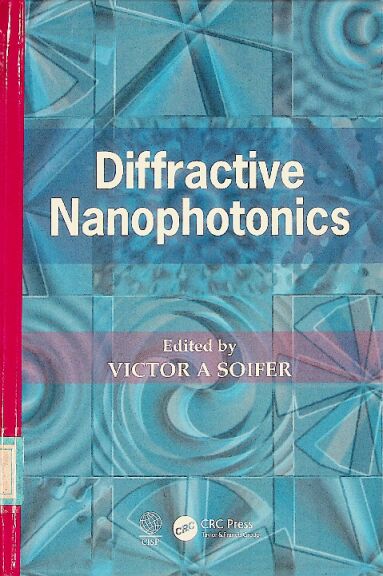
书名:Diffractive nanophotonics
责任者: Victor A. Soifer. | Soifer, V. A.
出版时间:2014
出版社:CRC Press, Taylor & Francis Group,
前言
Diffractive Nanophotonics demonstrates the utility of the well-established methods of diffractive computer optics in solving nanophotonics tasks. It is concerned with peculiar properties of laser light diffraction by microoptics elements with nanoscale features and light confinement in subwavelength space regions. Written by recognized experts in this field, the book covers in detail a wide variety of advanced methods for the rigorous simulation of light diffraction. The authors apply their expertise to addressing cutting-edge problems in nanophotonics.
Chapters consider the basic equations of diffractive nanophotonics and related transformations and numerical methods for solving diffraction problems under strict electromagnetic theory. They examine the diffraction of light on two-dimensional microscopic objects of arbitrary shape and present a numerical method for solving the problem of diffraction on periodic diffractive micro- and nanostructures. This method is used in modern trends in nanophotonics, such as plasmonics, metamaterials, and nanometrology. The book describes the simulation of electromagnetic waves in nanophotonic devices and discusses two methods of calculating the spatial modes of microstructured photonic crystal fibres—a relatively new class of optical fibres with the properties of photonic crystals.
The book explains the theory of paraxial and non-paraxial laser beams with axial symmetry and an orbital angular momentum—called vortex beams—which are used for optical trapping and rotating micro- and nanoparticles in a ring in the cross-sectional plane of the beam. The final chapter discusses methods for calculating the force and torque exerted by the electromagnetic field focused onto the microparticle of arbitrary form, whose dimensions are comparable with the wavelength of light.
查看更多
目录
1 Basic equations of diffractive nanophotonics 1
1.1. Maxwell equations 2
1.1.1. Mathematical concepts and notations 2
1.1.2. Maxwell's equations in differential form 3
1.1.3 Maxwell's equations in integral form 4
1.1.4. Fields at interfaces 5
1.1.5. Poynting's theorem 5
1.2. Differential equations of optics 6
1.2.1. The wave equation 6
1.2.2. Helmholtz equations 7
1.2.3. The Fock-Leontovich equation 7
1.2.4. Eikonal and transport equations 8
1.3. Integral theorems of optics 8
1.3.1. Green's formulas 8
1.3.2. Stratton-Chu formula 11
1.4. Integral transformations in optics 15
1.4.1. Kirchhoff integral 16
1.4.2. Fresnel transform 17
Conclusion 18
References 19
2 Numerical methods for diffraction theory 20
2.1. The finite-difference time-domain method for solving Maxwell's equation 22
2.1.1. Explicit difference approximation for Maxwell's equations 22
2.1.1.1. One-dimensional case 22
2.1.1.2. The two-dimensional case 26
2.1.2. Transition from time domain to frequency domain 32
2.1.3. Application of absorbing layers 34
2.1.3.1. Formulation of absorbing boundary conditions and the imposition of absorbing layers 34
2.1.3.2. The difference approximation of Maxwell's equations in absorbing layers 37
2.1.3.3. Association of absorbing layers in vectorization of calculations 33
2.1.3.4. Universal grid areas 42
2.1.4. Incident wave source conditions 46
2.1.4.1. Hard source conditions 48
2.1.4.2. The total field formulation method 51
2.1.4.3. The method of separation of the field 54
2.1.4.4. Comparison of methods for the formation of the incident wave 62
2.1.5. Decomposition of the grid region 64
2.1.5.1. Decomposition of the one-dimensional grid region 66
2.1.5.2. Decomposition of two-dimensional grid region 71
2.1.6. Simulation of the effect of the etching wedge on the focusing of radiation of cylindrical microlenses with a high numerical aperture 75
2.1.6.1. Selection of parameters of computational experiments 75
2.1.6.2. Simulation of radiation through a microlens with an etching wedge 75
2.2. Numerical solution of the Helmholtz equations BPM-approach) 77
2.2.1. The beam propagation method and its variants 77
2.2.2. Solution on the basis of expansion into thin optical elements (FFT BPM) 85
2.2.3. Solution on the basis of the finite difference method (FD BPM) 89
2.2.4. Solution on the basis of the finite element method (FE BPM) 93
2.2.5. Approaches to solving the Helmholtz vector equation 96
2.2.6. Examples of application of BPM 99
Conclusion 102
References 105
3. Diffraction on cylindrical inhomogeneities comparable to the wavelength 110
3.1. Analysis of diffraction on inhomogeneities by the combined
finite element method and boundary element method 111
3.1.1. Analysis of diffraction on inhomogeneities by the combined finite element and boundary element method 111
3.1.2 Analysis of the diffraction of light on periodic inhomogeneities 121
3.2. Finite element method for solving the two-dimensional integral diffraction equation 131
3.2.1. TE-polarization 131
3.2.2. TM-polarization 135
3.2.3. Application of finite element method for solving integral equation 139
3.2.4. Convergence of the approximate solution 142
3.2.5. The diffraction of light by cylindrical microlenses 143
3.2.6. Diffraction of light on microscopic objects with a piecewise-uniform refractive index 146
3.3. Diffraction of light on inhomogeneous dielectric cylinders 149
3.3.1. Solution of the problem of diffraction of an arbitrary wave on
a cylindrical multilayer dielectric cylinder by separation of variables 150
3.3.2. The analytical solution for a two-layer cylinder 161
3.3.3. Diffraction on a gradient microlens. Diffraction of electromagnetic waves on the internal Luneberg lenses 164
3.4. Fast iterative method for calculating the diffraction field
of a monochromatic electromagnetic wave on a dielectric cylinder 173
3.4.1. An iterative method for calculating the diffraction of TE-polarized wave 173
3.4.2. An iterative method for calculating the diffraction of TM-polarized wave 177
3.4.3. Relaxation of the iterative method 182
3.4.4. Comparison with the analytical calculation of diffraction of a plane wave 184
References 190
4. Modelling of periodic diffractive micro- and nanostructures 194
4.1. The method of rigorous coupled-wave analysis for solving the diffraction problem in periodic diffractive structures 195
4.1.1. The equation of a plane wave 195
4.1.2. The method of rigorous coupled-wave analysis in the two-dimensional case 199
4.1.2.1 The geometry of the structure and formulation of the problem 199
4.1.2.2. Presentation of the field above and below the structure 200
4.1.2.3. The system of differential equations to describe the field inside the layer 201
4.1.2.5. 'Stitching' of the electromagnetic field on the layer boundaries 212
4.1.2.6. Numerically stable implementation of the method 214
4.1.2.7. Characteristics of diffraction orders 217
4.1.3. Fourier modal method in a three-dimensional case 218
4.1.4. Examples of calculation of diffraction gratings 223
4.1.4.1. Grating polarizers 223
4.1.4.2. The beam splitter 224
4.1.4.3. Subwavelength antireflection coatings 227
4.2. Formation of high-frequency interference patterns of surface plasma polaritons by diffraction gratings 230
4.2.1. Surface plasma polaritons (SPP) 231
4.2.1.1. The equation of a surface plasma polariton 231
4.2.1.2. The properties of surface plasma polaritons 235
4.2.1.3. Excitation of surface plasma polaritons 239
4.2.2. Formation of one-dimensional interference patterns of surface plasma polaritons 242
4.2.3. Formation of two-dimensional interference patterns of surface plasma polaritons 248
4.2.4. Diffractive optical elements for focusing of surface plasma polaritons 260
4.3. Diffractive heterostructures with resonant magneto-optical properties 267
4.3.1. Magneto-optical effects in the polar geometry 267
4.3.1.1. The geometry of the structure 267
4.3.1.2. The study of magneto-optical effects 268
4.3.1.3. Investigation of three-layer structure 273
4.3.2. Magneto-optical effects in meridional geometry 275
4.3.2.1. The geometry of the structure and type of magneto-optical effect 275
4.3.2.2. Investigation of the magneto-optical effect 276
4.3.3. The magneto-optical effects in the equatorial geometry 282
4.3.3.1 The geometry of the structure and type of magneto-optical effect 282
4.3.3.2. Explanation of the magneto-optical effect 283
4.3.3.3. The equation of a surface plasma polariton at the boundary of a magnetized medium 285
4.4. Metrology of periodic micro- and nanostructures by the reflectometry method 288
4.4.1. Formulation of the problem 289
4.4.2. Methods for estimating the geometric parameters of the profile of the grating 290
4.4.3. Determining the parameters of a trapezoidal profile 291
Conclusion 294
References 296
5. Photonic crystals and light focusing 300
5.1. One- and two-dimensional photonic crystals 300
5.1.2. Plane wave diffraction on photonic crystals without defects 303
5.1.3. Propagation of light in a photonic crystal waveguide 303
5.1.4. Photonic crystal collimators 303
5.2. Two-dimensional photonic crystal gradient Mikaelian lens 306
5.2.1. The modal solution for the gradient secant-index waveguide 308
5.2.2. Photonic crystal gradient lens 310
5.2.3. The photonic crystal lens for coupling two waveguides 314
5.3. Sharp focusing of radially-polarized light 326
5.3.1. Richards-Wolf vector formulas 330
5.3.2. The minimum focal spot: an analytical estimation 332
5.3.3. Maxwell's equations in cylindrical coordinates 333
5.3.4. Maxwell's equations for the incident wave with linear polarization 337
5.3.5. Maxwell's equations for azimuthal polarization 339
5.3.6. Maxwell's equations for radial polarization 340
5.3.7 Modelling the focusing of a plane linearly polarized wave by a spherical microlens 342
5.3.8. Focusing the light by biconvex spherical microlenses 344
5.3.9. Focusing of a plane wave with radial polarization by a gradient cylindrical microlens 344
5.3.10. Focusing of a Gaussian beam with radial polarization using a conical microaxicon 345
5.4. Three-dimensional photonic crystals 346
5.5. Interefence-litographic synthesis of photonic crystals 351
5.5.1. The scheme of recording the lattice 352
5.5.2. Description of experiments and the resulting structure 353
5.6. Three-dimensional photonic approximants of quasicrystals and related structures 355
5.6.1. The geometrical structure of the quasicrystal approximants 356
5.6.2. Numerical analysis of quasicrystal approximants 357
5.6.3. Photonic crystal with the lattice symmetry of clathrate Si34 362
5.7. One-dimensional photonic crystal based on a nanocomposite:metal nanoparticles-a dielectric 365
References 370
6. Photonic crystal fibres 376
6.1. Calculation of modes of photonic crystal fibres by the method of matched sinusoidal modes 380
6.1.1. Method of matched sinusoidal modes in the scalar case 380
6.1.2. Method of matched sinusoidal modes in the vector case 393
6.1.3. The Krylov method for solving non-linear eigenvalue problems 399
6.1.4. Calculation by the modes of the stepped fibre 403
6.1.5. Calculation of modes of the photonic-crystal fibre 408
6.1.6. Calculation of modes using Fimmwave software 409
6.2. Calculation of modes of photonic-crystal light guides by the finite difference method 411
6.2.1. A difference method for calculating the modes for electric fields 412
6.2.2. The difference method for calculating the modes for magnetic fields 422
6.2.3. Calculation of modes of photonic-crystal fibres with a filled core 424
6.2.4. Calculation of modes of photonic-crystal fibre with a hollow core 425
6.2.5. Calculation of modes of Bragg fibres 428
6.2.6. Comparison of the calculation of the waveguide modes by differential method 428
References 431
7. Singular optics and superresolution 434
7.1. Optical elements that form wavefronts with helical phase singularities 436
7.1.1. The spiral phase plate (SPP) 436
7.1.2. Spiral zone plates 437
7.1.3. Gratings with a fork 437
7.1.4. Screw conical axicon 437
7.1.5. Helical logarithmic axicon 439
7.2. The spiral phase plate 439
7.2.1. Hankel transform 440
7.2.2. Radial Hilbert transform 442
7.2.3. Diffraction of a Gaussian beam on SPP: scalar theory. Fresnel diffraction of Gaussian beam on SPP 443
7.2.4. Diffraction of a Gaussian beam on SPP: vector theory 448
7.2.5. Fresnel diffi-action of a restricted plane wave on SPP 454
7.2.6. Diffraction of a restricted plane wave on SPP: paraxial vectorial theory 456
7.3. Quantized SPP with a restricted aperture, illuminated by a plane wave 460
7.4. Helical conical axicon 465
7.4.1. Diffraction of Gaussian beam on a restricted helical axicon 466
7.4.2. Diffraction of a restricted place wave on a helical axicon 471
7.5. Helical logarithmic axicon 475
7.5.1. General theory of hypergeometric laser beams 475
7.5.2. Hypergeometric modes 478
7.5.3. Formation of hypergeometric laser beams 482
7.5.4. Special cases of hypergeometric beams 485
7.5.5. Non paraxial hypergeometric beams 490
7.5.6. Superresolution by means of hypergeometric laser beams 496
7.6. Elliptic vortex beams 496
7.6.1. Astigmatic Bessel beams 496
7.6.2. Elliptic Laguerre-Gaussian beams 504
7.7. The vortex beams in optical fibres 518
7.7.1. Optical vortices in a step-index fibre 518
7.7.2. Optical vortices in gradient fibres 533
7.8. Matrices of optical vortices 540
7.9. Simulation of an optical vortex generated by a plane wave diffracted by a spiral phase plate 545
References 546
8. Optical trapping and manipulation of micro- and nano-objects 553
8.1. Calculation of the force acting on the micro-object by a focused laser beam 553
8.1.1. Electromagnetic force for the three-dimensional case 555
8.1.2. Electromagnetic force for the two-dimensional case 557
8.1.3. Calculation of force for a plane wave 558
8.1.4. Calculation of force for a non-paraxial Gaussian beam 560
8.1.5. Calculation of forces for the refractive index of the object smaller than the refractive index of the medium 566
8.2. Methods for calculating the torque acting on a micro-object by a focused laser beam 567
8.2.1. The orbital angular momentum in cylindrical microparticles 569
8.2.2. The results of numerical simulation of the torque 570
8.3. A geometrical optics method for calculating the force acting by light on a microscopic object 576
8.3.1. Description of the method 576
8.3.2. Comparison of results of calculations by geometrical optics and electromagnetic methods 580
8.4. Rotation of micro-objects in a Bessel beam 582
8.4.1. Transformation of diffractionless Bessel beams 582
8.4.2. Umov—Poynting vector for the non-paraxial 2D vector Bessel beam 584
8.4.3. Umov—Poynting vector for the paraxial 3D vector Bessel beam 587
8.4.4. The orbital angular momentum for a Bessel beam 589
8.4.5. DOE to form a Bessel beam 590
8.4.6. Experimental study of movements of the micro-objects in the Bessel beam 592
8.5. Optical rotation using a multiorder spiral phase plate 595
8.6. Rotation of microscopic objects in a vortex light ring formed by an axicon 597
8.7. Optical rotation in a double light ring 598
8.7.1. Production of DOE by electron-beam lithography 599
8.7.2. Production of DOE using photolithography 600
8.7.3. Formation of the DOE with a liquid-crystal display 600
8.7.4. Formation of a double ring of light with different types of DOE 602
8.8. Optical rotation in a double ring of light 602
8.9. Rotation of micro-objects by means of hypergeometric beams and beams that do not have the orbital angular momentum using the spatial light modulator (SLM) 603
8.9.1. Rotation of hypergeometric beams 604
8.9.2. Rotation of the laser beams with no orbital angular momentum 607
8.10. Investigation of rotation of micro-objects in light beams with orbital angular momentum 613
8.10.1. Investigation of rotation of micro-objects in the Bessel beam 613
8.10.2. Studies of mechanical characteristics of rotation of micro-objects in optical vortices 617
8.10.2. Studies of mechanical characteristics of rotation of micro-objects in optical vortices 617
8.11. The capture of micro-objects in Airy beams with ballistic properties 621
8.11.1. Airy laser beams 621
8.11.2. Optical trapping of micro-objects in Airy beams 625
References 629
Conclusion 634
Appendix A Simulation using FULLWAVE 638
A.1. Brief description of the FDTD-method 638
A.2.The main components of the program 639
A.3.Program design elements of micro-optics 640
A.4.The program for the modelling of propagation of the electromagnetic field by FDTD method 642
A.S. Program charting 644
Appendix B Simulation using FIMMWAVE 646
B.1. Creation of a project 646
B.2.Creating a model of the fibre 647
B.2.1. Model of the comb fibre 647
B.2.2. Model of the optical fibre 651
B.2.3. Model of the microstructured optical fibre 652
B.3.Calculation of modes 654
B.3.1. MOLAB - automatic search of eigenmodes 654
B.3.2. WG Scanner - parametric scanner of eigenmodes 658
Conclusion 662
References 662
List of special terms 663
Appendix C Simulation using OLYMPIOS program 664
C.1.The purpose and structure of the program 664
C.2.Determination of modelling parameters 667
C.3.Modelling and analysis of results 670
Index 676
查看更多
馆藏单位
中科院文献情报中心