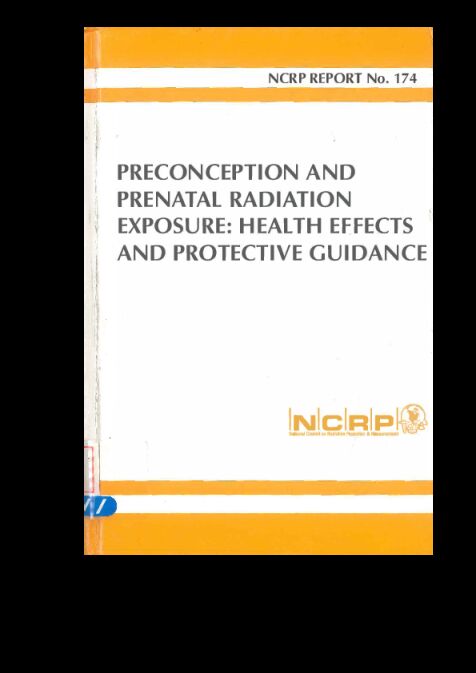
书名:Preconception and prenatal radiation exposure
责任者:[prepared Scientific Committee 4-4 on the Risks of Ionizing Radiation to the Developing Embryo | Fetus | and Nursing Infant].
出版时间:2013
出版社:National Council on Radiation Protection and Measurements
前言
The potential reproductive and developmental effects of ionizing radiation exposure on the gamete, embryo, fetus, and nursing infant from medical procedures or other sources of radiation are of considerable importance and concern with regard to radiation protection. The National Council on Radiation Protection and Measurements (NCRP) considered possible adverse outcomes of medical exposures of pregnant women and women of childbearing age in Report No. 54, Medical Radiation Exposure of Pregnant and Potentially Pregnant Women (1977). NCRP also published Commentary No. 9, Considerations Regarding the Unintended Radiation Exposure of the Embryo, Fetus or Nursing Child (1994), in which problems were discussed that could result from the administration of radioactive material in medical procedures. In 1997, NCRP held its Annual Meeting on The Effects of Pre- and Postconception Exposure to Radiation, and the proceedings were published in Teratology (1999).
Since the publication of NCRP Report No. 54, many advances have been made in understanding the reproductive and developmental risks of ionizing radiation exposure, as well as in updating risk assessments for other potential radiation health effects, including heritable disease and cancer. This Report represents a comprehensive evaluation of the current state-of-knowledge of ionizing radiation effects on the gamete, embryo, fetus, and nursing infant. It includes an in-depth review of radiation risks and potential outcomes, including congenital malformations, growth retardation, miscarriage and stillbirth, mental retardation and neurobehavioral effects, and cancer risks in the children of mothers exposed to radiation during pregnancy. Ionizing radiation exposure to medical, occupational and environmental sources are considered, together with the assessment of dose and discussion of the protective measures to mitigate risk to the gamete, embryo, fetus, and nursing infant. Effective methods of counseling and communicating the risk to a pregnant woman are described, along with examples of consultations concerning risk prior to and during pregnancy.
In addition to health effects of ionizing radiation, issues related to potential reproductive and developmental effects on the embryo and fetus of exposure to nonionizing sources (i.e., high-frequency electromagnetic fields and medical applications of magnetic-resonance imaging and ultrasound) as well as protective measures to mitigate risk from possible thermal effects are discussed.
This Report was prepared by Scientific Committee 4-4 on the Risks of Ionizing Radiation to the Developing Embryo, Fetus and Nursing Infant. Serving on Scientific Committee 4-4 were: Robert L. Brent, Chairman Thomas Jefferson University A.I. duPont Hospital for Children Wilmington, Delaware.
Members: Donald P. Prush Duke University Medical Center Durham, North Carolina; Robert O. Gorson Thomas Jefferson University Philadelphia, Pennsylvania; Roger W. Harms Mayo Clinic Rochester, Minnesota; Linda A. Kroger University of California Davis School of Medicine Sacramento, California; Martha S. Linet National Cancer Institute Bethesda, Maryland; Andrew D. Maidment University of Pennsylvania Philadelphia, Pennsylvania; John J. Mulvihill University of Oklahoma Oklahoma City, Oklahoma; Shiao Y. Woo University of Louisville Louisville, Kentucky
Consultants: Jerrold T. Bushberg University of California Davis Health System Sacramento, California; Joseph Morrissey Nova Southeastern University Plantation, Florida; Susan D. Wiltshire S. Hamilton, Massachusetts Marvin C. Ziskin Temple University Medical School Philadelphia, Pennsylvania.
NCRP Secretariat: Marvin Rosenstein, Staff Consultant (2010 - 2013); Brian Dodd, Staff Consultant (2008 - 2010); Cindy L.. O'Brien, Managing Editor; Laura J. Atwell, Office Manager James R. Cassata, Executive Director.
The Council expresses appreciation to the Committee members for the time and effort devoted to the preparation of this Report, and to the Centers fox Disease Control and Prevention for the financial support provided during its preparation. John D. Boice, Jr. President
查看更多
目录
Preface iii
1. Executive Summary 1
1.1 Background and Purpose 1
1.2 Ionizing Radiation Exposures of Reproductive Relevance 1
1.3 Preconception Ionizing Radiation Risks 1
1.4 Pregnancy Risks from Ionizing Radiation 2
1.5 Ionizing Radiation Risk to the Nursing Infant 4
1.6 Mitigation of Ionizing Radiation Risk for Pregnant or Potentially-Pregnant Women 7
1.7 Risks to the Embryo or Fetus During Magnetic-Resonance Imaging 8
1.8 Risks to the Embryo or Fetus from Other Radiofrequency Sources 9
1.9 Risks to the Embryo or Fetus from Ultrasound Imaging 10
1.10 Communicating Benefits and Risks 11
2. Introduction 13
2.1 Background and Purpose 13
2.2 Scope of this Report 15
2.3 Gestational Age Conventions 15
3. Ionizing Radiation Exposures of Reproductive Relevance 17
3.1 Quantities, Units, and Related Concepts in this Report 17
3.2 Primary Sources of Ionizing Radiation Exposure to Pregnant Women 20
3.2.1 Medical Care 20
3.2.2 Occupational Exposure 22
3.2.3 Ubiquitous Background Exposure 28
3.3 Principles of Ionizing Radiation Protection 29
3.4 Dose-Response Relationships for Stochastic Effects 31
4. Preconception Ionizing Radiation Risks 33
4.1 Importance of Preconception Exposures 33
4.2 Biology of Human Gametogenesis 34
4.3 Detecting Radiation Damage in Sperm and Eggs 35
4.4 Detecting Human Germ-Cell Mutagenesis in Offspring: Theory 39
4.5 Human Germ-Cell Mutagenesis: Practice 40
4.5.1 Endpoints for Studies of Mutagenesis 43
4.5.1.1 Infertility 43
4.5.1.2 Fetal Death 44
4.5.1.3 Sex Ratios at Birth 45
4.5.1.4 Congenital Malformations and Childhood Cancer 45
4.5.1.5 Chromosomal Abnormalities 45
4.5.1.6 Single-Gene (Mendelian) Disorders 46
4.5.1.7 Variations in Proteins and Nucleic Acids 47
4.5.2 Relative Biological Effectiveness 48
4.6 Heritable Disease in Exposed Populations 48
4.6.1 Residential Exposures from High or Enhanced Background Radiation 50
4.6.2 Japanese Atomic-Bomb Survivors 51
4.6.3 Exposed Occupational Groups 51
4.6.4 Mutations in Minisatellite Deoxyribonucleic Acid Sequences 53
4.6.5 Medical Groups 54
4.6.6 Summary of Heritable Disease in Exposed Populations 57
5. Pregnancy Risks from Ionizing Radiation 58
5.1 General Principles 58
5.1.1 Background Pregnancy Risks 58
5.1.2 Embryonic and Fetal Developmental Stages and the Deleterious Dose 58
5.1.3 Types of Effects 65
5.1.4 Protraction and Fractionation 66
5.1.5 The All-or-None Phenomenon 70
5.1.6 Lack of Indirect Effect on a Shielded Embryo During Maternal Irradiation 75
5.1.7 Evaluation of the Evidence for Radiation-Induced Effects 79
5.1.7.1 Epidemiological Studies 80
5.1.7.2 Animal Developmental Toxicity Studies 81
5.1.7.3 Biological Plausibility .81
5.1.8 Relative Biological Effectiveness 82
5.2 Risks and Outcomes 83
5.2.1 Mental Retardation and Other Neurological Effects 83
5.2.1.1 Mental Retardation 83
5.2.1.2 Intelligence Quotient and School Performance 84
5.2.1.3 Seizures 88
5.2.1.4 Mechanisms and Related Animal Studies 90
5.2.1.5 Small Head Size (microcephaly) 95
5.2.1.6 Neuromuseular Function 95
5.2.1.7 Conclusions 95
5.2.2 Congenital Malformations (birth defects) 96
5.2.2.1 Human Studies 96
5.2.2.2 Animal Studies 101
5.2.2.3 Summary for Congenital Malformations 103
5.2.3 Growth Retardation 103
5.2.4 Embryonic and Fetal Death (miscarriage and stillbirth in humans) 107
5.2.5 Adult Diseases 109
5.2.5.1 Cardiovascular Disease 111
5.2.5.2 Thyroid Disease 111
5.2.6 Oncogenic Effects of In Utero Irradiation 112
5.2.6.1 Medical Exposures: Diagnostic 113
5.2.6.1.1 Epidemiologic Case-Control Studies 115
5.2.6.1.2 Epidemiologic Cohort Studies 126
5.2.6.1.3 Other Issues 130
5.2.6.2 Medical Exposures: Therapeutic 131
5.2.6.3 Occupational Exposures: Nuclear Industry 132
5.2.6.4 Occupational Exposures: Medical Radiation Workers 132
5.2.6.5 Environmental Exposures: Ubiquitous Background Radiation 133
5.2.6.6 Environmental Exposures: Mail-Made (Japanese atomic-bomb survivors, nuclear reactor accidents, weapons tests, and residential proximity to radionuclide contaminants or nuclear plants) 134
5.2.6.7 Methodological Issues 140
5.2.6.8 Animal Studies 142
5.2.6.9 Summary for Fetal Exposure and Subsequent Cancer Risk 146
5.2.6.9.1 In Utero Diagnostic X-Ray Procedures 146
5.2.6.9.2 In Utero Exposure to Occupational or Environmental Sources, and Japanese Atomic-Bomb Survivors 148
5.2.6.9.3 Animal Data 149
5.3 Guidance for Diagnostic and Fluoroscopically-Guided Interventional Procedures 150
6. Radiation Risk to the Nursing Infant 151
6.1 Radiopharmaceuticals Administered to the Mother 151
6.2 Brachytherapy 154
6.3 Environmental Exposure to Radioiodine 156
7. Mitigation of Ionizing Radiation Risk for Pregnant or Potentially-Pregnant Women 157
7.1 Pregnancy Testing and Documentation 157
7.1.1 Introduction 157
7.1.2 Assessment of Pregnancy 158
7.1.3 Methods for Pregnancy Assessment 160
7.1.4 Documentation of Pregnancy and Pregnancy Policy Considerations 163
7.1.5 Summary of Pregnancy Assessment 164
7.2 Managing Dose and Mitigating Exposure 165
7.2.1 Medical Diagnostic Imaging 165
7.2.1.1 Introduction 165
7.2.1.2 General Considerations 168
7.2.1.3 Radiography 170
7.2.1.4 Fluoroscopy 171
7.2.1.5 Computed Tomography 171
7.2.1.6 Nuclear Medicine 172
7.2.1.7 Modifications of Diagnostic Imaging Strategies for Pregnant Patients 173
7.2.1.8 Image Gently® and Image Wisely® Philosophy 174
7.2.1.9 Summary of Dose Management in Diagnostic Imaging 175
7.2.2 Radiation Therapy 175
7.2.2.1 Treatment Simulation 176
7.2.2.2 Radiation Treatment Delivery 176
7.2.3 Occupational Exposure 180
7.2.4 Accidental or Deliberate Exposure 182
7.2.4.1 Dose Estimation 182
7.2.4.2 Immediate Clinical Requirements and Recommendations to Limit Exposure 183
7.2.4.3 Countermeasures Recommended 183
7.2.4.4 Long-Term Follow-Up 184
8. Nonionizing Modalities and Sources 186
8.1 Risks to the Embryo or Fetus During Magnetic-Resonance Imaging 186
8.1.1 Introduction 186
8.1.2 Effect of Radiofrequency Electromagnetic Fields 187
8.1.3 Effect of Time-Varying Magnetic Field Gradients 191
8.1.4 Effect of Static Magnetic Fields 192
8.1.5 Clinical Guidelines for Magnetic-Resonance Imaging in Pregnant Patients 194
8.1.6 Use of Contrast Agents 196
8.2 Risks to the Embryo or Fetus from Other Radiofrequency Sources 196
8.2.1 Introduction 196
8.2.2 Limits for Human Exposure to Radiofrequency Sources (300 kHz to 300 GHz) 197
8.2.3 Electromagnetic Field Interactions 198
8.2.4 Current Safety Standards 199
8.2.5 Nonthermal Effects 200
8.2.6 Thermal Effects 202
8.3 Risks to the Embryo or Fetus from Ultrasound Imaging 203
8.3.1 Introduction 203
8.3.2 Nature of Ultrasound 204
8.3.2.1 Mechanisms of Tissue Heating 205
8.3.2.1.1 Hyperthermia and Teratology 206
8.3.2.1.2 The Thermal Index 210
8.3.2.1.3 Measured Temperature Rise in Human Fetal Tissue 211
8.3.2.2 Nonthermal Mechanisms 212
8.3.3 Epidemiology 213
8.3.3.1 Low Birth Weight 213
8.3.3.2 Delayed Speech 214
8.3.3.3 Dyslexia 215
8.3.3.4 Nonright-Handedness 215
8.3.3.5 Intellectual Performance 216
8.3.3.6 Childhood Malignances 217
8.3.3.7 Conclusions from Epidemiological Studies 217
8.3.4 Areas of Special Concern 219
8.3.4.1 Transducer Self Heating 219
8.3.4.2 Use of Doppler in the First Trimester 219
8.3.4.3 Use of Contrast Agents 220
8.3.4.4 Keepsake Fetal Imaging 221
8.3.4.5 Ultrasound Examination of Febrile Patients 221
8.3.4.6 Possible Alterations in Neuronal Migration 221
8.3.5 Safety Guidelines 222
9. Communicating Benefits and Risks 223
9.1 State of Knowledge and Practice of Medical Professionals 223
9.2 Professional Counseling 224
9.3 Information Resources for Professionals 226
9.4 State of Public Knowledge 227
9.5 Information Resources for Members of the Public 228
10. Conclusions and Recommendations 230
10.1 Conclusions 230
10.2 Recommendations 234
Appendix A. Radiation Exposure Consultations 237
A.1 Introduction 237
A.2 Ionizing Radiation 237
A.3 Nonionizing Modalities and Sources 239
A.4 Examples of Consultations 239
A.4.1 Diagnostic X-Ray Studies When the Abdomen and Pelvis are Not Exposed 239
A.4.2 Diagnostic X-Ray Studies that Directly Expose the Abdomen and Pelvis 240
A.4.3 Diagnostic Nuclear Medicine Studies 241
A.4.4 Ionizing Radiation Therapy with Radionuclides that Exposes the Abdomen and Pelvis 241
A.4.5 External High-Dose Radiation Therapy During Pregnancy 241
A.4.6 Family Members or Friends Receiving External-Beam Radiation Therapy 242
A.4.7 Family Members or Friends Administered Radioactive Material for Diagnosis or Therapy 242
A.4.8 Exposure to the Sperm from Diagnostic X-Ray Studies 244
A.4.9 Exposure to the Sperm from Radiation Therapy 245
A.4.10 Exposure from Communication Microwave Sources 245
Appendix B. Radiation Exposure Questions and Answers 246
B.1 Single Questions and Answers 246
B.2 A More Complex Consultation 251
Appendix C. Example Forms 256
C.1 Pre-examination Pregnancy Determination 256
C.2 Informed Consent for X-Ray Examinations of Pregnant or Potentially-Pregnant Patient 257
Abbreviations, Acronyms and Symbols 258
Glossary 259
References 276
Scientific Committee 343
The NCRP 350
NCRP Publications 360
查看PDF
查看更多
馆藏单位
中国医科院医学信息研究所