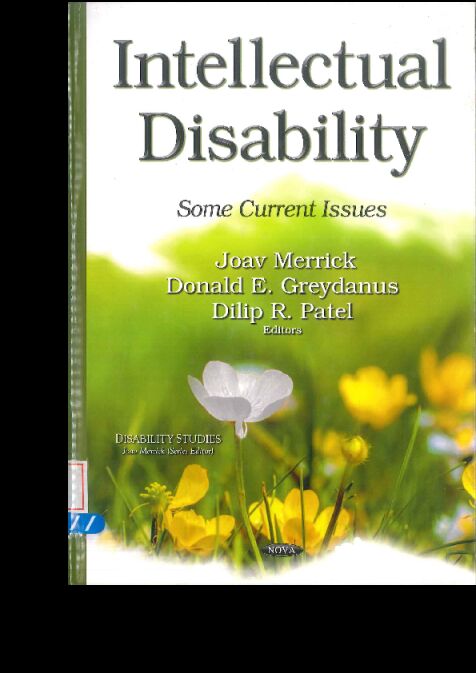
书名:Intellectual disability
责任者:Joav Merrick | Donald E. Greydanus and Dilip R. Patel | Patel, Dilip R.
出版时间:2014
出版社:Nova Science Publishers, Inc.,
摘要
Intellectual disability (ID), also known as general learning disability,[3] and mental retardation (MR),[4][5] is a generalized neurodevelopmental disorder characterized by significantly impaired intellectual and adaptive functioning. It is defined by an IQ under 70 in addition to deficits in two or more adaptive behaviors that affect everyday, general living.
Once focused almost entirely on cognition, the definition now includes both a component relating to mental functioning and one relating to individuals' functional skills in their environments. As a result of this focus on the person's abilities in practice, a person with an unusually low IQ may not be considered to have intellectually disability.
Intellectual disability is subdivided into syndromic intellectual disability, in which intellectual deficits associated with other medical and behavioral signs and symptoms are present, and non-syndromic intellectual disability, in which intellectual deficits appear without other abnormalities. Down syndrome and fragile X syndrome are examples of syndromic intellectual disabilities.
Intellectual disability affects about 2–3% of the general population.[6] Seventy-five to ninety percent of the affected people have mild intellectual disability.[6] Non-syndromic or idiopathic cases account for 30–50% of cases.[6] About a quarter of cases are caused by a genetic disorder,[6] and about 5% of cases are inherited from a person's parents.[7] Cases of unknown cause affect about 95 million people as of 2013.[8]
查看更多
目录
Introduction 1
Chapter 1 Intellectual and developmental disability 3
Section one: Current issues 15
Chapter 2 Developmental disabilities: Abuse and neglect 17
Chapter 3 Disability and women's health 45
Chapter 4 Intellectual and developmental disabilities: Dementia 71
Chapter 5 Intellectual and developmental disabilities: Dermatology issues 99
Chapter 6 Foot care and intellectual disability 121
Chapter 7 Intellectual disability and epilepsy 149
Chapter 8 Sleep disorders in children and adolescents with intellectual disability 177
Chapter 9 Transition to adulthood and the decision making process 201
Chapter 10 Immunizations: Protection against disease 215
Section two: Acknowledgments 253
Chapter 11 About the editors 255
Chapter 12 About the National Institute of Child Health and Human Development in Israel 257
Chapter 13 About the Department of Pediatric and Adolescent Medicine, Western Michigan University Homer Stryker MD School of Medicine (WMED), Kalamazoo, Michigan USA 261
Chapter 14 About the book series "Disability studies" 263
Section three: Index 265
Index 267
查看PDF
查看更多
馆藏单位
中国医科院医学信息研究所