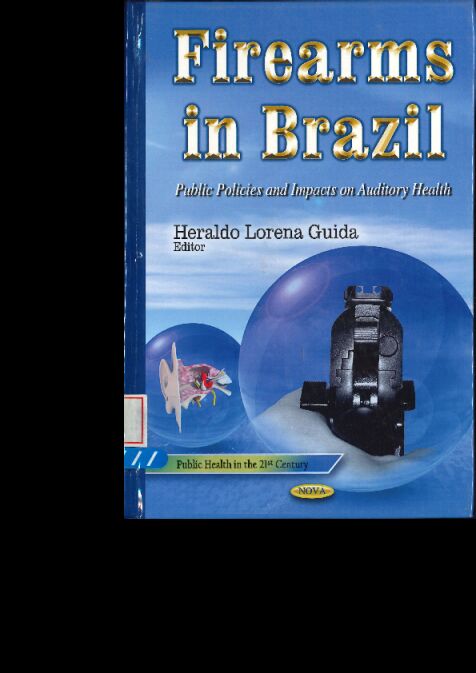
书名:Firearms in Brazil
责任者: Heraldo Lorena Guida.
出版时间:2014
出版社:Nova Biomedical/Nova Science Publishers,
前言
The book was developed based on the expertise of four research groups, three of them linked to the Universidade Estadual Paulista (UNESP): Studies on Hearing; Public Safety Observatory of UNESP; Research and Urban Management Organized Labor Group (GUTO); and Labor, Health and Society linked to the Tuiuti University.
The groups mentioned above fit mainly into two major areas, Speech and Social Sciences, with a focus on the following research lines: hearing health and public safety. For this reason, the present work is multidisciplinary and includes current information, of scientific relevance, focused on the theme "firearms".
This diversity has allowed the production of chapters that approach the audiological profile of militaries exposed to impact noise during their work activities, as well as the measurement of noise generated by firearms. Another situation that is worth mentioning is the recreational activity on private booth shots (as shooting clubs), where hearing protection is also required.
It is also worth noting that the book discusses violence with firearms in contemporary Brazilian society.
Chapter 1 - Brazil has one of the highest rates of violent firearm-related deaths in the world. The spread of firearms, despite more than a decade of public policies for their restraint and control, is still a serious problem that must be faced by the Brazilian government and its society. The weapons are in the hands of publicly-paid professionals without preparation and without control, in the hands of private security professionals, in non-official companies and feed a massive illegal market, in the main capital cities around the country. Guns primarily affect young people on the outskirts of urban areas, and are linked to the illegal drug market. One of the challenges for Brazil, at the national level, is to provide systematic data on firearms to better inform public policy.
Chapter 2 - The chapter aims to reflect on the importance of disarmament and criminal dynamics, through the potential and probable deaths prevented from the seizure of firearms by police. Therefore, the authors carried out a regression analysis involving the guns apprehended by military police in the Metropolitan Region of Sao Paulo, from January 2009 to August 2012, and the total number of homicides (attempted and accomplished) for that period. The results confirm that disarmament lowered homicides by 23%. It is estimated that 23 lives were saved for each group of one hundred firearms apprehended.
Chapter 3 - Firearms are a source of impulse noise that may potentially damage a hearing organ. The consequences of this kind of exposure depends on individual susceptibility, number of shots or explosion impulses, distance of injured ear from causal firearm as well as on hearing protectors usage. Research among military has shown different rates of hearing loss prevalence. This chapter presents a report of studies in the literature regarding the effects of impact noise produced by firearms in the hearing of military police and describes the audiological profile of this population in a group of Brazilians subjects. Audiological and electroacoustic measurements showed that the impact of noise injury initially affects the high frequencies, and it presents similar characteristics to continuous noise induced hearing loss. This evidence reinforces the need to implement programs for prevention and hearing conservation in military corporations.
Chapter 4 - Hearing loss is the main result of exposure to firearms noise. Several studies have been made on the hearing health of military personnel. It is important that some of these studies be brought together so that they can serve as a basis for action in improving the health of these professionals. Most studies conducted with military personnel regarding hearing health covers research on the levels of noise to which these workers are exposed and research on the auditory profile of a certain population of the military, obtained through audiological evaluation (pure tone audiometry and otoacoustic emissions). Over a period of 10 years, some Brazilian papers have been published on this issue. In this chapter, the authors will present studies to characterize the main auditory effects associated with exposure to noise from the firing of weapons.
Chapter 5 - Several studies have been conducted in order to check the noise level of firearms. In this chapter the authors prioritize some studies conducted in Brazil that characterized shooting practice at a military shooting stand. This chapter shows the importance of identifying sound pressure levels emitted by firearms for the development of future hearing loss prevention programs for the population exposed to impact noise.
Chapter 6 - This chapter presents a study of members of the Military Special Operations Battalion. This study, aiming for the deployment of a Hearing Preservation Program, analyzed the effects of impact noise on the hearing of military personnel who regularly conduct shooting practice. It was a case-control study with 115 military personnel, with 65 being exposed to noise from firearms and 50 not being exposed. Assessment of noise emitted by firearms was performed during shooting practice was carried out, and research on the knowledge about hearing health was measured. Pure tone audiometry and (transient and distortion product) otoacoustic emissions testing was also conducted. The results show that the level of noise emitted by firearms exceeds the limits established by regulatory standards. Also it was shown that despite the military personnel's having knowledge as to the importance of using hearing protection when exposed to weapons noise, many never received guidance on its proper use. And there are still significant differences in the hearing of those exposed to firearms noise when compared to those who are unexposed. For this population, it is necessary to implement a Hearing Preservation Program with the goal of not only to avoid hearing loss, but also to educate these military personnel on the importance of proper use of hearing protection and other hearing care issues.
Chapter 7 - This chapter will address the issue related to the use of firearms in recreational activities, with a brief historical introduction to the practice of sport shooting. The person who practices sport shooting, due to noise exposure to firearms, as well as contact with the lead projectile, may have health consequences, especially in hearing health with irreversible hearing loss if the due care and protection are not carried out. Because the practice of sport shooting has no legislation on noise limits and the use of hearing protection is not always required, it is left for the practitioner to be aware of the care that he should take during shooting. Measurements performed at recreational firing ranges showed differences among weapons and ammunition. In this chapter, the difference in noise when using factory ammunition and reloaded ammunition will be shown.
Chapter 8 - Nowadays it is necessary for military personnel to have good hearing, mental and general health in order to enter military service. To this end, not only are hearing evaluations such as audiometric tests required, but also qualitative assessments on quality of life, which verifies the subject's emotional health and stress levels. This chapter will present theoretical concepts about the quality of life at work focusing on stress caused by military activity. The studies conclude the need to give more attention to the quality of life in military work, because it is not only exposure to noise that causes hearing loss and social stress, but also the nature of the profession itself that is stressful and often degrades the performance of military police.
Chapter 9 - Hearing protection devices have the function of protecting the hearing against potential risks in environments that may threaten safety and health as a result of exposure to loud noise. This measure is used when it is unfeasible to adopt collective protection or until it is effectively implemented. The hearing protector is still the main instrument of hearing loss prevention in all fields of work where there is noise. This is no different in the military population. The authors present in this chapter a survey covering different aspects of one type of hearing protection (attenuation and comfort) provided for some aspiring officers of the Military Police.
查看更多
目录
Preface vii
Unit 1: Public Policies 1
Chapter 1 Violence, Firearms and Society in Contemporary Brazil 3
Chapter 2 Fewer Guns, More Lives: The impact of Weapons Seizures on Homicides in Sao Paulo, Brazil 29
Unit 2: Auditory Health 47
Chapter 3 Auditory Profile of Military Police 49
Chapter 4 Auditory Effects to Firearms Noise Exposure: State of the Art 67
Chapter 5 Assessment of Sound Pressure Levels in Military Shooting Stands 79
Chapter 6 Effects of Impulse Noise on Hearing in Members of the Police Special Operations Battalion 87
Chapter 7 Auditory Risk in Recreational/ Sporting Activities with Firearms 109
Chapter 8 Hearing Health and Stress for Military Police 117
Chapter 9 Effectiveness of Hearing Protection Devices (HPD) in Activities with Firearms 125
About the Contributors 139
Index 145
查看更多
馆藏单位
中国医科院医学信息研究所