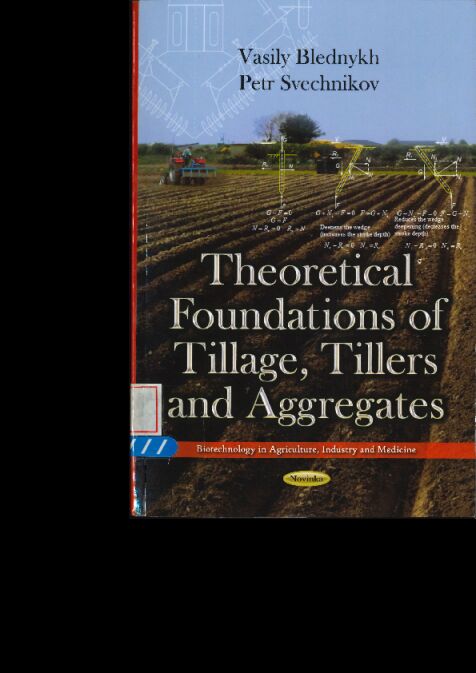
书名:Theoretical foundations of tillage, tillers and aggregates
责任者:Vasily Vasilyevich Blednykh and Petr Grigoryevich Svechnikov. | Svechnikov, Petr Grigoryevich
出版时间:2014
出版社:Nova Science Publishers,
摘要
"Soil is special natural formation having a number of properties inherent to animate and inanimate nature; consists of genetically related horizons (form a soil profile), arises from the transformation of the surface layers of the lithosphere under the combined action of water, air and organisms, is characterized by fertility".
Mechanical tillage plays a very important role in shaping the harvest on all soil types under normal weather conditions. Long-term studies found that the proportion of tillage in the wheat harvest in Russia is an average of 13 ... 14%. For the conditions of the Urals and Siberia, this share is approaching 20%. Good, high-yielding soil can be created by tillage. Only then we can speak about high yields and efficiency of plant growing. To fully meet the demands of Russia inhabitants in food one must produce 10 centners of grain per person on average per year (17 centners per hectare of arable land, or about 24 centners per each sown hectare).
The greatest achievement of mankind is the possession of efficient technologies of production (materials, machinery, equipment, buildings and roads). Any product can be produced in several ways. It is important to use a method when a product produced from existing resources, possesses all the desired properties and is cheap and reliable. Resources available to humanity are constantly improving. A manufactured product itself becomes a resource for other technologies, so at all times the task of improving the production technologies has been important. The preparation of soil with specified properties (characteristics) depending on arable crops has always been a significant problem. The task of preparing soil can be solved by many types (sorts) of working bodies, tools and traction machines, and in the future by a direct effect on the soil of various types of radiation: thermal, acoustic,microwave, etc. Which technology should be chosen, which method of tillage soil will be used? The answer is always clear: the technologies, tools or machines that provide maximum efficiency will be applied.
In this book you will not find information about existing tillage systems, specific recommendations on how to cultivate soil, what instruments to use. This book is about a wide choice for all people who are seriously engaged in the problems of tillage. The most effective way to improve the use of soil, to apply the most effective technologies nowadays, to develop new tools and aggregates is economic and mathematical modeling. It is preceded by a serious stage of research, analysis of the system (production, technological process), the wording of a working hypothesis. Below we will consider some examples of this approach to solving important problems of soil cultivation and tillage aggregates.
查看更多
目录
About the Authors vii
Introduction ix
Part 1.Tillage 1
Part 2.Tillers 15
Part 3.Approximate Design Scheme of Tillers 115
Part 4.Tillage Aggregates 131
References 163
Appendix Tillers Used in Russia in the Late 19th Century and Early 20th Century 165
Index 171
查看PDF
查看更多
馆藏单位
中国医科院医学信息研究所