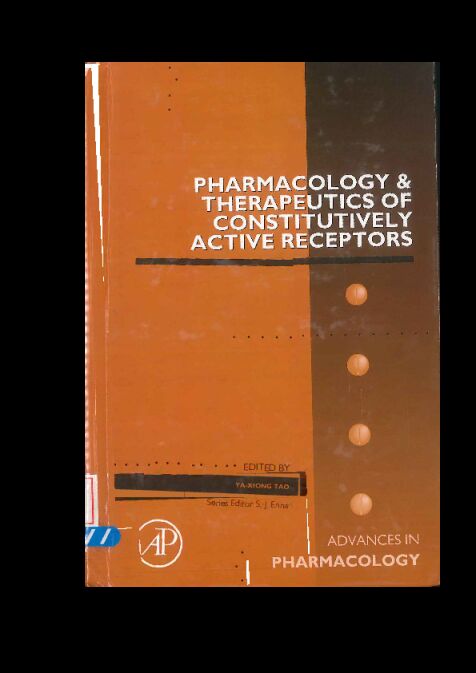
书名:Pharmacology & therapeutics of constitutively active receptors
出版时间:2014
出版社:Academic Press
前言
Constitutive activity, which is signaling in the absence of agonists, was first described in early 1980s in the type A γ-aminobutyric receptor, an ion channel. The recording of a single ion channel showed that it can, indeed, open in the absence of an agonist. Ligands that decrease the elevated basal activity were then described for these receptors. Very quickly, studies from Nobel Laureate Robert Lefkowitz's laboratory showed that G protein-coupled receptors (GPCRs) could couple to G proteins in the absence of ligands, at least in reconstituted systems. Finally in 1989, Costa and Herz demonstrated in neuroblastoma cells expressing δ-opioid receptors endogenously, there is significant basal activity which can be decreased by some antagonists, the so-called "negative antagonists," now commonly referred to as "inverse agonists."
Following these pioneering studies, together with the cloning of numerous GPCRs and their heterologous expression in cell lines, several important discoveries were made. Mutations generated by site-directed mutagenesis can cause significant increase in basal activity, presumably by breaking interactions that constrain the wild-type receptor in inactive conformation. Numerous studies utilized this strategy to gain insights into the structure of GPCRs before the crystal structures of GPCRs were reported. Other studies used these data, together with homology modeling, after some of the crystal structures of GPCRs began to appear in the literature. Some wild-type receptors have significant basal activity, which can be dramatically different even between closely related receptors. Naturally occurring mutations in several GPCRs that either increase or decrease basal activity can cause significant human diseases, including cancer. Highly constitutively active GPCRs in viruses also cause human diseases. Transgenic animals expressing constitutively active mutant receptors present phenotypes that suggest constitutive activity has physiological relevance in vivo. Receptor theory was modified to account for the constitutive activity. A look back at the drugs that target GPCRs indeed reveal that the majority of the antagonists are inverse agonists, not neutral antagonists. These are just some of the major advances and the field is still rapidly expanding.
In this volume, we tried to capture a glimpse of recent progress in several selected GPCRs. The offerings include not only rhodopsin, one of the most extensively studied and the first example of genetic mutations causing human disease, but also the glycoprotein hormone receptors, the cannabi-noid receptor, the melanocortin-4 receptor, the angiotensin type 1 receptor, the dopamine receptors, the chemokine receptors, and a chemosensory receptor, the bitter taste receptor. We also recruited a chapter on the constitutive activity of a nuclear receptor, the androgen receptor, and two chapters on ion channels.
I thank Dr. S.J. Enna, the Series Editor, for his support for this volume, and Ms. Lynn LeCount, the Managing Editor, for everything she did to make sure this volume moves along as scheduled. I am very grateful to all the contributors, who are all busy scientists with numerous commitments, for taking the time to write their excellent contributions. I anticipate this volume will stimulate further research in this fascinating field of constitutive activity. Ya-Xiong Tao Department of Anatomy, Physiology and Pharmacology, CoHege of Veterinary Medicine, Auburn University, Auburn, Alabama, USA Volume 70 Editor
查看更多
目录
Preface ix
Contributors xi
1. Constitutively Active Rhodopsin and Retinal Disease 1
1. Introduction 2
2. Rhodopsin Activity 5
3. Constitutive Activity in Rhodopsin that Causes Disease 12
4. How Constitutive Activity Can Cause Different Phenotypes 22
5. Conclusion 26
Conflict of Interest 27
Acknowledgments 27
References 27
2. Constitutive Activity in Gonadotropin Receptors 37
1. Introduction 38
2. Naturally Occurring CAMs of the Gonadotropin Receptors 41
3. Experimental Models of Gonadotropin Receptor CAMs 50
4. Molecular Basis of Constitutive Activity in Gonadotropin Receptors 59
5. Design of New Molecules for Controlling the Activity of Constitutively Active Gonadotropin Receptors 65
6. Conclusion 68
Conflict of Interest 68
Acknowledgments 68
References 69
3. Constitutive Activities in the Thyrotropin Receptor: Regulation and Significance 81
1. Introduction 82
2. Constitutive Activity in the Thyrotropin Receptor 86
3. Conclusion 104
Conflict of Interest 105
Acknowledgments 105
References 105
4. Constitutive Activity in Cannabinoid Receptors 121
1. Introduction 122
2. Challenges in Proving Constitutive Receptor Activity 123
3. Supporting Evidence for Constitutive Activity in Cannabinoid Receptors 129
4. Conclusion 130
Conflict of Interest 132
References 132
5. Constitutive Activity in Melanocortin-4 Receptor: Biased Signaling of Inverse Agonists 135
1. Introduction 136
2. Constitutive Activity of MC4R in the Gs-cAMP Pathway 138
3. Constitutive Activity of MC4R in the ERK1/2 Pathway 141
4. In Vivo Relevance of the Constitutive Activity of the MC4R 144
5. Therapeutic Relevance of Inverse Agonism 146
6. Conclusion 147
Conflict of Interest 148
Acknowledgments 148
References 148
6. Constitutive Activity in the Angiotensin II Type 1 Receptor: Discovery and Applications 155
1. Introduction 156
2. Discovering Constitutive Activity of AT1 Receptor 157
3. Mechanism of Constitutive Activation in AT1 Receptor 160
4. Inverse Agonists and Partial Agonists of AT1 Receptor 162
5. Constitutive Activity of AT1 Receptor In Vivo 163
6. Constitutive Activation of AT1 Receptor and Pathophysiology 164
7. CAM AT1 Receptors as Research Tools 165
8. Conclusion 170
Conflict of Interest 171
Acknowledgments 171
References 171
7. Constitutive Activities and Inverse Agonism in Dopamine Receptors 175
1. Introduction 177
2. Molecular Basis for the Constitutive Activities of D_1-CIass Receptors 177
3. Molecular Basis for the Constitutive Activities of D_2-Class Receptors 188
4. Regulation of Constitutive Activities oF D_1-Class Receptors 194
5. Physiological and Pathological Relevance of Constitutive Activity for Dopamine Receptors 198
6. Conclusion 202
Conflict of Interest 203
Acknowledgments 203
References 203
8. Receptor Conformation and Constitutive Activity in CCR5 Chemokine Receptor Function and HIV Infection 215
1. Introduction 217
2. CCR5 Signaling Pathways and Evidence for Constitutive Activity of the Wild-Type CCR5 Chemokine Receptor 220
3. Role of CCR5 Chemokine Coreceptor Conformation in HIV Entry 237
4. Therapeutic Potential for CCR5 Chemokine Receptor Antagonists and Inverse Agonists 245
5. Conclusion 248
Conflict of Interest 248
References 248
9. Constitutively Active Chemokine CXC Receptors 265
1. Introduction 266
2. Chemokine CXC Receptors 271
3. Conclusion 292
Conflict of Interest 292
References 292
10. Constitutive Activity of Bitter Taste Receptors (T2Rs) 303
1. Introduction 304
2. Activation Mechanism of T2Rs 307
3. Constitutive Activity in GPCRs 311
4. Role of CAMs in Discovery of Bitter Taste Blockers 318
5. Conclusion 319
Conflict of Interest 320
Acknowledgments 320
References 320
11. Constitutive Activity of the Androgen Receptor 327
1. Introduction 328
2. Basic AR Functions 329
3. Modes of Constitutive and Hypersensitive Activity of Full-Length AR 335
4. Discovery of Constitutively Active AR Splice Variants 342
5. Mode of Action of Constitutive Active AR and AR-V in Gene Regulation 347
6. Targeting Constitutive Activity of AR in PCa 350
7. Conclusion 355
Conflict of Interest 357
Acknowledgments 357
References 357
12. Sodium Channels, Cardiac Arrhythmia, and Therapeutic Strategy 367
1. Introduction 368
2. Structure and Physiological Function of Cardiac Na~+ Channels 370
3. Cardiac Diseases Associated With Abnormal Na~+ Channels 374
4. Conclusion 386
Conflict of Interest 387
References 387
13. Constitutive Activity of the Acetylcholine-Activated Potassium Current /_k.ach in Cardiomyocytes 393
1. Introduction 394
2. Molecular Mechanisms of Constitutively Active /_k.ach 396
3. Constitutively Active /_k.ach as Potential Therapeutic Target 403
4. Conclusion 404
Conflict of Interest 405
Acknowledgments 405
References 405
Index 411
查看PDF
查看更多
馆藏单位
中国医科院医学信息研究所 中科院文献情报中心