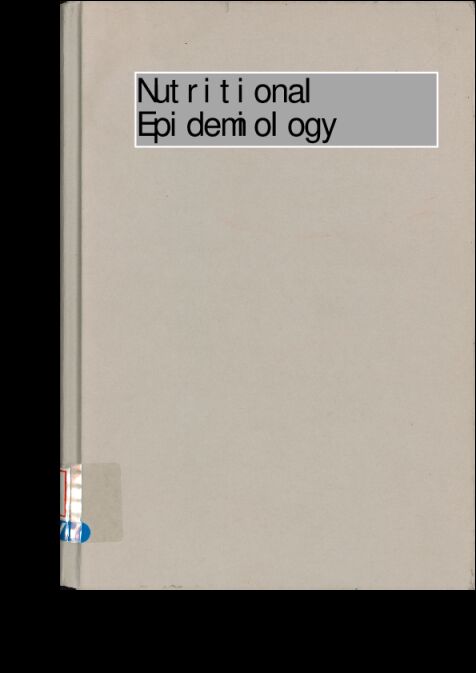
书名:Nutritional epidemiology
出版时间:2013
出版社:Oxford University Press
前言
This book is written for individuals seeking to understand the relation between diet and long-term health and disease. A basic premise is that our understanding of biologic mechanisms remains far too incomplete to predict confidently the ultimate consequences of eating a particular food or nutrient. Thus, epidemio-logic studies directly relating intake of dietary components to risk of death or disease among humans can play a critical role in making individual and policy decisions complementary to information from laboratory research.
A great expansion of the literature in nutritional epidemiology and the development of a firmer quantitative basis for this science occurred in the 1980s. Most important, the substantial variation in diet among individuals was quantified in many populations; standardized dietary questionnaires were developed for use in large epidemiologic studies, and the ability of these questionnaires to measure diet was documented. Although many questions about diet and disease remained unresolved, the foundations for obtaining this information were firmly put in place. The first edition of Nutritional Epidemiology, published in 1990, represented an attempt to consolidate this new body of methodologic information.
In the 1990s, the literature of nutritional epidemiology grew enormously. This research extended the scope of investigation to new aspects of diet and different populations across the globe, and methodologic topics were developed in greater detail. Also, large cohort studies started in the 1980s began to provide data on diet and disease relationships, raising important issues about the analysis, presentation, and interpretation of complex nutritional data. Thus, a second edition of Nutritional Epidemiology was published in 1998 that added chapters addressing these issues and incorporating new examples of their application.
Although the basic principles and approaches underlying nutritional epidemiology have remained intact since the second edition, the literature on methods and the results from their application have continued to grow rapidly. This new edition of Nutritional Epidemiology attempts to capture the new insights that we have gained on ways to better understand the relation between diet and disease over a lifetime. Considerable new information has been incorporated in all of the previous chapters, and three new chapters have been added on the assessment of physical activity, the integration of genetics into nutritional epidemiology, and the application of nutritional epidemiology to policy. Importantly, additional colleagues, Laura Sampson, and Drs. Tom Baranowski, Frank Hu, Rob van Dam, and Rebecca Sedjo have joined with Drs. Elizabeth Lenart, Meir Stampfer, Tim Byers, Graham Colditz, David Hunter, and me to produce this edition.
This book is designed specifically for researchers actively engaged in studies of diet and disease and for persons seriously attempting to read and interpret published epidemiologic information relating to nutrition. As a field develops, the methodologic cutting edge inevitably becomes more distant from the level of knowledge needed by someone entering the area. Thus, creating a book that provides an introduction to the field and also serves as a resource for investigators becomes increasingly challenging. This edition still attempts to meet both needs. For this reason, though, some parts of the later methodologic chapters could be skipped by the newcomer to nutritional epidemiology without sacrificing the essential concepts. The book is not intended for the casual reader seeking to learn what is currently known about the effects of diet and nutrition on human disease; such a work would rapidly be out of date. Also, this book does not address issues related to child growth and studies of nutritional deficiency in developing countries; both are important topics, but outside the scope of this text. However, I am confident that those involved in studies of these topics can benefit from the material presented, as many of the principles are relevant.
Although I have not attempted to define or explain basic epidemiologic terms, most of the chapters can be read by someone with elementary statistical knowledge and some epidemiologic background. Readers without exposure to epidemiology would profit by referring to an introductory text such as MacMahon and Trichopoulos' Principles of Epidemiology, Aschengrau and Seage's Essentials of Epidemiology in Public Health, Rothman's Epidemiology: An Introduction, or Rothman, Greenland, and Lash's Modern Epidemiology, the last being the most advanced. Similarly, epidemiologists without formal exposure to nutrition can benefit by reading Bowan and Russell's Present Knowledge in Nutrition Volumes I and II, Whitney and Rolfes' Understand Nutrition, or Gibney, Lanham-New, Cassidy, and Vorster's, Introduction to Human Nutrition. The weighty Modern Nutrition in Health and Disease (Shils) edited by Shils, Shike, Ross, and Caballero can serve as a detailed reference. I have tried to summarize the most important information on diet and health for a nonacademic reader in Eat, Drink, and Be Health: The Harvard Medical School Guide to Healthy Eating.
The first edition of Nutritional Epidemiology was almost exhaustive in covering the published literature in nutritional epidemiology. However, due to the great expansion of the literature after 1990, by the second edition it was no longer possible to discuss all relevant papers and still provide a readable text for those entering this field. This forced me to be selective about citations in some areas, but despite this, the book almost doubled in length. The need to be selective has increased even more for the third edition; I was determined not to expand by more than about 20% because going beyond this would make the book less useful for an introductory text. To add new information without greatly increasing the length, it was necessary to rewrite much of the earlier text, which made the creation of this edition a larger task than anticipated. I apologize to colleagues if in some cases their contributions seem to have been overlooked or removed in this edition.
To help avoid a major increase in length, some of the material on specific biochemical indicators of diet (Chapter 8) has been moved to a new website for this book (www.nutepi. org). Also, colleagues have suggested that the book include readings and sample discussion questions for students. Both of these suggestions will be addressed on the website, which can be more timely than a textbook. I hope that others will add to this material and that the website can become a platform for moving our field forward.
The content of the different chapters varies considerably in depth, and many readers will want to reserve some sections for future reference rather than read the whole book from cover to cover. Chapter 1 provides an overview of nutritional epidemiology for those unfamiliar with the field; experienced epidemiologists may want to skim this material. Chapter 2, written together with Laura Sampson, senior dietitian for over 30 years in the Nurses' Health Study, addresses the various perspectives from which diet can be viewed and discusses the calculation of nutrient intakes from data on food consumption.
Chapter 3 provides a conceptual background regarding sources of variation in diet for the novice to this field and also assembles data on dietary variation that may be of use to the serious investigator. Chapter 4, written by Tom Baranowski, reviews the strengths, limitations, and appropriate applications of short-term recalls and dietary records as methods for measuring intake. Dr. Baranowski also discusses the assessment of diet in children and the application of new technologies in nutritional epidemiology. Because of the central role of food frequency questionnaires in nutritional epidemiology, the design and evaluation of these questionnaires are examined in detail in Chapters 5 and 6. Recall of diet from the remote past is of potential importance for diseases with a long latency; the small but growing literature on this topic is reviewed in Chapter 7. The use of spouse surrogates for reporting of diet had been common in case-control studies, and in the last edition a chapter was devoted to this. However, with the greater availability of data from cohort studies, this topic is of less importance and has been folded into Chapter 5.
Chapter 8 addresses the use of biochemical indicators of diet in nutritional epidemiology; with his new responsibilities as Dean for Academic Affairs at our school, David Hunter has handed the large task of updating this chapter to Rob van Dam. This chapter is divided into two parts. The first deals with conceptual and general issues in the use of biochemical indicators for assessing intake of specific dietary factors. The second part provides detailed information on the biochemical measurement of specific nutrients; two examples are included in the book and additional detailed, specific information has been moved to the website for reference. Drs. van Dam and Dr. Hunter emphasize the importance of close collaboration between laboratory scientists and epidemiologists when embarking on studies that involve biochemical measurements. Chapter 9 addresses the use of measures of body size and composition, also with a special emphasis on epidemiologic applications. Dr. Frank Hu, who has recently published another textbook by Oxford University Press, Obesity Epidemiology, has joined me in updating this chapter. Dr. Hu has also contributed Chapter 10, new to this edition, on the assessment of physical activity in epidemiologic studies.
Chapters 11, 12, and 13 probe issues in the analysis, interpretation, and presentation of epidemiologic data. Issues relating to total energy intake are considered in detail in Chapter 11 and incorporate new insights from the use of doubly labeled water. The effect of measurement error in epidemiologic studies and statistical methods to compensate for measurement error are addressed in Chapter 12. This is an active area of development in epidemiology and statistics in general, but much of the stimulus has arisen from studies of diet. Although it is of general epidemiologic interest, I have included a chapter on this topic because of the important implications for nutritional studies. Some of the later sections of Chapters 11 and 12 go beyond the needs of an entrant to this field and could be skipped in a first read. Chapter 13 has been expanded substantially to deal with dietary pattern analysis and temporal relationships in prospective studies, which have become increasingly important with the availability of repeated measures of diet during longer periods of follow-up.
Chapter 14 is a new chapter on the integration of contemporary genetics into nutritional epidemiology. Dr. Hu has joined me in writing this addition on a fast-moving topic that will be important to almost everyone involved in nutritional epidemiology.
Chapters 15 to 20 address substantive applications of nutritional epidemiology, and are included to reinforce the principles covered in the earlier chapters. Drs. Rebecca Sedjo and Tim Byers have expanded the earlier chapter on nutritional surveillance, drawing on their experience in this field. The other chapters on vitamin A and lung cancer, dietary fat and breast cancer, diet and heart disease, and folic acid and neural tube defects address topics that have been of great interest in nutritional epidemiology, that have taught us much, and that continue to unfold.
Many chapters on the relation of diet and disease remain to be written. The brief final section of this book attempts to anticipate the direction of future research and to encourage work in areas that seem most promising. W.W. Boston, Mass. November 2012
查看更多
目录
1. Overview of Nutritional Epidemiology 1
2. Foods and Nutrients 17
3. Nature of Variation in Diet 34
4. 24-Hour Recall and Diet Record Methods 49
5. Food Frequency Methods 70
6. Reproducibility and Validity of Food-Frequency Questionnaires 96
7. Recall of Remote Diet 142
8. Biochemical Indicators of Dietary Intake 150
9. Anthropometric Measures and Body Composition 213
10. Assessment of Physical Activity in Nutritional Epidemiology 241
11. Implications of Total Energy Intake for Epidemiologic Analyses 260
12. Correction for the Effects of Measurement Error 287
13. Issues in Analysis and Presentation of Dietary Data 305
14. Genetics in Dietary Analyses 334
15. Nutrition Monitoring and Surveillance 344
16. Policy Applications 357
17. Vitamin A and Lung Cancer 380
18. Dietary Fat and Breast Cancer 397
19. Diet and Coronary Heart Disease 426
20. Folic Acid and Neural Tube Defects 468
21. Future Research Directions 487
Index 503
查看PDF
查看更多
馆藏单位
中国医科院医学信息研究所