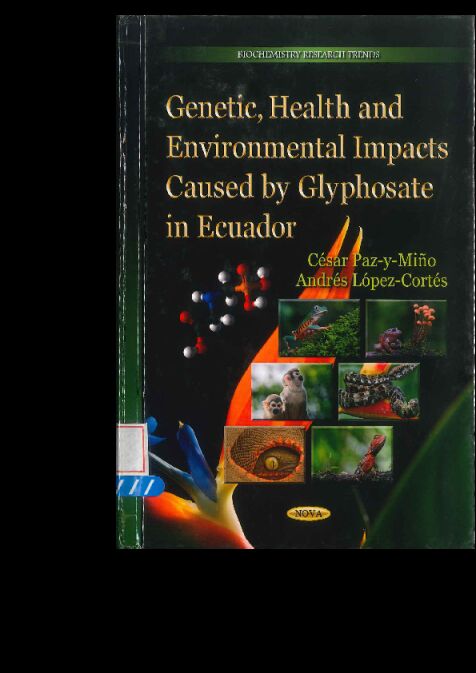
书名:Genetic, health and environmental impacts caused by glyphosate in ecuador
责任者:César Paz-y-mi?o and Andrés López-cortés. | López-cortés, Andrés
出版时间:2014
出版社:Nova Science Publishers
前言
Glyphosate is one of the most widely used chemical products worldwide and its manufacturer considers it the safest herbicide for human health around the world under the stated technical conditions: a direct fumigation on weed, concentration use of between 1 to 3%, and low dose and low exposure time on the part of the person who is handling the herbicide.A\In Ecuador the aerial spraying that the Government of Colombia carried out from 2000 to 2007, in connection with the Colombian plan to combat coca, opium poppy, and marijuana crops, affected the communities located along the Colombian-Ecuadorian international border. This caused both countries to take up divergent diplomatic, scientific-technical, ethical, and governmental positions which ended up with a State problem.A\Both countries, by means of their governments, appointed scientific commissions which did not reach an agreement during bilateral discussions. For Ecuador, the problem lies in the fact that the use of glyphosate is anti-technical: the aerial spraying was carried out from a great height in a repetitive manner which used a combination of herbicides that, besides containing glyphosate as an active agent, contained Cosmo-Flux as coadjuvant, and polyoxyethylene amine (POEA) as surfactant. Therefore, the chronic exposure to the environment (water, plants, and land), animals, and people resulted in important changes and problems due to the indirect effects that affected the Ecuadorian side of the border. The effects were observed and determined, according to the testimony of the people from the affected areas who commented on the deaths of their animals, plants, and water, as well as the denunciations made at the Ombudsman's Office. The effects were verified by several national and international commissions, including the United Nations. At the same time, Ecuadorian doctors reported on changes in the health patterns of the people exposed to the aerial spraying with the herbicide compound. Gastrointestinal, skin, respiratory, eye, and psychological problems and disorders increased, according to the Ecuadorian Scientific Commission (Comision Cientifica Ecuatoriana), appointed by the President of Ecuador, Rafael Correa, and his minister of Foreign Affairs at that time, Maria Fernanda Espinosa.A\The research conducted by the Ecuadorian Scientific Commission was captured in the book "The Plan Colombia's Aerial Spraying System and its Impact on the Ecosystem and Health in the Ecuadorian Border" (2007) which includes the different evidence and damage that Ecuador claims to have experienced. As result of the documentation collected by Ecuador, the country decided to file an international lawsuit before The Hague after alleging that the fumigation caused serious damage to the Ecuadorian health and environment.A\There is currently plenty of scientific information that questions the innocuousness of glyphosate by itself and combined with other products, especially an herbicide compound with a high concentration, and an application method for which there is no comparison on the planet whatsoever. The analyses of the damage caused by glyphosate to the genetic material prove the DNA degradation, by means of the comet assay test and chromosome breakage, turning it into a genotoxic agent. Genotoxics are involved in at least three important biological phenomena: cancer development, miscarrying, and infertility in the exposed individuals.A\The aerial spraying with the herbicide compound containing glyphosate stopped in January 2007 and the experience the Ecuadorian people gained from this weird and new factor that altered the biology along the border has enriched academic knowledge, as well as the wisdom in the communities located in the affected areas.A\Glyphosate has a short lifespan; its manufacturer talks about three months, but the analyses on the environmental destination of this herbicide are able to detect it up to two years later, especially in soils rich in iron. Whatever the case may be, it is obvious that the aerial spraying caused problems along the border, which have been studied by several organizations over time. After becoming aware of this situation, the Biomedical Research Institute at the Universidad de las Americas outlined a project that was approved by the National Science and Technology Secretariat (Secretaria Nacional de Cienciay Tecnologia-SENACYT), currently known as the National Higher Education, Science, Technology, and Innovation Secretariat (Secretania Nacional de Educaci6n Superior, Ciencia, Tecnologia e Innovacion-SENESCYT), in order to evaluate the impact of the aerial spraying with glyphosate on the Northern border, and to analyze for two years an array of genetic, physical, and psychological factors that define the results that this book gathers.A\By means of this new book, which includes many actors and researchers, we intend to provide scientific information related to the pollution, precaution, protection, and remediation mechanisms, as well as the potential effects caused by the indirect and direct aerial spraying on the Ecuadorian communities settled along the border with Colombia. For a better understanding of the impact caused by the herbicide cocktail, the SENACYT created the Ecotoxicology Network made up of the Universidad de las Americas, the Ecuadorian Natural Sciences Museum, and the Escuela Politecnica Nacional, which focuses on exchanging information that these four institutions will obtain regarding the same topic: aerial spraying with the herbicide cocktail and its effects on the Ecuadorian territory.A\The results of the project, together with a video, were previously presented at the 13 th Pacific Basin Consortium Meeting, called "Environmental Exposures in the Era of Climate Change", which took place in November 2009 at the Telethon Institute for Child Health Research in Perth, Australia, titled "Social, Health and Genetic Diagnoses of the Zone of Influence Affected by Glyphosate Aerial Spraying in the North Ecuadorian Border"; the formal scientific work is available on the magazine Reviews on Environmental Health, Vol. 26, No. 1, January 2011, titled "Baseline Determination in Social, Health, and Genetic Areas in Communities Affected by Glyphosate Aerial Spraying in the Northeastern Ecuadorian Border".A\Once the project under my supervision is finished and the results that we present today are extended and analyzed in this book, it may be considered a "baseline" study of the genetic, cytogenetic, social, health, and environmental conditions from the communities in the province of Sucumbios bordering Colombia.A\This book provides information on the effects of this genotoxic on the DNA structure and chromosomes; the mechanism of action of glyphosate and its increasing action by means of surfactants, coadjuvants, and other pollutants; the international toxicological studies of pesticides in humans and other organisms; the Ecuadorian Amazon biodiversity threatened by the aerial spraying, as well as the effects on crops, animals, and water; the origin and life conditions of the communities; the study of chromosome alterations and DNA genetic polymorphisms related to large or little susceptibility to glyphosate; the valuation of the nutritional status; the mother-child health and the impact of the aerial spraying on the psychological condition; the environmental diagnosis by means of the analysis of glyphosate and AMPA in soil samples; and the parasitological and microbiological analysis of water samples. To finalize, this book is also a good source of bibliographic information on antimutagenic agents and physical-chemical, enzymatic, and oxidation mechanisms used in other countries in order to mitigate and remediate the presence of glyphosate in the environment; this can be helpful in Ecuador if the indiscriminate use of this pesticide continues.A\The importance of conducting a strictly scientific research of wide range in order to determine a baseline for the genetic, health, and environmental areas, as well as the importance of continuing with short and long-term prospective studies will allow both public and private institutions to evaluate in a more realistic manner the situation of the Ecuadorian communities, and to carry out social, psychological, nutritional, and environmental projects, with the aim of improving the social-economic, nutritional, health, psychological, and environmental levels of the Ecuadorian communities bordering Colombia. Cesar Paz-y-Mino, Quito, Ecuador. 2015
查看更多
目录
About the Authors ix
Acknowledgments xi
Preface xiii
Chapter 1 Herbicide Package-Mix 1
Chapter 2 Toxicology 19
Chapter 3 Aerial Spraying 33
Chapter 4 Biomonitoring in the Province of Sucumbios 49
Chapter 5 Genetic Diagnosis 63
Chapter 6 Health Diagnosis 85
Chapter 7 Psychological Diagnosis 113
Chapter 8 Environmental Diagnosis 123
Chapter 9 Mitigation and Remediation Mechanisms 147
Chapter 10 Conclusion and Recommendations 157
Glossary 171
Index 179
查看PDF
查看更多
馆藏单位
中国医科院医学信息研究所