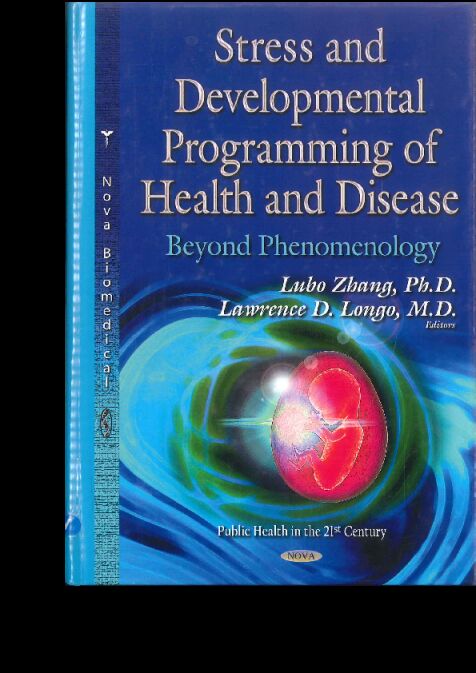
书名:Stress and developmental programming of health and disease
责任者:Lubo Zhang and Lawrence D. Longo. | Longo, Lawrence D.
出版时间:2014
出版社:Nova Science
前言
Stress is a constant experience and threat throughout life. In his monumental volume The physiology and pathology of exposure to Stress, the McGill University endocrinologist, Hans Selye (1907-1982), observed that stress to the organism, in essentially any of its forms - dietary, environmental, disease, and others - could result in cellular, hormonal, and related damage, with the body mounting a response he termed the "General-Adaptation-Syndrome" (Selye, 1950). Writing years before many of the nuances of biochemical and molecular mechanisms were established, and before the phenomenon of epigenesis was appreciated, Selye envisioned an orchestrated brain to tissue system-wide biological defensive response to the challenge of stress of whatever origin. Subsequent investigation has clarified that while stress of relatively short duration is often followed by successful adaptation, that of longer duration and/or repeated insult many result in cell damage and death (Bale et al., 2010; McEwen, 2004).A\In the present volume, we have attempted to bring together some of the latest thinking on the role of antenatal environmental stress to the pregnant mother and the developmental origins of health and diseases in the adult. Since the earliest days that David J. Barker (1937- 2013), those before him, and others first articulated this Thesis/Hypothesis, epidemiologists have explored its many facets. As is well known, these include but not limited to cardiovascular diseases (hypertension, ischemic heart disease, cerebrovascular accident), metabolic syndrome/type 2 diabetes, schizophrenia and other neuropsychiatric diseases, and some cancers. It is a dizzying array of a multitude of serious disorders, the fundamental pathophysiology of which little is known. Developing the epidemiologic associations for these conditions to stress in utero often has not been easy, and at times, has been labeled as descriptive.A\This depiction is unfortunate. For it is by establishing such relationships that one can postulate hypothesis as to the manner of origin and their fundamental mechanisms. Even so, as one journeys through the several hierarchical levels of organ, tissue, cell, subcellular, and molecular, too often we discover that we have only punted discovery of the fundamental mechanisms further down into the morass of complexity within the organism.A\In the present collection of essays, each author has attempted to bring the latest, deepest thinking to bear on the subject. This includes providing background for rationale of the study, some details but more general principles of the methodologic aspects of study, findings of consequence, and their interpretation. Each of these Chapters has the goal of understanding, at a deeper level, the meaning of the investigation.A\We trust that this offering may provide the reader with a more profound grasp of the issues involved, the complexity of the problem, and the diversity of challenges that lie ahead.
查看更多
目录
Preface vii
Acknowledgmetns ix
Chapter 1 Developmental Origins of Health and Disease - The Past and the Future 1
Chapter 2 Programming and the Barker Hypothesis 13
Chapter 3 Stress and Programming of Metabolic Disease 87
Chapter 4 The Stress of Chronic Hypoxia in Fetal Growth Restriction: Some Physiological Considerations 131
Chapter 5 Fetal Stress and Growth Restriction at High Altitude 169
Chapter 6 The Developing Brain: What is the Role of Antenatal Stress-Mediated Epigenetics? 239
Chapter 7 Maternal Cardiovascular Adaptation and Uterine Circulation: Physiology and Pathophysiology 341
Chapter 8 The Role of the Placenta in Fetal Programming 375
Chapter 9 Stress and Maternal Response: Preeclampsia and Its Impact on Offspring Health 387
Chapter 10 Stress and the HPA Axis Response: The Ovine Model of Developmental Programming 427
Chapter 11 Increased Central and Peripheral Glucocorticoid Synthesis Act As an Orchestrator of Developmental Programming 463
Chapter 12 Early Life Stress and Predisposition to Cardiovascular Disease 487
Chapter 13 Stress and Preterm Birth 509
Chapter 14 Sex Dimorphism in Developmental Programming of Health and Disease 541
Chapter 15 Epigenetic Mechanisms in Developmental Programming of Health and Disease 559
Chapter 16 Stress, the Immune System and Cancer 601
Chapter 17 Developmental Programming of Telomere Biology: Role of Stress and Stress Biology 633
Chapter 18 Cranial Compression Ischemic Encephalopathy:Fetal Neurological Injury Related to the Mechanical Forces of Labor and Delivery 651
Index 689
查看PDF
查看更多
馆藏单位
中国医科院医学信息研究所