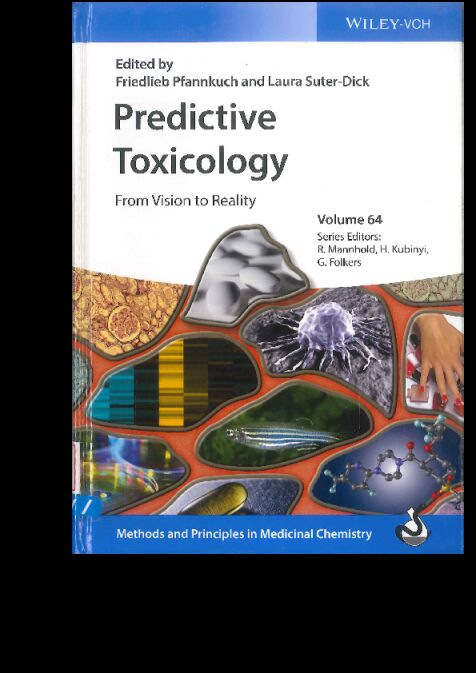
书名:Predictive toxicology
责任者:Friedlieb Pfannkuch and Laura Suter-Dick. | Suter-Dick, Laura
前言
With great pleasure we announce volume 64 of our book series "Methods and Principles in Medicinal Chemistry." The volume editors Friedlieb Pfannkuch and Laura Suter-Dick present an excellent book dedicated to predictive toxicology, a highly important research area with prime impact on the quality of compounds from drug discovery and development projects. Therapeutic use of any new compound is in demand of a thorough identification and profiling of its safety. Protection of human safety is a primary objective of toxicology research and risk assessment.
Toxicology is the study of the adverse effects of drugs and other chemicals on living systems and the means to prevent or at least minimize such effects. Toxicology is a multifaceted field, overlapping with biochemistry, histology, pharmacology, pathology, and several others. Subdisciplines of toxicology include clinical, regulatory, forensic, and occupational toxicology as well as risk assessment
Poor pharmacokinetics, side effects, and compound toxicity are frequent causes of late-stage failures in drug development. A safe in silico identification of adverse effects triggered by drugs and chemicals would be highly desirable as it not only bears economic potential but also spawns a variety of ecological benefits.
The drug development industry has undertaken significant efforts to identify toxic events at the earliest opportunity during the development process, moving from a predominantly observational science at the level of disease-specific models to a more predictive model focused on target-specific mechanism-based bio-. logical observations. The growth in such Early Safety Assessment initiatives has driven the need for more reliable, cost-effective high-throughput in vitro toxicity assays capable of predicting toxic liabilities prior to investment in more costly preclinical and clinical trials.
In silico toxicology studies can help to focus in vitro and in vivo experiments to make the latter highly efficient. In some cases, in silico studies might even replace particularly expensive, lengthy, uninformative, or offensive in vitro or in vivo, experiments. Moreover, by virtue of being computer-based and, hence, inexpensively replicable, in silico toxicology can vastly expand the applicability and availability of toxicological analysis [1-6].
The ultimate goal for predictive toxicology would be the ability to go from visualizing the chemical compound structure to predicting its safety profile. The major challenge is to translate the tremendous scientific progress in this field into practical use or general acceptance. Scientists are using biological data very effectively -whether it is gene expression data or even data from proteomic or other profiling techniques - to gain a sense of whether a drug is having off-target effects or otherwise adversely impacting the system. As technologies become more mechanism-based and as more data accrue, it should enable predictions with better accuracy and decrease occurrences of false negatives and false positives.
Chapters of this comprehensive volume consider all topic areas relevant in the field of predictive toxicology, such as in silico approaches, data management, and bioinformatics (Chapters 2-4), omics technologies and biomarker development (Chapters 5-10), advanced in vitro systems (Chapter 11), models for cosmetic products (Chapter 12), use of stem cells with focus on neurotoxicology and teratology (Chapters 13 and 14), immunogenicity of protein therapeutics (Chapter 15), and finally aspects on acceptance by Drug Regulatory Authorities (Chapter 16).
The series editors are grateful to Friedlieb Pfannkuch and Laura Suter-Dick for organizing this volume and collaborating with excellent authors. Last but not least, we thank Frank Weinreich and Heike Nothe from Wiley-VCH for their valuable contributions to this project and to the entire book series. Diisseldorf Raimund Mannhold; Weisenheim am Sand Hugo Kubinyi; Zurich Gerd Folkers October 2014
查看更多
目录
List of Contributors XV
Preface XXI
A Personal Foreword XXIII
1 Introduction to Predictive Toxicology Tools and Methods 1
1.1 Computational Tools and Bioinformatics 1
1.1.1 In Silico Prediction Tools 1
1.1.2 Bioinformatics 2
1.2 Omics Technologies 2
1.2.1 Toxicogenomics (Transcriptomics) 2
1.2.2 Proteomics 3
1.2.3 Metabolomics 3
1.3 Data Interpretation and Knowledge Management 4
1.4 Biomarker Development 4
1.5 Advanced In Vitro Systems and Stem Cell Research 4
1.5.1 Advanced In Vitro Testing 4
1.5.2 Stem Cell Research 5
1.6 Immunogenicity 6
1.7 Integration and Validation 7
1.7.1 Use of Omics for Toxicology Testing 7
1.7.2 Integration of "New" Technologies into Risk Assessment 7
1.7.3 Use of Human-Derived Cellular Systems 8
1.7.4 "General" Acceptance - Translation into Guidelines 8
1.8 Research Initiative/Collaborations 9
1.9 Concluding Remarks 9
References 9
2 In Silico Toxicology - Current Approaches and Future Perspectives to Predict Toxic Effects with Computational Tools 11
2.1 Introduction 11
2.2 Prediction of Hazard 11
2.2.1 Definition of Hazard and Its Use 11
2.2.2 Prediction of Mutagenicity 12
2.2.3 Prediction of Phospholipidosis 13
2.2.4 Prediction of Carcinogenicity 14
2.2.5 Prediction of Skin Sensitization 14
2.2.6 Prediction of Skin and Eye Irritation 16
2.2.7 Approaches to Systemic Toxicity Prediction 17
2.2.7.1 The Cramer Classes 17
2.2.7.2 Predicting Toxic Doses of Drugs 18
2.2.7.3 Predicting Organ Toxicity 18
2.2.7.4 Adverse Outcome Pathways and Potential for Prediction 20
2.3 Prediction of Risk 21
2.3.1 Risk Definition and Some Basic Considerations 21
2.3.2 Data Availability 23
2.3.3 Database Structure and Data Curation 24
2.3.4 Approaches to Model and Predict Risk 26
2.4 Thoughts on Validation 27
2.5 Conclusions and Outlook 28
References 28
3 In Silico Approaches: Data Management - Bioinformatics 33
3.1 Introduction 33
3.2 Experimental Setup and Statistical Power 34
3.3 Properties of Different Omics Data 35
3.3.1 Next-Generation Sequencing Data 35
3.3.2 DNA Methylation Data 36
3.3.3 miRNA Data 36
3.3.4 CNV and SNP Data 36
3.3.5 ChIP-seq Data 37
3.3.6 Gene Expression Microarray Data (Affymetrix) 37
3.3.7 Mass Spectrometry Data 38
3.3.8 Missing Values and Zero Values 40
3.3.9 Data Normalization 40
3.4 Statistical Methods 41
3.4.1 Data Overviews 41
3.4.2 Null Hypothesis/Type I and Type II Errors 42
3.4.3 Multiple Testing Methods 42
3.4.4 Statistical Tests 43
3.4.5 Linear Models and Linear Mixed Models 43
3.5 Prediction and Classification 44
3.5.1 Overview 44
3.5.2 Generating a Reference Compendium of Compounds 45
3.5.3 Cross-Validation 46
3.5.4 Selection Bias 47
3.6 Combining Different Omics Data and Biological Interpretations 47
3.7 Data Management 48
References 51
4 Role of Modeling and Simulation in Toxicology Prediction 53
4.1 Introduction 53
4.2 The Need to Bring PK and PD in Predictive Models Together 54
4.2.1 Physiologically Based Pharmacokinetic Modeling 54
4.2.2 Mathematical (PBPK, PK/PD) Modeling 55
4.2.3 Predictive Tools 55
4.3 Methodological Aspects and Concepts 56
4.3.1 "Cascading" Drug Effects 56
4.3.2 Linking Exposure and Effect 57
4.3.3 Receptor Occupancy/Enzyme Inhibition 57
4.3.4 Transduction into In Vivo Response 57
4.3.4.1 Indirect Response Models 58
4.3.4.2 Transit Compartment Models 58
4.3.5 Disease Modeling 59
4.4 Application During Lead Optimization 60
4.4.1 Example 1: PK/PD Modeling for Identifying the Therapeutic Window between an Efficacy and a Safety Response 60
4.5 Application During Clinical Candidate Selection 62
4.5.1 Example 2: Translational PK/PD Modeling to Support Go/No Go Decisions 63
4.6 Entry-into-Human Preparation and Translational PK/PD Modeling 65
4.6.1 Selection of Safe and Pharmacologically Active Dose for Anticancer Drugs 65
4.6.1.1 Example 3 65
4.6.1.2 Example 4 67
4.6.2 PK/PD for Toxicology Study Design and Evaluation 67
4.6.2.1 Examples 67
4.6.2.2 Example 6 68
4.6.2.3 Example 7 68
4.7 Justification of Starting Dose, Calculation of Safety Margins, and Support of Phase I Clinical Trial Design 69
4.8 Outlook and Conclusions 70
References 71
5 Genomic Applications for Assessing Toxicities of Liver and Kidney Injury 73
5.1 Introduction 73
5.1.1 Toxicogenomics in Drug Development 73
5.2 Toxicogenomic Approaches 75
5.2.1 High-Throughput Expression Profiles and DNA Microarrays 75
5.2.2 Data Analysis 76
5.3 Specific Applications of Toxicogenomics 77
5.3.1 Mechanistic Toxicogenomics and Risk Assessment 77
5.3.2 Toxicogenomic Profiling of Hepatotoxicity 78
5.3.2.1 Hepatotoxicity in Drug Development 78
5.3.3 Functional and Structural Properties of the Liver 78
5.3.4 Liver Morphology 79
5.3.5 Cell Types 80
5.3.6 Functional Gradients 80
5.4 Toxicogenomic Applications for the Better Understanding of Hepatotoxicity 80
5.4.1 Mechanistic Toxicology 80
5.4.2 Class Identification 82
5.4.3 Predictive Toxicology 83
5.4.4 In Vitro Classifiers of Hepatotoxicity 84
5.4.5 Biomarker Identification 84
5.5 Toxicogenomic Profiling of Nephrotoxicity 86
5.5.1 Toxicogenomic Approaches in Nephrotoxicity 86
5.5.2 Finding Genes that Matter in AKI 87
5.5.3 Searching for New Biomarkers of Kidney Injury 88
5.6 Limitations of Toxicogenomics 90
5.6.1 Idiosyncrasies 90
5.6.2 Epigenetics 91
5.7 Conclusions 91
References 92
6 Use of Toxicogenomics for Mechanistic Characterization of Hepatocarcinogens in Shorter Term Studies 97
6.1 Introduction 97
6.1.1 Rodent Carcinogenicity Testing 97
6.1.2 Classes of Carcinogens 99
6.2 Toxicogenomics 99
6.2.1 Mechanistic Toxicogenomic Analysis after Short-Term Treatment with Rodent Hepatocarcinogens 99
6.2.2 Approaches for Prediction of Potential Hepatocarcinogens Based on Gene Expression Profiling 104
6.2.3 Recent Developments: Transcriptional Benchmark Dose Modeling Based on Functional Analyses 119
6.2.4 Recent Opportunities: Publicly Available Data 120
6.3 Conclusions and Outlook 123
References 123
7 Discovery and Application of Novel Biomarkers 129
7.1 Introduction 129
7.1.1 New Technologies Give Rise to Novel Opportunities for Biomarker Discovery 130
7.2 Novel RNA Biomarkers 131
7.2.1 The Complex RNA Biomarker in Cancer 131
7.2.2 The Complex RNA Biomarker in Toxicology 133
7.2.3 Connectivity Mapping with the Complex RNA Biomarker for Hazard Identification 134
7.2.4 miRNA Biomarkers 135
7.3 DNA as a Biomarker 138
7.3.1 DNA Polymorphisms as Future Biomarkers of Disease and Xenobiotic Susceptibility 138
7.3.2 DNA and Protein Adduct Biomarkers 140
7.3.3 Epigenetic Biomarkers 140
7.4 Novel Biomarkers: Beyond Nucleotide-Based Discovery 143
7.5 Summary and Outlook 145
References 146
8 Predictive Toxicology: Genetics, Genomics, Epigenetics, and Next-Generation Sequencing in Toxicology 151
8.1 Introduction 151
8.2 Technological Advances 152
8.3 Applications in Toxicology 154
8.3.1 Genome Sequencing and Sequence Level Comparisons 154
8.3.2 Genotype and Metabolism 157
8.3.3 Mechanistic Toxicology and Toxicogenomics 160
8.3.4 Epigenetic Changes and miRNAs 162
8.4 Summary and Outlook 164
References 165
9 Biomarkers as Tools for Predictive Safety Assessment: Novel Markers of Drug-Induced Kidney Injury 171
9.1 Need and Search for Novel Biomarkers of Kidney Injury 171
9.2 Urinary Biomarkers of Drug-Induced Kidney Injury 172
9.2.1 Structure and Function of Novel Urinary Biomarkers 172
9.2.1.1 Kidney Injury Molecule-1 172
9.2.1.2 Clusterin 174
9.2.1.3 CystatinC 175
9.2.1.4 β_2-Microglobulin 175
9.2.1.5 Liver-Type Fatty Acid Binding Protein 175
9.2.1.6 Neutrophil Gelatinase-Associated Lipocalin 176
9.2.1,7 Others 176
9.2.2 Experimental and Clinical Support for the Use of Novel Urinary Biomarkers for the Detection and Prediction of Acute Kidney Injury 177
9.2.2.1 Performance of Novel Urinary Biomarkers in Preclinical Models of Renal Injury 177
9.2.2.2 Clinical Support for Novel Urinary Kidney Injury Biomarkers 178
9.3 Genomic Biomarkers 179
9.3.1 Individual Genes 179
9.3.2 Biomarker Panels and Gene Signatures 180
9.3.3 MicroRNAs 181
9.4 Qualification and Use of Novel Kidney Injury Biomarkers in Preclinical Safety Assessment 182
9.4.1 Biomarker Qualification and Regulatory Acceptance 182
9.4.2 Application of Novel Renal Safety Markers to Preclinical Decision Making 183
9.4.3 Technological Aspects 184
9.5 Summary and Perspectives 185
References 186
10 The Use of Renal Cell Culture for Nephrotoxicity Investigations 195
10.1 Introduction 195
10.2 In Vitro Renal Models 196
10.2.1 Characterization 197
10.2.2 Immortalization of Primary Cells 199
10.2.3 Available Podocyte and Proximal Tubule Cell Lines 201
10.3 Stem Cells 202
10.4 Optimal Cell Culture Conditions 206
10.5 In Vitro Nephrotoxicity Assessment 208
10.6 Outlook 209
References 210
11 The Zebrafish Model in Toxicology 217
11.1 The Need for a Physiologically Relevant Organ Model in Drug Toxicity Testing 217
11.2 Extensive Knowledge about Genetics, Development, and Physiology of D. rerio 219
11.3 Studies of Specific Organ Toxicities in Zebrafish Embryos and Larvae 220
11.3.1 Cardiotoxicity 220
11.3.2 Neurotoxicity 221
11.3.3 Hepatotoxicity 222
11.3.4 Teratogenicity 226
11.3.5 Future Directions: ADME Studies and Future Explorative Research 231
11.3.5.1 Absorption and Distribution 231
11.3.5.2 Metabolism 232
11.3.5.3 Harmonization and Validation 232
11.3.5.4 Future Explorative Research 234
References 234
12 Predictive Method Development: Challenges for Cosmetics and Genotoxicity as a Case Study 241
12.1 Introduction 241
12.2 The Toolbox of Predictive Methods 243
12.2.1 In Silico Tools 243
12.2.2 Biochemical (In Chemico) Assays 244
12.2.3 In Vitro 2D Assays 245
12.2.4 Organotypic Models 246
12.3 Genotoxicity as a Case Study 246
12.3.1 Materials and Methods 248
12.3.1.1 Episkin 248
12.3.1.2 RHE 249
12.3.1.3 TK6 Cells 249
12.3.1.4 Episkin + TK6 Cells Coculture 250
12.3.2 Chemicals 250
12.3.3 Treatment Schedules 250
12.3.3.1 Episkin + TK6 Cells Coculture 250
12.3.3.2 RHE 254
12.3.3.3 Micronucleus Assay 255
12.3.3.4 In Vitro Comet Assay Protocol 256
12.3.3.5 Statistical Analysis 257
12.3.4 Results 257
12.3.4.1 In Vitro and In Vivo Genotoxins 257
12.3.4.2 Non-DNA-Reactive Chemicals (Including Nongenotoxic Carcinogens) That Give Negative Results in the In Vitro Mammalian Cell Genotoxicity Tests 263
12.3.4.3 Non-DNA-Reactive Chemicals (Including Nongenotoxic Carcinogens) That Have Been Reported to Induce Positive Results In Vitro (CA, MLA/TIC), Often at High Concentrations or at High Levels of Cytotoxicity 264
12.3.4.4 Discussion 265
12.3.4.5 Conclusions 267
12.3.4.6 Related Initiatives 268
12.4 The Way Forward: Combining In Silico and In Vitro Tools 268
Abbreviations 269
References 270
13 Using Pluripotent Stem Cells and Their Progeny as an In Vitro Model to Assess (Developmental) Neurotoxicity 279
13.1 Introduction 279
13.2 Neurodevelopment In Vivo 281
13.3 Main Principle of In Vitro Test Systems to Model DNT 283
13.4 Requirements of an In Vitro Test System for DNT/NT 284
13.5 Modeling of Disease and Toxicant-Induced Damage 297
13.6 Using Stem Cells to Assess (Developmental) Neurotoxicity 296
13.6.1 Proliferation and Cell Death 296
13.6.2 Differentiation 297
13.6.3 Migration 298
13.6.4 Neuritogenesis 299
13.6.5 Synaptogenesis and Neuronal Excitability 300
13.6.6 Myelination 302
13.6.7 Neuroinflammation 302
13.7 Limitations 303
References 304
14 Stem Cell-Based Methods for Identifying Developmental Toxicity Potential 321
14.1 Introduction 321
14.2 Developmental Toxicity Screening: Past and Present 321
14.2.1 Definition and Scope of the Problem 321
14.2.2 Historical Strategies and the Need for New Human-Based Models 323
14.3 Pluripotent Stem Cells 324
14.3.1 Definition 324
14.3.2 Ethical Considerations 325
14.4 Metabolomics 326
14.4.1 Definition 326
14.4.2 Methods 326
14.4.3 Untargeted versus Targeted Metabolomic Approaches 328
14.4.4 Metabolomics in Toxicology 329
14.5 Stem Cell-Based In Vitro Screens for Developmental Toxicity Testing 331
14.5.1 Mouse Embryonic Stem Cell Test 331
14.5.2 Human Embryonic Stem Cell-Based Developmental Toxicity Tests 332
14.5.3 Combining Human Embryonic Stem Cells and Metabolomics: A Powerful Tool for Developmental Toxicity Testing 333
14.5.4 Drawbacks of In Vitro Models 337
14.6 Summary 338
References 339
15 Immunogenicity of Protein Therapeutics: Risk Assessment and Risk Mitigation 347
15.1 Introduction 347
15.2 The Central Role of CD4~+ T Cells 349
15.3 Generation of T-Cell Epitopes 350
15.3.1 HLA Restriction 350
15.3.2 T-Cell Epitopes Controlling Immunogenicity 352
15.4 Tolerance to Therapeutic Drugs 352
15.5 Tool Set for Immunogenicity Risk Assessment 353
15.5.1 Epitope Determination 353
15.5.1.1 In Silico Screening 353
15.5.1.2 Peptide Elution 354
15.5.2 HLA Binding Assays 354
15.5.2.1 Competition Binding Assay 354
15.5.2.2 Real-Time Kinetic Measurements 355
15.5.3 T-Cell Activation Assays 555
15.5.3.1 Cytokine Release 355
15.5.3.2 T-Cell Proliferation 356
15.5.3.3 Tetramers 356
15.5.3.4 Naive T-Cell Assay 356
15.5.3.5 T-Cell Stimulation by Whole Therapeutic Proteins 356
15.5.3.6 T-Cell Responses in Artificial Lymph Nodes 356
15.5.4 Mouse Models 357
15.5.4.1 HLA Transgenic Mice 357
15.5.4.2 Humanized Mouse Models 357
15.5.5 Case Studies 358
15.5.5.1 Translation of In Silico and In Vitro Data into Clinical Context 358
15.5.5.2 Link between HLA Haplotype and Immunogenicity: In Vivo versus In Vitro 359
15.6 Immunogenicity Risk Mitigation 359
15.6.1 Deimmunization 360
15.6.2 Tolerization 360
15.6.3 Clinical Control of Immunogenicity Risk Factors 361
15.7 The Integrated Strategy of Risk Minimization 361
15.8 Summary 363
References 364
16 Regulatory Aspects 369
16.1 The History of Medicines Regulations in Brief 369
16.1.1 United States of America 369
16.1.2 Europe 370
16.1.3 The International Conference on Harmonisation 371
16.2 Impact on Drug Success of the Current ICH Nonclinical Testing Paradigm 373
16.3 Actions Taken for Increasing the Drug Development Success 374
16.4 Innovative Drugs: Impact on Nonclinical Development Strategies 376
16.4.1 Biopharmaceuticals 376
16.4.2 Advanced Therapy Medicinal Products 377
16.4.3 Nanopharmaceuticals 379
16.4.4 Biosimilar Medicinal Products 380
16.4.5 Innovative Small Chemical Entities 380
16.5 Envisaging a Paradigm Change 381
16.5.1 The Present 381
16.5.2 The Basis for a Paradigm Change 382
16.5.3 Vision of a Renewed Paradigm 385
16.6 Regulatory Actions Needed to Shift the Animal-Based Paradigm 386
References 388
Index 391
查看PDF
查看更多
馆藏单位
中国医科院医学信息研究所