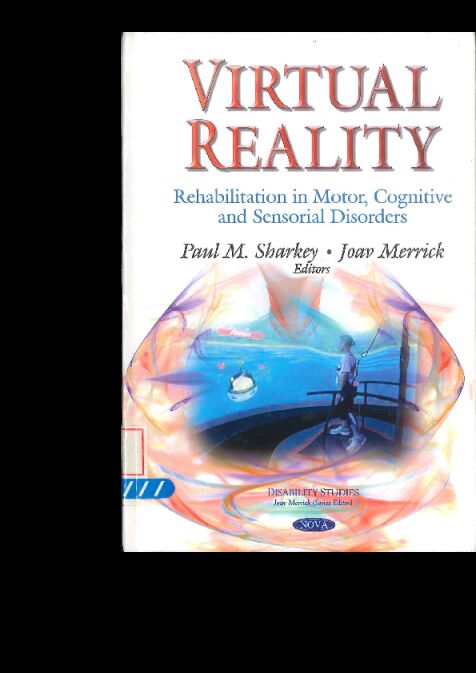
书名:Virtual reality
责任者:Paul M. Sharkey and Joav Merrick | Merrick, Joav
出版时间:2014
出版社:Nova Science Publisher’s, Inc.
摘要
Over the past twenty years, groups of therapists, researchers and engineers have seized the potential of virtual reality (VR) and its associated technologies to work together on designing and testing a great variety of rehabilitation devices and systems with the objective of improving the support for people with disabilities. Virtual reality technologies offer new paradigms for human exploration, understanding and support by providing participants a safe setting in which they can interact and develop goal-oriented activities within functional-virtual environments, especially when they find themselves in situations of cognitive, behavioral or motor disabilities. The solutions built from these technologies reduce patients' limitations of activity and participation by promoting the recovery of capabilities. The current diversification of VR technology can also lead to tools used at home so that the patient can pursue the training that was initiated with the therapist in the care center. In this book you will find research on the rehabilitation in motor, cognitive and sensorial disorders
查看更多
目录
Introduction 1
Chapter 1 Virtual reality based rehabilitation applications for motor, cognitive and sensorial disorders 3
Section One: Virtual Reality and Rehabilitation 5
Chapter 2 Movement rehabilitation in virtual reality from then to now: How are we doing? 7
Chapter 3 Virtual reality for cognitive rehabilitation 21
Chapter 4 Balance rehabilitation using custom-made Wii Balance Board exercises: clinical effectiveness and maintenance of gains in acquired brain injury population 37
Chapter 5 Development of a system for the assessment of a dual-task performance based on a motion-capture device 49
Chapter 6 Virtual exercises to promote cognitive recovery in stroke patients 57
Chapter 7 Automatic non-contact categorization of upper body motion impairments and common post-stroke motion synergies 69
Chapter 8 Augmented reality improves myoelectric prosthesis training 81
Chapter 9 Patient engagement and clinical feasibility of augmented reflection technology for stroke rehabilitation 95
Chapter 10 Using virtual environments for trigger identification in addiction treatment 107
Chapter 11 Impact of contextual additional stimuli on the performance in a virtual activity of daily living (vADL) among patients with brain injury and controls 123
Chapter 12 Chilean higher education entrance examination for learners who are blind 135
Chapter 13 Combining virtual reality and a myoelectric limb orthosis to restore active movement after stroke 153
Chapter 14 Robotic/virtual reality intervention program individualized to meet the specific sensorimotor impairments of an individual patient 167
Section Two: Acknowledgments 181
Chapter 15 About the editors 183
Chapter 16 About the School of Systems Engineering, University of Reading, United Kingdom 185
Chapter 17 About the National Institute of Child Health and Human Development in Israel 189
Chapter 18 About the book series "Disability studies" 193
Section Three: Index 195
Index 197
查看PDF
查看更多
馆藏单位
中国医科院医学信息研究所