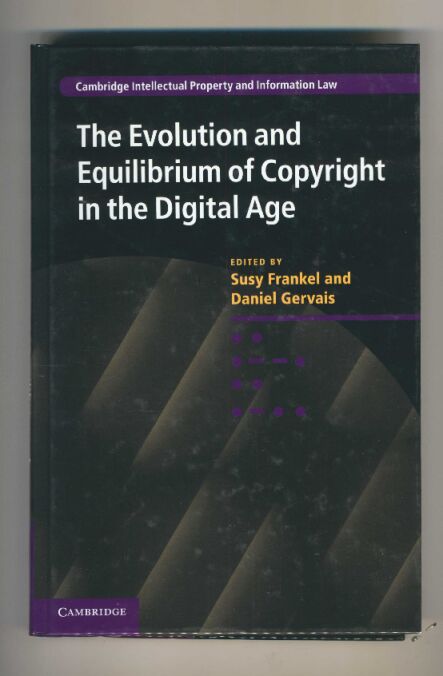
书名:The evolution and equilibrium of copyright in the digital age
责任者:Susy Frankel and Daniel Gervais | Frankel, Susy | Gervais, Daniel
出版时间:2014
出版社:Cambridge University Press
摘要
It is axiomatic to suggest that copyright and its utility in the digital environment are important issues. There is much debate on the role and appropriate parameters of copyright (how should copyright works be available and protected online and how should fair uses work in the online environment?) especially where the availability of works is more international than ever before. The importance of the issues and the difficulties have resulted in the debate becoming significantly polarised, and those at the poles are frequently uncompromising.
Public choice theory explains some of the changes as existing players try to use regulatory mechanisms, including copyright,to preserve existing business models,and others use the same levers to disrupt those same models, and create their own - until they too become entrenched and start to defend their acquis.
At bottom, the debates often oppose two types of intermediaries; namely, on the one hand, those who have typically dealt with creators by acquiring rights from them (publishers, film and record companies and a number of software developers) and who developed business models as 'right-holders', and, on the other hand, intermediaries who use the work product of creators (which is often referred to as 'content' in that context) and who developed business models linked to advertising or fair uses. The latter are either reluctant licensees or operating under some theory of copyright which absolves them of any obligation to pay creators. The related regulatory schemes vary from liability exemption as 'conduits' of content to fair use/fair dealing. As a result, there is a gap between law and practice at so many levels.
The Internet tends to reshape views of authors' incentives and the linkages between control of uses by copyright holders and the provision of those incentives. The first category of intermediaries (the so-called 'copyright industries') are trying to capture more of shrinking revenue pies. The second category (the 'user' intermediaries) is trying to increase profits by not paying for 'content' or by paying as little as possible. Both categories are, therefore, in the business of 'squeezing creators'. We posit that a viable equilibrium must take account of the interests of right-holders, new ('non-right-holder')intermediaries, and of those whose voice is less often heard though often instrumentalised by both categories of intermediaries, creators and users. We are also well aware that these categories are useful heuristic tools, but they are not airtight (authors are users; users are authors; etc.).
We do not question the need for intermediaries to find suitable business models for online 'content'. Indeed, Apple and Google are two of the largest enterprises in terms of market capitalisation of any field of business. Online intermediaries and business models constantly evolve and businesses face new competitors. More content is made available to more people on more devices than ever before. Users want as little control as possible, but that may mean interfering with business models, especially those based on advertising if users can skip adverts. Authors and creators should welcome these new opportunities, and most do, but some also want to get paid for their work. The real question is: can copyright reconcile their interests?
Profit is not, of course, a matter for public debate. Other normative arguments are explored here. At one pole are those who support all online uses of copyright works,no matter what the impact is on copyright, in the name of various public goods including free information,free expression and other similar goals which might require access to copyright works. The free flow of information and freedom of expression are extremely important. We do not discount them, but at the same time their maintenance does not depend on the non-existence or destruction of copyright. Copyright and access to copyright works to ensure the availability of information and freedom of expression have and do coexist. Some might even say that copyright is a mechanism that supports these goals and it exists to encourage the proliferation of works of art and literature and their modern offspring found in mediums online. At times copyright and access goals clash. It may be that in the digital age they once again need to find a point of equilibrium. Then there are those who disrespect copyright and ignore it, happily creating, using or trading in counterfeit copyright works.
At the other end of the spectrum are some copyright owners (who may or may not be the original authors) who insist that copyright means that they must control all uses of their work,commercial or otherwise, and that their interests should most often prevail over any other public goods. Such voices often also hold the view that uses for reasonable purposes, which are guided by fair use or permitted acts, should not be extended. That view is often motivated by a desire to maintain a business model which is dependent on the pre-digital copyright regime and may be struggling to adapt to the modern world. Yet, businesses do adapt. They must. The process may be harsh and even incomplete. It is not, however, copyright's core function to incentivise redundant or obsolete business models. Equally so, it is not the role of the Internet to make it excessively hard for authors and creators to make a living when ways exist to reconcile this objective with the objective of maximising access.
The debate often uses false dichotomies. A main objective of this book is to demonstrate that there are many viewpoints between the two extremes put forward by those who are looking for ways to make copyright law work in the digital age. By 'work' we mean balancing the interests of the many so that copyright protects, but does not unduly inhibit the reasonable activities of users of copyright works, the transfer of knowledge and information flows. The many who have an interest in copyright broadly fit into three groups: the creators and owners of copyright works; the users (new creators and consumers) of copyright works; and those businesses and individuals that 'connect them'~1 (including publishers and distributors both of the traditional and online business model). This volume offers analysis of perspectives from all of those groups. In doing so, the guiding framework of this collection is, as the title suggests, supporting the evolution of copyright in order to bring some equilibrium to the international and national copyright systems.
Evolution and equilibrium capture the foundations of copyright; of the old supporting the development of the new,and of the challenges that accompany any growing process. It is almost self-evident that copyright evolves and that the digital age has required and continues to require all kinds of developments, some of which are likely to necessitate significant changes to the way in which copyright functions. But, if copyright's evolution is to be successful, it needs to be about more than growth. We often hear that copyright needs to achieve a balance of interests. Balance is not enough. Equilibrium captures more than a simple balance between two opponents; it is about balancing multiple competing interests from multiple players and recognising that equilibrium in copyright is complex and dynamic, not static. Just as the circumstances that influence copyright continue to evolve, so should the relationship between players. Put differently, the law is a tool which cannot provide the answers for all situations in advance, but it can provide the means to find those answers as copyright evolves. Copyright law is not yet achieving that level of guidance in the digital age.
1 D. Gervais, ‘The Internet Taxi: Collective Management of Copyright and the Making Available Right, After the Pentalogy', in M. Geist (ed.),The Copyright Pentalogy: How the Supreme Court of Canada Shook the Foundations of Canadian Copyright Law (University of Ottawa Press, 2013),pp. 373-401.
In many ways, the debate about copyright has become a challenge about who is or who should be the beneficiary. One familiar debate that is frequently expressed in a binary way is that of the interests of the owner versus the user. Another debate is the distributors versus the author, but that division is not so simple because we know that sometimes distributors are owners or even authors and sometimes they are neither. One thing is for sure: they all need each other; how much they need each other and how much each of their interest should be recognised in copyright law is, of course, the centre of the debate. There are multiple possible outcomes of the current tensions. Here are two possibilities: the first is that copyright is now as good as it is going to get. This seems unlikely because copyright has many discontents that have little in common except for their discontent. Many of the stakeholders want different things from copyright. The second and perhaps more likely possible outcome is that copyright will continue to evolve.
As a matter of international law - and in many ways this is reflected in domestic law settings - copyright is structured to evolve. We can adapt the definitions, we can change the laws, the courts will reinterpret the laws in so many ways; but all of this presupposes both a good understanding and the genuine desire to reach balanced outcomes.
Core concepts in the international agreements are broad; they are thinly, if at all,defined. Reproduction, we know, is something about making a copy, but we also know it has very few limits, which in many ways is tantamount to a lack of definition. Nonetheless, domestic law and a vast body of international law tell us quite a lot about the definition of copying. The open-textured nature of international definition is important, but it can also give rise to problems. For at least 200 years, if not longer, it has been easier to give owners exclusive rights over all kinds of copying and then to try to frame justifications for exceptions, limitations, permitted acts, fair deals, fair users or what have euphemistically been described as flexibilities. One question is this: can we ask the question how much reward does the copyright owner or an author need? Should one not question in the same breath whether the likes of Apple or Google are making too much money? As we noted above, this is typically not a matter for debate. We can, however, ask, how much reward should an author have, because,below a certain threshold,even a successful author (in the sense that many users want to read, listen to or watch her work) is unable to sustain a living from her creative production.
We are aware that this sort of discussion can sometimes lead in the opposite direction of the goal of equilibrium and has frequently tended to polarise and to gridlock positions. In this volume, we avoid gridlock by addressing the different positions from various angles. By choosing the word 'equilibrium', we must not be mistaken for expecting a calm sea. On the contrary, this volume contains firm and opposing views.
Has a convincing case that incentives are normatively undesirable or economically unnecessary been successfully made? The Internet is a phenomenal global dissemination vector, and, combined with all sorts of digital tools, it allows new works to be created and disseminated. While that is all good, equilibrium assumes that the interests of authors are also reflected. To that extent at least, a proper regulatory response may not have been found just yet. An international regulatory response may also require recognition that reflecting and respecting local differences, most probably through flexibilities and exceptions,must be possible. While some minimum standards are desirable to provide a sufficient degree of international protection then, the notion that the appropriate regulatory response is a 'one size fits all' model for every detail is thus both uncompromising and unrealistic.
Creators and users matter
Without authors, new 'content' will not be created. Copyright is not an arbiter of good and bad creativity.~2 That said,having only content created by amateurs or those seeking fame/attribution as their only payment is a solution that may not convince everyone. As a matter of fairness, if tens of billions of dollars are generated by business models using and making available this 'content', is it so unfair to ask whether at least some of those 'pesky'~3 authors should get paid, bearing in mind that, if control is exercised on users today, it is by intermediaries, not authors. Users matter because they ultimately experience and give value to the content. Professional authors create to be read,listened to, watched and hopefully enjoyed. The digital environment allows users to manipulate content to create new works. All of this must be encouraged. That said, the myriad new options to create and disseminate copyright works using the Internet and digital tools does not, contrary to suggestions heard from Silicon Valley and elsewhere, mean that paying creators is somehow obsolete because new amateur content is meant to replace professionally created works.
2 See Susy Frankel 'From Barbie to Renoir: Intellectual Property and Culture' (2010) 31 Victoria University of Wellington Law Review 1,3.
3 See Jane C. Ginsburg 'Copyright 1992-2012: The Most Significant Development' (2013) 23 Fordham Intellectual Property, Media and Entertainment Law Journal 101, 135.
The topics in and structure of this book were developed from a conference, hosted by the New Zealand Centre of International Economic Law,which was also structured to provide debate and discussion rather than polarisation of the issues and binary approaches to questions such as: Whose side are you on? Are you for copyright or against copyright? Are you for authors or for users? Are you for enforcement or against it? Do you want new rights or do you want new exceptions? The binary approach has usually not led to very fruitful debates but rather to growing echo chambers. In this book - as with the conference which inspired it - we take a new approach with a combined focus on equilibrium and evolution, or evolution towards a new equilibrium.
This volume gathers together many copyright scholars and offers a dialectic approach, not ideological filter, to find a better way forward. This volume is divided into four substantive parts which address the following broad themes:
Part I: Central players: authors, owners, intermediaries and users
Part II: New enforcement regimes
Part III: Old legal techniques and new challenges
Part IV: The collective management solution
Part I looks at the central players of copyright online. The focus on authors begins with Chapter 1 by Jane Ginsburg, 'Exceptional authorship: the role of copyright exceptions in promoting creativity'. Ginsburg contests the proposition that today's authors need copyright exceptions and limitations more than they need exclusive rights. In doing so, she reminds us that,without the author, there is not much of a role for copyright and that copyright should protect and support the author. She puts authors' interests first and considers that those who have built industries out of exceptions to authors' rights do not have such a great claim to either the protection of or the exceptions of copyright. Next, Niva Elkin-Koren analyses the evolving role of online intermediaries in Chapter 2, 'After twenty years: revisiting copyright liability of online intermediaries'. Some intermediaries have been immune from liability for copyright infringement in order to preserve their roles as conduits of information and the medium through which freedom of expression takes place. Online intermediaries are no longer merely passive conduits: some also now supply and control content. Elkin-Koren questions whether the function of the online intermediary has changed so much that they are not now so neutral. She concludes that framing the public debate around intermediary liability or immunity overlooks some risks to users' freedoms. Consequently, 'free flow of information in the digital ecosystem can no longer rely on keeping online intermediaries clear of liability'. She argues, therefore, that online intermediaries should also be subject to duties in order to safeguard users' rights.
When copyright is not working, copyright owners may not only seek more rights and remedies, but may also turn to other areas of intellectual property, particularly trade mark law, for a remedy. In Chapter 3, 'Overlapping rights: the negative effects of trademarking creative works,, the last chapter of Part I,Irene Calboli discusses this overlap of rights and the problems and benefits it brings. She examines the different purposes of copyright and trademark laws and concludes that,despite these differences, nothing prevents copyright and trademark law from overlapping, particularly in relation to product appearance. Where the protection overlaps, practitioners have utilised these 'opportunities' to make protection for the same product broader and potentially perpetually under trademark law rather than for a limited time under copyright law. Calboli discusses how this opportunistic approach is unlikely to be what the architects of the intellectual property system envisioned, both at the international and national levels.
One of the biggest hurdles facing authors and owners is that the rights they have are often difficult to enforce. This has led to a surge in the number of attempts to improve enforcement. Copyright seems to be evolving a special enforcement regime. One might also ask if the attempts to increase enforcement are changing the nature of the core of copyright. Part II discusses the new enforcement regimes that have emerged in the digital age. In varying ways, the evolving focus on enforcement recognises that there is little equilibrium in copyright as for many copyright owners there is no effective enforcement and for many copyright users there is a lack of guidance or sometimes enforcement overreach by copyright owners. The solution is not simple where, for the most part, suing individual infringers is impractical under traditional copyright remedies. Thus, we have seen the emergence of regulated response and criminal enforcement regimes. In some jurisdictions, online intermediaries have played a role in issuing various sorts of notices to alleged infringers of copyright on the Internet. Rebecca Giblin, in Chapter 4,'Beyond graduated response', argues that this requires many Internet Service Providers (ISPs) to be involved in the policing of online copyright infringements. As she points out, the various regulated response regimes that have emerged differ on virtually every detail and have different approaches to matters such as transparency, allocation of costs, due process and judicial involvement. Giblin discusses these differences, and concludes that there is little evidence any of those widely varying regimes have done much to reduce infringement levels or to grow the legitimate market. The chapter explores the linkages between the availability of copyright works through legitimate options and concludes that such availability is the key to reduced infringement, not graduated response.
Next, in Chapter 5, Christophe Geiger assesses 'The rise of criminal enforcement of intellectual property rights... and its failure in the context of copyright infringements on the Internet'. He discusses how policy-makers around the world seem to take the approach that criminal enforcement is an effective way to address global counterfeiting. The chapter questions the appropriateness of criminal sanctions for copyright infringements. Geiger suggests that public opinion may turn against intellectual property law in general if enforcement is seen to be too heavy-handed. He suggests an alternative approach to criminal enforcement which takes into account cultural, historical, social, psychological and economic considerations.
In the final chapter of Part II, Chapter 6, 'Administrative enforcement of copyright law in China: a characteristic deserving of praise or repeal?', Luo Li provides an overview of the administrative enforcement of copyright and its organisational structure in China. She discusses the core justification, the public interest, behind the administrative enforcement of copyright law. She discusses how the scope of 'public interest' cannot serve as the boundary between administrative and judicial enforcement because it is not defined. She concludes that enforcement through copyright administration should be repealed.
Part III turns the focus to how some new technologies are causing new problems, but also how some of these problems are not so new and that lessons can be learned from the past. This part begins with exploring different jurisdictional approaches. In Chapter 7, ‘Out of time? Copyright law and the Australasian judiciary in the digital age',Susan Corbett looks at how Australasian courts have approached time-shifting for personal use. An examination of the statutes and case law shows an analysis of each step the user takes rather than a balancing of copyright's competing interests. She also compares the approach in Canada and Europe and suggests that the Australasian courts should make better use of the jurisprudence from those jurisdictions in order to achieve a better balance. This is followed by Pablo Wegbrait's discussion in Chapter 8, 'Internet Service Provider liability for copyright infringement in Latin America'. Wegbrait's survey shows how the approach to ISP liability varies from country to country in Latin America, and that, with the exception of Chile and Paraguay, the variation illustrates a lack of clear rules for ISP liability. Wegbrait advocates for coordination and adoption of liability principles to better align Latin America. He nevertheless concludes that, in the absence of a clear regime, courts can also apply relevant general legal principles to resolve cases. Consequently, the absence of additional written laws should not be an excuse for not resolving ISP liability cases in Latin American jurisdictions.
In Chapter 9,'New technologies and the scale of copyright infringement: should size matter to liability?',Graeme Austin asks whether there is a connection between the scale of a firm infringing copyright and the likelihood of its being liable. He discusses how the volume of infringing activity pulls in two directions for the purposes of establishing liability for infringement of copyright. The first is where the amount of infringement is used to determine if a defendant's business model genuinely relies on 'inducing' primary infringement by others. The second is when the amount and nature of infringing activity make it impractical to prevent it easily and how this can weigh against liability. The chapter discusses how these features play out in liability and in the fair use context. As Austin rightly notes, 'any analysis of the "benefits" of the defendant's activities should be accompanied by a clear-eyed view of the public benefits of the creative outputs by parties who more directly rely on copyright's incentives'.
In Chapter 10, 'Facilitating access to information: understanding the role of technology in copyright law',Leanne Wiseman and Brad Sherman analyse how law is, and has always been, a creature of technology. As the authors say,rather than being something that is external to the law, technology forms an integral part of the very fabric of copyright. They discuss how this is demonstrated in technology including the printing press, the telegraph and the camera,through to the phonogram,the photocopier, the tape player, the personal computer and the Internet. They argue that technological developments have always driven and shaped copyright law. The chapter uses historical examples to explore the role that technology plays in copyright law in facilitating and in hindering access to information and creative outputs. The authors conclude that, while there is nothing inevitable about the way that the law responds to and deals with technology, the process of responding to technology has often brought about unrelated changes.
Part IV puts collective management under the microscope. Just as the problem of the Internet is a problem of the many, so too are the potential solutions which some suggest could and should include collective management. All agree that there would need to be changes to existing collective management practices. Few agree on what those changes should or ought to be. In Chapter 11, 'Is there potential for collective rights management at the global level? Perspectives of a new global constitutionalism in the creative sector', Christoph Graber departs from the insight that a globalising culture and the Internet economy are both interested in a much simpler system of copyright licensing and that systems of Collective Rights Management could be a promising solution. The chapter argues that a globalised Collective Rights Management system would provide a counterpoise to the prevailing economic concentration that results from big entertainment corporations controlling intellectual property rights. The central question that the chapter discusses is how the conflicting public policy interests at issue, including intellectual property, open markets and cultural diversity,could be reconciled.
In Chapter 12, 'Copyright collective management in the twenty-first century from a competition law perspective', Yee Wah Chin gives an overview of US antitrust law relevant to copyright, and notes that, outside of the specific intellectual property laws,in the US the full scope of antitrust law is applicable to copyright. She therefore assesses that the question then becomes what is the scope for copyright that may be legitimately collectively managed. She concludes that competition law should be applied to the fullest extent possible, and exemptions and immunities should be limited.
In Chapter 13,'Copyright on the Internet: consumer copying and collectives', Glynn Lunney discusses file-sharing, and notes that sharing data is the raison d'etre of the Internet. While record companies and other major copyright holders have won a number of important legal battles, they are losing the war because their objective, namely, control of the Internet as a distribution platform for copyright content, is misplaced. Lunney examines how dramatically the digital revolution has reshaped the economics of the music business, and provides data and analyses to question some of the dire scenarios about the impact of file-sharing on artist development. Despite a drop in overall revenue, a number of artists are finding positives in file-sharing, including the ability to develop without being subservient to the content industries. He opines that, because consumers are able to distinguish between continuous and discrete public goods, that is, they 'view individual works, rather than works generally, as the relevant market, then the market can produce an optimal supply of original works even in the absence of copyright'. In his last section, Lunney reviews and then discards the suggestion that collective licensing to establish a legalised file-sharing market would increase efficiency. He also notes in that connection that the 'central difficulty with a distributional equity argument for a collective licensing regime is that such a regime would redistribute from the relatively less well-off, music consumers, to the relatively better off, copyright owners'.
The volume finishes with a coda in Chapter 14,'Coda: fair trade music: letting the light shine in',in which Eddie Schwartz discusses aspects of Lunney's and Giblin's chapters. He replies to some of the discussion, giving the perspective of a songwriter. He argues that, in defining a future equilibrium, necessary distinctions must be made between the three remaining record/media companies and the '99% or more of music creators who are at best no better off than their fellow citizens'. The major risk he outlines is the capture of new intermediaries, such as Spotify, by record companies in a way that, as the figures in Eddie Schwartz's chapter show, is biased against individual creators. The capture of Internet policy by giant intermediaries such as Apple and Google on the one hand,and major media conglomerates, on the other, is not the equilibrium one should normatively seek to establish. It will impoverish us all.
查看更多
前言
The chapters in this book were first presented at a conference entitled 'Evolution and Equilibrium Copyright this Century' in 2012,which the editors of this book, Susy Frankel and Daniel Gervais, co-hosted. The conference was held under the auspices of the New Zealand Centre of International Economic Law (NZCIEL), a research centre at the Faculty of Law, Victoria University of Wellington. NZCIEL was co-founded in 2007 by Susy Frankel and Meredith Kolsky Lewis. In 2012, Daniel Gervais was appointed as a Research Affiliate of NZCIEL. The NZCIEL acknowledges the support of InternetNZ as partners of and contributors to the conference. That support brought together a truly international field of experts and has made this publication possible.
查看更多
目录
List of figures page vii
Notes on the contributors viii
Preface xi
Evolution and equilibrium: an introduction 1 SUSY FRANKEL AND DANIEL GERVAIS
Part I Central players: authors, owners, intermediaries and users
1 Exceptional authorship: the role of copyright exceptions in promoting creativity 15 JANE C. GINSBURG
2 After twenty years: revisiting copyright liability of online intermediaries 29 NIVA ELKIN-KOREN
3 Overlapping rights: the negative effects of trademarking creative works 52 IRENE CALBOLI
Part II New enforcement regimes
4 Beyond graduated response 81 REBECCA GIBLIN
5 The rise of criminal enforcement of intellectual property rights... and its failure in the context of copyright infringements on the Internet 113 CHRISTOPHE GEIGER
6 Administrative enforcement of copyright law in China: a characteristic deserveing of praise or repeal? 143 LUO LI
Part III Old legal techniques and new challenges
7 Out of time? Copyright law and the Australasian judiciary in the digital age 161 SUSAN CORBETT
8 Internet Service Provider liability for copyright infringement in Latin America 180 PABLO WEGBRAIT
9 New technologies and the scale of copyright infringement: should size matter to liability? 203 GRAEME W. AUSTIN
10 Facilitating access to information: understanding the role of technology in copyright law 221 LEANNE WISEMAN AND BRAD SHERMAN
Part IV The collective management solution
11 Is there potential for collective rights management at the global level? Perspectives of a new global constitutionalism in the creative sector 241 CHRISTOPH B. GRABER
12 Copyright collective management in the twenty-first century from a competition law perspective 269 YEE WAH CHIN
13 Copyright on the Internet: consumer copying and collectives 285 GLYNN S. LUNNEY, JR
14 Coda: fair trade music: letting the light shine in 312 EDDIE SCHWARTZ
Index 317
Figures
13.1 Worldwide file-sharing traffic on the Internet (in petabytes per month) page 290
13.2 Music sales (all formats) in the United States (constant 2011 dollars) 291
13.3 New albums released in the United States, 1996-2011 293
13.4 New artist development: new artists in the top 50 of the Billboard Hot 100, 1990-2010 294
13.5 Reuse of old songs: cover songs in the top 50 of the Billboard Hot 100, 1990-2010 295
查看PDF
查看更多
馆藏单位
中国标准化研究院国家标准馆