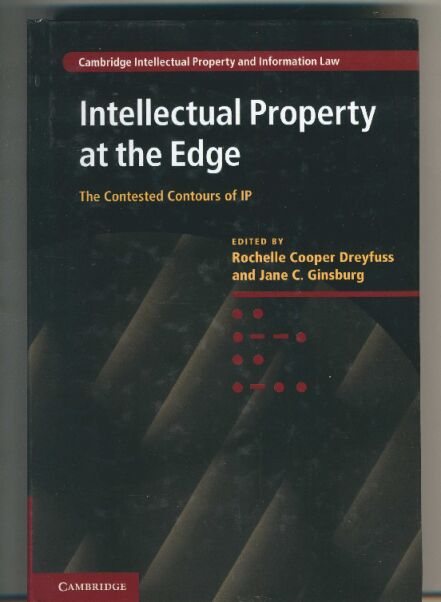
书名:Intellectual property at the edge
责任者:Rochelle Cooper Dreyfuss and Jane C. Ginsburg | Dreyfuss, Rochelle Cooper | Ginsburg, Jane C.
出版时间:2014
出版社:Cambridge University Press
摘要
No one should take this title in the wrong way: that's a "real" property lawyer in the sense of real estate,not in the sense of actuality - realty, not reality. I believe the editors of this volume thought that they themselves knew too much about intellectual property to see the perplexities that could obscure the path for uninitiated readers. And so,for the Introduction, the editors sought out someone who knows something about ordinary property, but not so much about intellectual property. Lucky me! Thanks to their request, I have had the great pleasure of going through these very enlightening essays about the emerging and sometimes ongoing issues in this area, really one of the most dynamic fields in all of property law. But I can only hope that my relative unfamiliarity with specifically intellectual property enables me to feel at one with other less expert readers. For the readers who are more like me, I hope this brief introductory essay can point out some of the common themes and some of the oddities that these chapters address, and in some cases connect those themes and oddities to current theoretical trends in other areas of property law.~1
1 Just to reassure the forgetful or uninitiated even further, here is a quick and very conventional primer on the main regimes of IP: Copyright protects artistic and authorial productions, but it has considerable leeway for peripheral copying; its protection also lasts a long time,but not forever — now usually the life of the author plus someone else's life after that. Trademark protects distinctive brands, symbols and slogans that identify the sources of commercial products; trademarks too allow some exceptions, but they can last indefinitely, so long as they are in use. Patents give very strong protection to useful inventions, but they generally only last twenty years. Besides, patents take some effort and expense to get, and they require the inventor to tell others how to make and use the invention, even if those others are not supposed to do so until the patent expires. Trade secrets, on the other hand, allow inventors to hold on to their secrets indefinitely (like trademark), but a trade secret gives no protection if someone else figures out how an invention works.
I will begin with a question that runs through most of the chapters and commentaries in this book: What is intellectual property supposed to be doing? After that, I will take up some versions of the "edge" and what several of these chapters mean by the edges of intellectual property. After that, I will run through a melange of other themes that readers may find in these chapters - certainly not an exclusive list, but one that generally bounces off other ideas in property law.
So, to begin with the most fundamental question.
What is it all about?
Silke von Lewinski (Chapter 10),~2 commenting on the differences between traditional knowledge protections and conventional commercial copyright, observes that both copyright and protection of traditional knowledge aim to control uses of intellectual endeavors. Indeed, without too much of a stretch, one might say the same about the rest of intellectual property (IP) as well. But to what end? Are IP protections supposed to encourage innovation, by preventing others from free-riding on original work for some appropriate period of time, and (at least in the case of trademark) by protecting quality and staving off consumer error? Those are the conventional rationales, and if true, the underlying innovation-incentivizing goal ought to benefit the public and give a good reason for the public's recognition and enforcement of IP claims. But von Lewinski's comments also suggest that these and other conventional IP rationales seem rather mismatched with the reasons for protecting the creative productions of traditional peoples, including the Maori haka performance works described by Susy Frankel (Chapter 9). For many such works, the object is not to innovate at all, but rather to reaffirm the identity and continuity of the community and the community's place in the larger universe; indeed one might think that innovative (aka mistaken) performance may cause grievous cosmic disarray.
But even within the many more conventionally familiar types of IP, like patent or copyright, aid to innovation may be a sideshow, and the real object of protection may lie somewhere else. For example, might the idea of IP protection be simply to help businesses repress rivals, whether or not innovation is involved? Some of the chapters in this book suggest this rather questionable objective, notably the regional wine makers' claims against others' use of the name "Spanish Champagne" (Gangjee, Chapter 5). Alternatively, as the the Rt Hon. Robin Jacob (Chapter 20) rather tartly but interestingly suggests about copyright in particular, might a good deal of IP protection be aimed at protecting amour propre?
2 In this as in other references to the authors in this book, I will use brief names together with the chapter locations of the authors' contributions.
If amour propre is a matter of dignity, then some topics in these chapters answer Jacob's comment affirmatively, because a number of dignitary claims - some more sympathetic than others - do surface in these chapters. Traditional cultural expressions, like those of the Maori haka performances (Frankel, Chapter 9), would appear to raise quite sympathetic dignitary claims indeed, as traditional peoples try to impose a respectful treatment on outsiders. On the other hand, Stacey Dogan (Chapter 1) describes how baseball cards in gum packages initiated a right to personal celebrity,but seemingly with little purpose other than to make certain that celebrity images could be hawked for exclusive advertising deals. The French, perhaps not surprisingly,have taken a somewhat more limited and one might even say more dignified approach to celebrity protection (Lefranc, Chapter 2), in which celebrity is not so readily bought and sold. Perhaps this reflects a greater Continental concern for "moral rights" and personality protection than has been the case for the bubblegum-snapping commercial cousins across the Atlantic.
But coming back to amour propre, it is hard to see what motivation other than affronted dignity would drive the early twentieth-century makers of the "Odol" brand of mouthwash to object to the use of "Odol" by a cutlery manufacturer (Beebe, Chapter 3), unless perhaps there was an unspoken rivalry about some other personal hygiene matter, like nail clippers. Indeed, subsequent developments of the trademark dilution concept after Odol,in both America and Europe, suggest motivations mixing possessiveness with a sense of lèse majesté on the part of commercial kingpins (Beebe, Chapter 3; Dinwoodie, Chapter 4). Another kind of dignitary claim appears in the actions of the optical surgeon who took out a patent on a surgical method, because, he said, he felt disrespected by professional insiders (Strand- burg, Chapter 15), although this surgeon did seem to have some monopoly profits in mind as well. And speaking of mixing dignity with money, there is always the much-lampooned but ever-defended Barbie (Tushnet, Chapter 19): is it amour propre or innovation or simply monopoly profit that induces Mattel to threaten to sue the purveyors of Barbie-like whip-wielding "dungeondolls"? Or perhaps do all three motivations conjoin, under the rubric of reputation? And should the rest of us care? With that question in mind, let us turn to another set of common themes: edges.
What is all this about edges? What is in and what is out of IP, or, the edge of the cliff
The title to this book has to bring a certain smug smile to the lips of lawyers who deal in real property. Try as they might, scholars dealing in more ethereal forms of property cannot seem to escape metaphors that refer to the brute physicality of real things. An edge smacks of real estate and other tangibles: the edge of a cliff, or the edge of a field - the border between something and nothing on the one hand; or on the other hand, the border between one crop and another. The edge of the knife suggests a different kind of edge: "edgy" in the sense of cutting, critical,hard to manage. All three of those metaphors of the edge show up in these chapters. But I will start with the cliff.
Several topics in the book seem so close to the edge of IP that they threaten to fall off the cliff altogether. Fashion is one of those cliff- toppling topics (Hemphill and Suk, Chapter 7; Kur,Chapter 8) - too artistic and too ephemeral for patent, too functional for copyright, in effect straddling the copyright/patent divide without belonging to either. But the chapters on geographical designations for wines (Gangjee, Chapter 5),protections of traditional knowledge (Frankel, Chapter 9), and surgeons' methods for medical procedures (Strandburg, Chapter 15) also present scenarios that fit only very uncomfortably into the usual rubrics of IP. The fit is uncomfortable for surgical procedures because of the surgeons' own vehement professional objections to proprietary claims on medical procedures. It is uncomfortable for wine makers' geographical designations - and indigenous cultural expressions too - at least in part because the identities of the rights holders are somewhat uncertain. Who is in, and who is out of the rights-holding group? Who qualifies for membership; and who gets to define the qualifying activities?
Some scholars think that such issues are manageable through evolving concepts in more traditional IP; Gervais (Chapter 6), for example, thinks that trademark can deal with demands for geographical designations. On the other hand, Frankel (Chapter 9) proposes a quite different way to manage indigenous people's traditional knowledge, allocating control to traditional guardians. In the fashion industry, Hemphill and Suk (Chapter 7) describe the 1930s upscale designers' elaborate organization to ward off copyists, suggesting that a given industry might try to organize itself to come up with its own crypto-property rights. By the way, this organization sounds much like the diamond merchants' and cotton traders' organizations that Lisa Bernstein has described in detail elsewhere, except that industry self-organization in those trades appears to have been considerably more robust than was the case for the 1930s fashionistas.~3
The larger point is that cliff-hangers like these regularly emerge to raise institutional issues for IP law. Should the cliff-hangers have their own IP rubrics, known in this area as sui generis regimes? Or might they manage to squeeze into standard IP categories? Or should they escape from formal IP and design their own institutional norms? Those are the issues that emerge when the edge means the edge of the entire IP cliff.
But there are other edges in this book as well.
The edge of the field: The borders between different IP domains
Several of the chapters in this book describe the ways that the boundaries can blur between different areas of IP - and what happens when they do. Lionel Bently (Chapter 14) describes an early example, where the purveyors of an eighteenth-century medical concoction received a patent early on, but then claimed trade secrecy many years later. Here the blurring occurred in a context in which legislators and courts themselves had not yet really figured out the boundaries between these types of protections. But another example came decades later, when the boundaries should have been clearer to all concerned. Jeanne Fromer (Chapter 13) describes a case in which the inventor of an industrial pump got the protection of a patent for a time, but then managed to tack on the advantages of trade secrecy - confidentiality and indefinite duration - to what looked suspiciously like the same invention whose patent protection had expired. Similarly, Rebecca Tushnet (Chapter 19) tells of the way that the producers of the very famous Barbie have endeavored to use both copyright and trademark for their notorious dolls, maneuvering between these regimes to try to take advantage of the most protective features of each.
3 Lisa Bernstein, "Private Commercial Law in the Cotton Industry: Creating Cooperation Through Rules, Norms, and Institutions," 99 Mich. L. Rev. 1724 (2001); Lisa Bernstein, "Opting Out of the Legal System: Extralegal Contractual Relations in the Diamond Industry,” 21 J. Legal Stud. 115 (1992).
As the last two examples suggest, blurring the boundaries can enable inventors and authors alike to expand the protection of their work beyond what either regime alone would accord them. In more conventional property, there is a similar pattern that has been noticed in some less-developed countries, where traditional landed property arrangements have been only partially displaced by modernist titling regimes. In that context, as Daniel Fitzpatrick has described, clever and powerful players can shift back and forth to claim more than either regime alone would have given them.~4 There too, a blurring that begins in simple confusion can take a more purposeful and aggrandizing turn. Which brings me to yet another edge.
The edge of the knife: Stilettos and blunderbusses in IP-land
"Edgy" can mean something cutting and critical, and parody is one of the edges in that sense. Parody requires some copying of the target to get the target in view (and then stick in the stiletto), but in so doing, parody becomes particularly transgressive to the holders of IP rights. Not only is the parodist copying the song or the slogan, but she is poking fun at it. The IP rights holders know it, and as Robin Jacob illustrates (Chapter 20),they can work themselves into quite a huff about parody, sometimes to the point of making themselves look ridiculous.
Parody needles the trademark or creative work on purpose, but some other transgressive types just want to have fun - without paying for it, of course. In his chapter, Joseph Liu (Chapter 11) suggests the great lengths to which hackers will go to watch an encrypted television show or play a time-restricted video game, sneaking through the cracks in anti- circumvention "digital rights management" (DRM) code to do so; while Séverine Dusollier (Chapter 12) points to the difficulties that computer gamers cause for European IP law when, say, they tinker with PlayStation software in order play games outside the PlayStation empire.
4 Daniel Fitzpatrick, "Evolution and Chaos in Property Rights Systems: The Third World Tragedy of Contested Access," 115 Yale L. J. 996 (2006).
5 This kind of mix and match could backfire, though. See Jane C. Ginsburg, Of Mutant Copyrights,Mangled Trademarks,and Barbie's Beneficence: The Influence of Copyright on Trademark Law, in Trademark Law and Theory: A Handbook of Contemporary Research 481 (Graeme B. Dinwoodie & Mark D. Janis eds., Edward Elgar, Cheltenham, UK, 2008) (describing how the copyright "fair use” defense has infiltrated some trademark law).
These chapters suggest that transgression and defense establish a peculiar kind of thrust and parry between transgressors and IP rights holders. The fight begins when the transgressors take a jab at IP-protected material, but then it goes on: The rights holders defend themselves so aggressively as to overreach the protections that they would have under IP itself. For example, US copyright law allows exceptions for parodies under the rubric of "fair use," with rather less regard than the Europeans have for authors' fusty "moral rights"(Jacob, Chapter 20). Nevertheless, Mattel scares off would-be parodists everywhere by mixing and matching trademark and copyright claims, claiming more protections than would be available under either copyright or trademark alone (Tushnet, Chapter 19).~5 Trademark dilution - i.e., knocking-off someone else's famous brand to publicize some other kind of product altogether - often rings of parody too, and of the major brands' reactions to parody.~6 The early case of Odol mouthwash/cutlery looked all very serious, but "Greatest Snow on Earth" was Utah's little joke at Barnum & Bailey's expense.~7 Barnum & Bailey lost in court, but they and other famous brands won over Congress, which soon armed them with the blunderbuss of dilution protection, safeguarding marks far beyond the traditional idea of fending off imitation by competitors (Beebe, Chapter 3; Dinwoodie, Chapter 4).
Liu and Dusollier's contributions on "Paracopyright" (Chapter 11, Chapter 12) describe an eerily similar pattern of thrust and aggressive parry when it comes to technological restraints on copying: The technology of DRM does not always outsmart the transgressive gamers and other hackers,and in order to fend them off, holders of IP rights call on legislation to punish those who would sneak through technological protections. But once having attained this goal, the rights holders then find a pleasant surprise: they can stretch the new legislative language to protect matters considerably beyond the scope of IP - for example, stopping players who figure out ways to "cheat" at computer games. Cheating may be undesirable to the game manufacturers, but it is hard to say it is a copyright violation in itself.
By the way, several chapters suggest something that I will take up shortly again: what may be a persistent difference between the European and American approaches. In this area of overreaching, the European model seems to use ex ante legislation to crack down on rights holders' overextension of IP, while the Americans do so ex post, through the judiciary. But both efforts may be haunted by the specter of contracts, in which the parties determine their rights outside the ambit of public legislation, either through direct agreement, as described by Dusollier (Chapter 12),or through producer-imposed "shrinkwrap" contracts that have been much discussed in the context of software licensing.~8 Contracts like these raise a further question about IP: Is the law of IP a ceiling as well as a floor on rights holders' claims? And is there something about the history of IP rights that drives in the direction of overprotection?
6 One of my personal favorite examples is the former Anchorage rock band known as Mr. Whitekeys and the Fabulous Spamtones. Hormel, the maker of the meat product Spam, was not amused. See Mike Dunham, "'Whale Fat' Comes Back,” Anchorage Daily News, September 11, 2011 (mentioning Hormel's objections to the use of the name Spamtones). Even better known is Hormel's unsuccessful suit against Jim Henson's company for a Muppet movie character named "Spa'am," described in the case as "the high priest of a tribe of wild boars that worships Miss Piggy as its Queen Sha Ka La Ka La." Hormel Foods Corp. v. Jim Henson Productions, Inc., 73 F.3d 497 (2d Cir. 1996).
7 Ringling Bros.-Barnum & Bailey Combined Shows, Inc. v. Utah Div. of Travel Development, 170 F.3d 449 (4th Cir. 1999), certiorari denied 528 U.S. 923 (1999).
Morals and the evolution of rights
Conventional property rights are often discussed in evolutionary terms. Blackstone has a little potted story about the evolution of property rights at the beginning of his exhaustive (and exhausting) discussion of the common law of property, and much the same story is told by modern economists and "free market environmentalists." The story, very roughly, is that property rights systems cost something to create and maintain, but that they will evolve when it is worth the cost and effort.~9
Several of the contributions in this book, however, suggest a somewhat different and rather surprising element in the opening stages of evolving property rights, at least in the IP world: moralisms. Barton Beebe (Chapter 3) discusses the 1924 German decision protecting the Odol brand of mouthwash as an opening salvo in the still-controversial concept of trademark dilution. But the Odol decision reads as if the judge was more concerned about the copycat cutlery company's bad manners than about any legal rights that the mouthwash firm might have had. Similarly, in Jeanne Fromer's description of Tabor v. Hoffman (Chapter 13),where the issue was the copying of a boiler-maker's construction patterns, the judges seemed more concerned about the copyist's bad behavior than about the pattern maker's legal rights under trade secret law. The early twentieth-century Haelen case,according baseball celebrities a hitherto unknown "right of publicity," focused on celebrities' "bruised feelings" and the corresponding unjust enrichment to the unauthorized user (Dogan, Chapter 1). Much more recently,in cases testing new statutory DRM protections, it may be significant that the entering wedges to extending DRM beyond copyright were instances where decryption devices permitted owners to receive broadcast signals without paying for them (Liu, Chapter 11).
8See, e.g., Mark A. Lemley, "Intellectual Property and Shrinkwrap Licenses," 68 So. Cal. L. Rev. 1239 (1995) (querying whether sellers of software can "opt out" of intellectual property).
9For some variations on this story, see Carol M. Rose, "Property as Storytelling: Perspectives from Game Theory, Narrative Theory, Feminist Theory," 2 Yale J. Law & Humanities 37 (1990).
All this creates some interesting possibilities about the evolution of property rights. Property is supposed to be good "against the world," but could it be that when property rights are at early stages, more attention focuses on unseemly behavior by some of the pushier non-owners from out there in the "world"? Only later, as conflicts and pressures grow, does one seem to find closer attention to the content and validity of the right itself, as in the case of trademark dilution and, more recently,DRM protection; and even then, the moral ire lingers on. Graeme Dinwoodie (Chapter 4) notes that a 2009 British case about perfume packaging expressed some moralisms about knock-offs that echo the old Odol case (Chapter 3). The question then becomes whether the early moralisms can set us on a course of overbroad protection, where moral aggravation eclipses reconsideration and readjustment of the property right.
Institutional design: Ex ante vs. ex post, rules vs. standards, and similar issues
The possible pitfalls of evolution raise more questions about institutional design. Moralisms may push IP rights in the early stages in the direction of overly broad definitions, but there also may be other factors that undermine a legal system's ability to strike the right balance about new kinds of innovations - factors like the "hindsight bias" that makes innovation seem obvious after the fact, and that perhaps might work in the direction of under-protection rather than overprotection.~(10) On the one hand, the DRM discussions (Liu, Chapter 11; Dusollier, Chapter 12) suggest that it is all too easy to overreact to the need to safeguard what look like important innovations, and to create protections that sweep up activities considerably beyond whatever it was that called for protection in the first place. On the other hand, however, Ted Sichelman's discussion of the 1948 Funk case (Chapter 17),with the majority's dismissive attitude toward mixtures of biological materials, strongly reinforces the idea that it is easy to make light of genuine innovation.
But then,what to do? One possible route is to focus on potential overreaching, and to take a tightfisted approach to creating new IP rights at the outset, and only later follow up with rigorous and tailored protective systems. In the conventional property/contract literature, one might call this the "rules" approach. On the other hand, Sichelman is more concerned about the problem of under-recognition of innovations, and takes what one might call the "standards" line. On this view,precisely because of the difficulty of assessing innovation, legislatures and courts should set up IP regimes as loose and expansive at the outset, but subject to ex post revision as the scope of the innovation comes into focus.
10 Jeffrey J. Rachlinski, "A Positive Psychological Theory of Judging in Hindsight,” 65 U. Chi. L. Rev. 571 (1998).
Incidentally, in this area of institutional design, readers may notice a trace of a difference between European and American thinking about IP - or more generally civil law and common law approaches. One notices several instances in which commentators suggest that the European approach is more sparing about recognizing IP rights in new areas - Lefranc (Chapter 2), for example, notes that the French have been slow to acknowledge rights in the emerging areas of celebrity or publicity,and thereafter they have made the right more personal and less subject to exclusive rights for commercial purposes. In a different area, Justine Pila (Chapter 18) insists on a European view that there be some "there there" of patentable subject matter - unlike Sichelman's loosey- goosey anything-goes view of what counts as a patentable subject up front, but with strict post hoc reins on the scope of the patent right. Similarly, Stefan Bechtold's contribution (Chapter 16) notes that European legislation takes the more precise - and more restrictive - path of banning patents on medical procedures, as opposed to the looser American approach that allows potential patents of these procedures, but excuses doctors from patent liability. Moreover, in keeping with the civil law tradition, the European approach is more apt to take the form of ex ante formal legislation, as in the case of the French legislation about parody, whereas the American IP system tends to dump all such questions on the courts for ex post assessment (Jacob,Chapter 20).
One should not make too much of these differences; as Graeme Dinwoodie (Chapter 4) notes about US and European conceptions of trademark dilution, there is considerable dialog between systems in many areas of IP. But if there are differences, it will be interesting to see whether or how they play out in areas that now thoroughly stretch IP, like protections for indigenous traditional knowledge. One might expect the European approach to proceed with caution but then look for sui generis codes, while the common law jurisdictions might be more likely to let judges tinker with existing IP regimes post hoc,or perhaps to give the issues to a special commission for case-by-case resolution, as with New Zealand's Waitangi Tribunal's resolutions on the Maori haka (Frankel, Chapter 9).
And still more institutional design: The social structure of innovation
IP discussions often tell a standard story that is very familiar in conventional property theory. The story is that property rights produce good things for a reason: These rights induce their holders to put effort, investment, and careful management into the assets they own,because property rights allow one to reap what one sows. But anyone with even a passing knowledge of IP has to realize that IP is under fire in some quarters, on the ground that creative productivity requires less property protection rather than more, or at least that creativity emerges from social structures that differ from the standard market structures of individual property rights with contractual transfers. There has been much discussion of these issues already - all those disquisitions on Shakespeare's theater group or the multiple contributions to open source software. IP, Jamie Boyle complains, is fixed on the "romantic" individual author or inventor, the lone genius who is falsely supposed to act as the fount of creativity.~(12)
While none of the chapters here take up the whole "copyleft" enterprise of attacking IP root and branch, several do offer interesting perspectives on the social structure of innovation, and how and whether formal IP plays a role. Some of these perspectives focus on group-based efforts to encourage and protect innovation. The American fashion designers of the 1930s could not really rely on IP protection, which at best could have come up with something like the short-term "hot news" protections that the courts created for news gathering organizations; so instead they created their own very elaborate administrative structure to protect their fashion products, basically borrowing early New Deal ideas of cartelized industrial organization (Hemphill and Suk, Chapter 7). Unfortunately for the designers, their self-made protections succumbed to internal quarrels, transactions costs, and antitrust scrutiny; they barely outlasted the New Deal's more general experiment with economic corporatism.
11 Mark Rose, Authors and Owners: The Invention of Copyright (Harvard University Press, Cambridge, Mass., 1993); Yochai Benkler, "Nicely Sharing: On Sharable Goods and the Emergence of Sharing as a Modality of Economic Production," 114 Yale L. J. 273 (2004).
12 James Boyle, Shamans,Software and Spleens: Law and the Construction of the Information Society (Harvard University Press, Cambridge, Mass.,1996).
Katherine Strandburg's (Chapter 15) discussion of the "user innovator" surgeons suggests a different model of group-based self-organization for innovation, one that is less formal and that relies more on social and professional norms, but that appears to be considerably more durable. Strandburg's user innovators are rather like the cohorts of scientists that Robert Merges has described elsewhere in the context of patent pooling among innovators: They share information among themselves, and they take their rewards not only from their pooled information but also from prestige accorded by other insiders to the most innovative contributors.~(13) In this context, an exclusive individual patent is disruptive, as was the case with Dr. Pallin's abortive attempt to force his fellow ophthalmological surgeons to accept his patent rights on a particular mode of incision. Even Dr. Pallin backed down in the face of the increasingly organized outrage from other members of the user innovator group.
Strandburg draws a very evocative contrast to medical devices, which require the participation of outsiders like engineers, who are not subject to the whole normative reward system of the user innovators; hence the special reward system of patent is not so objectionable. But this contrast suggests further extension. One intriguing possibility is that the user innovators' additions are generally incremental improvements on business-as-usual,but that major innovations of any kind are sharper departures, and they are just as likely to come from outsiders. Dava Sobel's wonderful book Longitude comes to mind: To the shock of disdainful eighteenth-century astronomical insiders, the great innovation for calculating longitude was the use of timepieces rather than stars.~(14) Insider approbation was obviously not an appropriate reward for the man the astronomers thought a mere tinker. Outsiders like that need special incentives rather than the chummy prestige enjoyed among insiders. In the case of longitude, the special reward was a prize, but formal IP might help to fill the bill too; as Jeanne Fromer notes (Chapter 13),patent law is democratic; and in another context,Rebecca Tushnet has said much the same of copyright, albeit with some qualifications.~(15)
The potential importance of outsider contributions links IP to some discussions in the conventional property world too, especially to some recent criticism of the work of Elinor Ostrom and her colleagues. Ostrom's school has rediscovered and celebrated resource management in community-based property regimes,and quite appropriately so; but some critics think those communities are not necessarily very egalitarian or open-minded, and their hierarchical character can stifle innovation.~(16)
13 Robert P. Merges, "Property Rights Theory and the Commons: The Case of Scientific Research," 13 Social Phil. & Pol'y 145 (1996).
14 Dava Sobel, Longitude: The True Story of a Lone Genius Who Solved the Greatest Scientific Problem of his Time (Walker, New York, 1995).
15 Rebecca Tushnet, "Copyright as a Model for Free Speech Law: What Copyright Has in Common with Anti-Pornography Laws, Campaign Finance Reform, and Telecommunications Regulation," 42 B. C. L. Rev. 1 (2000).
16 Elinor Ostrom, Governing the Commons (Cambridge University Press, New York, 1990); Brigham Daniels, "Emerging Commons and Tragic Institutions," 37 Envtl. L. 515 (2007); Hanoch Dagan & Michael A. Heller, "The Liberal Commons," 110 Yale L. J. 549 (2001); for these and other discussions of the impact of Ostrom's work,see Carol M. Rose, "Ostrom and the Lawyers: The Impact of Governing the Commons on the American Legal Academy,” 5 Intl. J. of the Commons 28 (2011).
The larger points are these: First,formal IP may not really serve well for incremental innovation, which probably does dominate human innovation overall.~(17) Incremental innovation is hugely important, and it may well depend on the organization of social groups with appropriate social norms. Some organizations do not work out well (the fashion designers), but some do (the user innovator surgeons). It is important to study those groups to see why some work and some do not.
But second, the big creative breakthroughs may often come from outside the user innovator social box. Insider approval is unlikely to incentivize that sort of change. In this respect, perhaps the major role of IP is to celebrate and reward the weird and the wonderful, and dare one say it, the romantic author or inventor.
★★★
And so, Reader, these are some of the themes that a real property lawyer (i.e.,a lawyer of real property) sees in these very provocative chapters about the edges of IP. But you and other readers will see other edges and other themes as well. I guarantee it.
17 See J. H. Reichman, "Of Green Tulips and Legal Kudzu: Repackaging Rights in Subpatentable Innovationn,53 Vand. L. Rev. 1743 (2000) (discussing the prevalence of small-scale innovation).
查看更多
前言
In 2005 we edited Intellectual Property Stories, a book recounting the seminal cases in traditional intellectual property law in the United States. By examining the contemporary socio-economic conditions and the human "backstory" to the leading nineteenth- and twentieth-century cases in copyright, patent and trademarks, the book attempted to uncover the factors that led courts to structure the law as we find it in the twenty-first century in the United States. Intellectual Property at the Edge is both more forward-looking and more geographically encompassing. It addresses intellectual property rights that are either newly forming or, if of older vintage, had nonetheless lurked on the fringes, unadmitted to the established canon. The emergence of these rights reflects new technological opportunities as well as the increasing dependence of the economies of developed and many developing countries on innovation. Their appearance calls for a fresh look at history and an analysis of their impact on creativity.
Significantly, emerging norms do not pertain only to rights holders. As intellectual property law develops, the public's interest, in the form of new limitations on longstanding rights as well as concomitant curbs on new aspirants, also claims attention. A book about the Contested Contours of IP necessarily confronts the contending demands of creators for new or increased coverage and of users (whether other creators, commercial competitors or their audience) for freedom to innovate or to enjoy the fruits of intellectual endeavors. Thus, in addition to addressing the scope of new rights, this book focuses its last chapters on emerging limitations on patent, copyright and trademarks.
Because the growing prominence of new forms of intellectual property rights and limitations is a global phenomenon, we chose to examine these developments comparatively. Accordingly, for each new development, we asked scholars in two jurisdictions to describe the evolving legal norm and to consider the extent to which the development responded only to internal conditions, or instead was influenced by legal evolution elsewhere. In several instances, the first of the paired authors writes from the perspective of the legal system in which the doctrine emerged, and the second addresses its reception in his or her jurisdiction.
Intellectual property rights also evolve in the broader context of property rights in general. While rights in intangibles may seem more susceptible to expansion (or contraction), the phenomenon of changed contours is not unique to intellectual property. The book therefore begins with an introduction by Carol Rose, a scholar of real property, who has written extensively about how such changes occur in property regimes more generally. Like Professor Rose, many of the other contributors to this volume enjoy long-established international reputations. However, as seems appropriate to a work about emerging IP norms, several authors are emerging IP scholars whose international standing we hope this book enhances.
We would particularly like to thank Nicole Arzt for all her excellent assistance.
查看更多
目录
List of Figures page viii
List of Tables ix
List of Contributors x
Editors' Preface xvii
Table of Cases xix
Introduction: A real property lawyer cautiously inspects
the edges of intellectual property 1 CAROL M. ROSE
Part I Right of publicity 15
1 Haelan Laboratories v. Topps Chewing Gum: Publicity as a legal right 17 STACEY L. DOGAN
2 Do the French have their own "Haelan" case? The droit à l'image as an emerging intellectual property right 39 DAVID LEFRANC
Part II Dilution 57
3 The suppressed misappropriation origins of trademark antidilution law: The Landgericht Elberfeld's Odol Opinion and Frank Schechter's "The Rational Basis of Trademark Protection" 59 BARTON BEEBE
4 Dilution as unfair competition: European echoes 81 GRAEME B. DINWOODIE
Part III Geographical indications 103
5 Spanish Champagne: An unfair competition approach to GI protection 105 DEV S. GANGJEE
6 A Cognac after Spanish Champagne? Geographical indications as certification marks 130 DANIEL GERVAIS
Part IV Design protection 157
7 The Fashion Originators' Guild of America: Self-help at the edge of IP and antitrust 159 C. SCOTT HEMPHILL AND JEANNIE SUK
8 Protection for fashion: The European experience 180 ANNETTE KUR
Part V Traditional knowledge 191
9 "Ka Mate Ka Mate" and the protection of traditional knowledge 193 SUSY FRANKEL
10 Comments on Susy Frankel: "Ka Mate Ka Mate' and the protection of traditional knowledge" - an international perspective 215 SILKE VON LEWINSKI
Part VI "Paracopyright": Technological protection measures 225
11 Paracopyright - A peculiar right to control access 227 JOSEPH P. LIU
12 The protection of technological measures: Much ado about nothing or silent remodeling of copyright? 253 SÉVERINE DUSOLLIER
Part VII Trade secrets 269
13 A legal tangle of secrets and disclosures in trade: Tabor v. Hoffman and beyond 271 JEANNE C. FROMER
14 Patents and trade secrets in England: the case of Newbery v James (1817) 295 LIONEL BENTLY
Part VIII Open innovation 319
15 Legal but unacceptable: Pallin v. Singer and physician patenting norms 321 KATHERINE J. STRANDBURG
16 Physicians as user innovators 343 STEFAN BECHTOLD
Part IX Limitations: Patent subject matter and scope 359
17 Funk forward 361 TED SICHELMAN
18 Patent eligibility and scope revisited in light of Schütz v. Werit, European law,and copyright jurisprudence 382 JUSTINE PILA
Part X Limitations: Copyright and trademark defenses 403
19 Make me walk, make me talk, do whatever you please: Barbie and exceptions 405 REBECCA TUSHNET
20 Parody and IP Claims: a defence? - a right to parody? 427 RT HON. SIR ROBIN JACOB
Index 441
查看PDF
查看更多
馆藏单位
中国标准化研究院国家标准馆