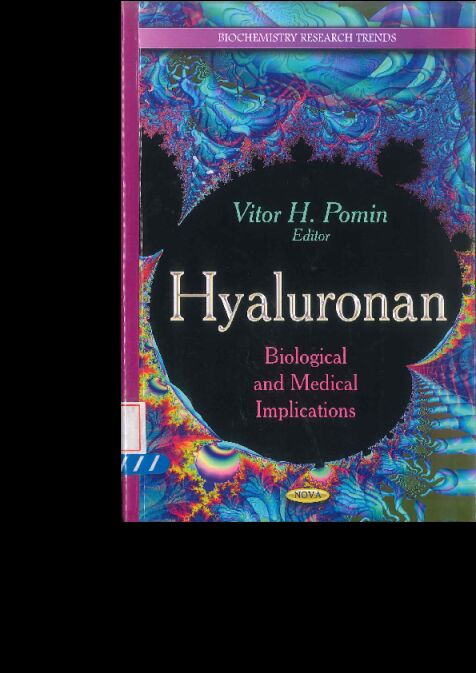
书名:Hyaluronan
出版时间:2014
出版社:Nova Publishers,
前言
Hyaluronan or hyaluronic acid (HA), the only non-sulfated glycosaminoglycan (GAG) of the body, is structurally composed of disaccharide repeating units of alternating 3-linked N-acetyl β-D-glucosamine and 4-linked β-D-glucuronic acid. Despite the lack of sulfation and the lowest structural heterogeneity among all GAGs, HA still retains efficient capability in interacting with many molecules, especially functional proteins like growth factors, cytokines, and adhesive proteins involved in angiogenesis, tumor proliferation, migration, and invasion. However, the main biological role of HA is to assemble the extracellular matrices of certain soft tissues, such as vitreous humor, synovial fluid, umbilical cord, and the intercellular space of the epidermis. HA is the major structure-forming component in the globe of the eye and cornea. For this reason, this GAG can be used to compose ophthalmic solutions. The most famous physicochemical property of HA is its capacity to make gels in solution. This property can be pharmaceutically and industrially useful as either a vehicle to make specific media or biologically active sera. This book, heavily based on recent scientific results from research groups of several countries, will cover many of these aspects of HA, the related enzymes and metabolism in health and disease. The seven chapters are basically centered in 1) the covalent modifications of HA by serum protein and the biological consequences; 2) the aspects of HA as a function of age; 3) carcinogenesis as a function of HA metabolism; 4) therapeutic applications of HA-related enzymes; 5) characterization and analyses of HA-based ophthalmic solutions; 6) the role of HA in reproductive medicine; and 7) the role of HA in bone medicine. The contributing authors are renowned scientists in the HA field and this collaborates to the high-quality of this publication.
Chapter 1 - During inflammatory responses and cancer malignance, hyaluronan becomes covalently modified by serum-derived hyaluronan-associated proteins (SHAP), which are derived from the heavy chains of inter-alpha-trypsin inhibitor (ITI). The physiological significance of SHAP modification of hyaluronan was explored using knockout mice deficient in SHAP-hyaluronan complex formation. In ovalbumin-induce airway hyperresponsiveness (AHR) model, the SHAP-deficient mice exhibited elevated AHR. The levels of sTNFRl and IL12p40 in the airway secretion were greatly reduced in SHAP-deficient mice. In addition, the proliferation of epithelial cell and the repair of airway epithelium were significantly impaired in SHAP-deficient mice. These findings suggest that the SHAP modification of hyaluronan is important to the protection of airway epithelium and remission of tracheal inflammation. In contrast, the SHAP-deficient mice were resistant to bacterial lipopolysaccharide (LPS)/D-galactosamine-induced acute liver injury, exhibiting significant decrease in the serum alanine aminotransferase level, the number of apoptotic hepatocytes and infiltrated neutrophils, and the mortality rate. LPS stimulation neither upregulate the avidity of neutrophil CD44 to HA nor increase the amount of hyaluronan on the surface of liver sinusoidal endothelium. But it stimulated the deposition of SHAP on sinusoidal HA. Cell adhesion experiment showed that the presence of SHAP dramatically potentiates the adhesion of CD44-bearing cells to hyaluronan. Consistently, LPS-induced neutrophil adhesion to liver sinusoids was reduced by 50% in SHAP-deficient mice. Therefore, SHAP-HA-CD44 interaction underlies LPS-induced liver injury. Taken together, these findings show clearly that the SHAP modification of hyaluronan is crucial to hyaluronan function in inflammatory responses. However, the effect could be either proinflammatory or anti-inflammatory, depending on the tissues and cells involved.
Chapter 2 - The effect of aging on Hyaluronan (HA) has been studied primarily in the context of skin and cutaneous wound repair in animal models ranging from mice to human. Fetal skin contains high levels of higher molecular weight (HMW) HA, which is well described as inducing healing without fibrosis and scar formation. Adult skin is thought to retain HA content, but have alterations in HA synthesis. There is also evidence that aging alters cleavage of native HMW HA into lower MW forms. For example, author have found that age-related impairments in cutaneous wound repair are correlated with a deficit in the production of LMW-HA in aged mouse dermis. More recently, author have demonstrated that healing of dermal wounds in aged mice is significantly improved by treatment with HA of lower MW size. The influence of aging on HA content and MW in other tissues remains incompletely characterized. Aging might affect the extraction of HA, thereby altering the accurate measurement of HA content and size. Data in other organs such as the brain, prostate, and joints have evaluated HA content and size in the context of diseases that are more common with aging, rather than age itself. These studies also suggest that with aging, most tissues modify HA content, size and influence on cellular processes relevant to injury, repair, and the development of pathology. This chapter will provide an overview of age-related changes in HA in the basal state and during injury in organs such as skin, brain, prostate and skeletal joints.
Chapter 3 - Most of the cells in multicellular organisms are in contact with intricate meshwork of interacting, extracellular macromolecules that constitute extracellular matrix (ECM). The ECM plays an important role not only in tissue architecture but also in regulation of gene expression and cell behavior. Many of the ECM effects are mediated by dynamic interaction between ECM macromolecules and their receptors. Among the ECM components, Hyaluronic Acid (HA) is one of the fascinating molecule. HA is a high molecular weight, uniformly repetitive, linear glycosaminoglycan (GAG) composed of disaccharides of glucuronic acid and N-acetylglucosamine. HA is huge-not only in molecular weight, but also in the space it occupies in solution, and its versatile biological function is completely dependent on its size. Earlier studies showed that cell divide and migrate within ECM rich in HA. The dramatic modulation of HA concentration and organization accompany cellular changes that take place during tissue and organ differentiation. In recent years, ample of studies have revealed the critical role of HA in carcinogenesis in many types of cancer, and it can be an independent prognostic indicator. During tumor development, cancerous cells tend to synthesize more HA and has been shown to accumulate in the intracellular compartments and pericellular matrices. The accumulated HA in the tumor is known to triggers signaling pathways that are favorable for tumor growth. These effects are mediated through the interaction between HA and its binding proteins (HABPs, Hyaluronic Acid Binding Proteins). Further, catabolism of HA to HA oligosaccharides by hyaluronidase enzyme leads to angiogenesis and new array of cell signaling events. Therefore, targeting aberrant HA synthesis and accumulation could potentially prevent tumor growth. In this chapter, author will discuss the biological synthesis of hyaluronic acid during normal developmental process and carcinogenesis. Further author will discuss the catabolism of HA to HA oligosaccharides. Finally, author will discuss the possible ways to prevent aberrant HA synthesis and its accumulation during carcinogenesis.
Chapter 4 - Hyaluronidases are enzymes able to degrade hyaluronic acid. They are classified in three groups: mammalian, leeches and microbial hyaluronidases. Their role in vivo is essential for the homeostasis and metabolism of the extracellular matrix, thus regulating cell growth. Then-action could be measured by chemical, physicochemical and biological methods. The first employ reductimetric reactions on the products of hyaluronidases. Physicochemical procedures measure the changes of physical features of the substrate, like viscosity. Biological methods evaluate the spreading effect of the enzyme in the animal model. Several applications have been described in literature, mainly a spreading factor. The most important application is hypodermoclysis, the capacity of increasing absorption and dispersion of an injected drug. Hyaluronidases are employed in radiography for increasing the spread of radiopaque substances, in gynecology along with ergometrine to prevent post-partum hemorrhage, in obstretric blocks of the pudendal and ileoinguinal nerve. In ophtahnology hyaluronidases are instilled with local anesthetics for retrobulbar, peribulbar, sub-Tenon's, and van Lint blocks. In fact the injection of hyaluronidase increases in intraocular pressure (IOP), less distortion of the surgical site, decreased incidence of postoperative strabismus, and potential for limiting local anesthetic myotoxicity. Hyaluronidase could also be employed for post-operative edema reduction. In this perspective hyaluronidases are employed in transplant surgery as long as they reduce interstitial edema and the risk of rejection. In chemotherapy hyaluronidases prevent the risk of local injury after drug extravasation. In pain therapy the enzymes are employed to increase the spread of local anesthetics in selective blocks, while in cardiology they could reduce the size of myocardial infarcts after coronary occlusion. Moreover hyaluronidases can be successfully employed to treat complications by inappropriate subcutaneous injection of hyaluronic acid for aesthetic purposes. In fact an excessive inoculation of hyaluronic acid filler mayhesitate in visible overecorrection, nodules, bumps or ischemic complications by compression of the dermal plexus. Given the importance of these enzymes for homeostasis and their applications in Medicine, a proper knowledge is essential for the everyday practice.
Chapter 5 - Hyaluronan (HA), also known as hyaluronic acid or sodium hyaluronate, has drawn considerable interest and attention from ophthalmic surgical and eye care industries due to its biocompatibility, lubricity, and viscoelastic properties. A more complete understanding of HA biopolymers has therefore become increasingly critical since thorough characterization of raw materials and finished ophthalmic products helps promote product quality and process control. Often such detailed information requires the use of a combination of analytical techniques. In this chapter, author compare size exclusion chromatography (SEC) with on-line multi-angle light scattering (SEC-MALS) and SEC with triple detection (SEC-TD) experiments for HA analysis. Three lots of commercially available eye drop grade HA raw materials were characterized by SEC-MALS and SEC-TD. The absolute molecular weight averages, molecular weight distribution, radius of gyration, intrinsic viscosity, and solution conformation of the HA lots were determined and compared by the two techniques.
In addition, the molecular weights and concentrations of HA in eleven marketed ophthalmic products were evaluated by hyaluronidase digestion experiments and by SEC-TD. The weight-average molecular weights (M_w) of the products tested ranged from 155,000 to 1,400,000 Daltons and the concentration of HA ranged from 0.003% to 0.15%. The work presented in this chapter is from the first publication on characterizing HA molecular weights and concentrations in various marketed HA containing ophthalmic products. Research has indicated that there is a correlation between the molecular weight of hyaluronan and its biocompatibility/biological functions, with high molecular weight HA exhibiting many biological and physiological benefits. Future investigation of the effect of low molecular weight HA on eye is required.
Chapter 6 - This chapter presents the usefulness of hyaluronan in reproductive medicine. Hyaluronan is a major constituent of the extracellular matrix of the cumulus cells in the cumulus-oocyte complex and may play a critical role in the selection of functionally competent spermatozoa during in vivo or in vitro fertilization. Hyaluronan can serve as the selective marker during intracytosplasmic sperm injection (ICSI) to select and inject the most optimal spermatozoon. The technique of ICSI requires the immobilization of the spermatozoa. Polyvinylpyrrolidone (PVP) routinely used during ICSI, facilitates handling of spermatozoa. PVP is an artificial polymer, which has been regarded as chemically inert, although adverse effects as a result of its use have been reported. Viscous solution of hyaluronan can be used as an alternative to toxic PVP. Moreover, hyaluronan is also a major glucosaminoglycan in the uterine fluid. It has been shown to increase cell-cell adhesion and may improve embryo apposition and attachment. Some studies suggest that the use of hyaluronan containing embryo transfer medium can improve the implantation.
Chapter 7 - Bone serves as a structural framework and provides protection to various organs, yet also contributes substantially to hemopoiesis and mineral homeostasis. Osseous tissue is richly supplied with blood vessels and nerves, which are embedded in extracellular matrix composed of collagen fibers and crystallized calcium-phosphate salts known as hydroxyapatite. After a bone fracture, typically blood leaks from torn ends of vessels and forms a clotted mass known as the fracture hematoma. During healing progression, fibroblasts, chondroblasts, and osteogenic cells invade the fracture site and start forming a cartilage-and hyaluronan-rich fibrous callus that is replaced first by spongy bone trabeculae and subsequently further remodeled to compact bone. Depending on the site and size of the bone defect, but also on the health status and age of the patient, complete healing can take up to several months. In this regard, treatment with β-tricalcium phosphate-based bone graft substitutes has been reported to support the overall regeneration progress. Further along these lines, hyaluronan-coated biocompatible bone replacement material is providing a more favorable environment for invading cells or was shown to serve as a delivery vehicle for autologous cells. In this review the osteoconductive role of hyaluronan and its medical application in bone graft substitutes in the context of fracture healing, bone fragment fixation surgery and implant osseointegration will be discussed.
查看更多
目录
Preface vii
Chapter 1 Covalent Modification of Hyaluronan by Serum Protein and Its Biological Consequence 1
Lisheng Zhuo and Koji Kimata
Chapter 2 Aging and Hyaluronan 15
Mamatha Damodarasamy and May J. Reed
Chapter 3 Biological Synthesis and Catabolism of Hyaluronic Acid during Carcinogenesis 31
Rajeev K. Boregowda and Shib Das Banerjee
Chapter 4 Hyaluronidases: Biological Features and Current Therapeutic Applications 53
if. Gazzola, G. Colombo, S. Marcelli and L. Vaienti
Chapter 5 In vitro Characterization and Ophthalmic Applications of Hyaluronan 85
X. Michael Liu, Patricia S. Harmon, E. Peter Maziarz and John W. Sheets
Chapter 6 The Role and Use of Hyaluronan in Reproductive Medicine 113
Barbara Pregl Breznik, Borut Kovacic and Veljko Vlaisavljevic
Chapter 7 Hyaluronan-Coated Bone Graft Substitutes and Their Osteoconductive Properties 139
Stephan Reitinger, Robert G. Stigler and Gunter Lepperdinger
Editor's Contact Information 149
Index 151
查看PDF
查看更多
馆藏单位
中国医科院医学信息研究所