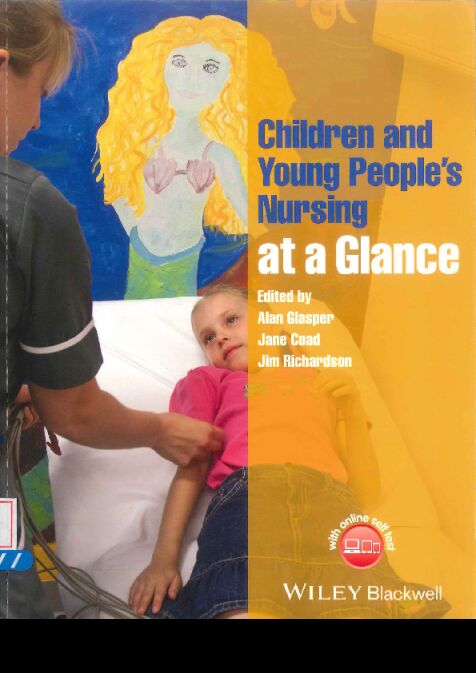
书名:Children and young people’s nursing at a glance
责任者:Alan Glasper | Jane Coad | Jim Richardson. | Richardson, Jim,
出版时间:2015
出版社:John Wiley & Sons Inc.,
前言
The education of children's and young peoples nurses remains a foremost challenge for those wishing to ensure the accuracy-arid safety of the evidence base for practice. As long ago as 1952, Twistington-Higgins in his book written to commemorate the first 100 years of The Hospital For Sick Children, Great Ormond Street, London, UK, reiterates one of the original aims of the hospital dated 1852, which was: 'To disseminate among all classes of the community but chiefly among the poor a better acquaintance with the management of infants and children during illness by employing it [The Hospital] as a school for the education of women in the special duties of children's nursing'.
That initial aim of one of the early children's hospitals resonates with contemporary children's and young people's nursing and Catherine Jane Wood, one of the early matrons of The Great Ormond Street children's hospital left a tangible legacy of the importance of educating children's and young people's nurses in stating that 'Sick children require special nursing and sick children's nurses require special training' (Wood 1888). In recognition of that laudable aim this new and exciting at a Glance book has been written by experienced practitioners and educators in a common quest to capture the complexities delivering nursing practice based on best evidence.
All children's and young people's nurses share a single espirt de corps which unites them with their colleagues worldwide and although this book is primarily reflective of children's and young people's nursing in the United Kingdom, others will find it an invaluable guide to the delivery of evidence-based nursing care.
Although the prime focus of the book is to illuminate best clinical practice, my fellow editors and I hope that the format of the at a Glance series will provide quick and easy access to important care delivery information packaged in an engaging and informative style. This book will be of interest to undergraduate student nurses and existing registrants wishing to remind themselves of the complexities of children's and young people's nursing which encompasses care delivery across the lifespan of the child from birth through to the emergence of the young person and future adult. In the pages of this book you will find concise information to help you deliver that care to this wide and disparate client group that makes up the landscape of contemporary childhood.
For those students wishing to test their knowledge and understanding of the content there is a comprehensive bank of multiple choice questions on the companion website.
This book could not have been completed without the organizational expertise and help of Brenda Nash. My fellow editors and I are in her debt. Alan Glasper
查看更多
目录
Preface viii
Contributors ix
How to use your revision guide xiv
About the companion website xvii
Part 1 Assessment and screening 1
1 Assessment of the child 2
2 SBAR framework 4
3 The nursing process 6
4 Nursing models 8
5 The care plan 10
6 Record keeping 12
7 Engagement and participation of children and young people 14
8 Observation of the well child 16
9 Observation of the sick child 17
10 Septic screening 19
11 Advanced physical assessment 20
12 Developmental assessment 22
13 Paediatric Early Warning Score 24
14 Paediatric critical care 26
15 Understanding investigations 28
16 Understanding blood gas analysis 30
17 Understanding blood chemistry 32
18 Understanding pathology specimen collection 34
19 Understanding X-rays 36
20 Pulse oximetry 38
21 Central venous devices 40
22 Tracheostomy care 42
23 Infant resuscitation 44
24 Young person resuscitation 46
25 Resuscitation drugs 48
26 Emergency care 50
Part 2 Working with families 53
27 Partnership 54
28 Family centred care 56
29 Family health promotion 58
30 Communicating with children 60
31 Hospital play 62
32 Role of the community children's nurse 64
33 Collaboration with schools 66
34 Family information leaflets 68
35 Safeguarding 70
36 Fabricated or induced illness 72
37 Gaining consent or assent 73
38 Clinical holding 74
39 Breaking bad or significant news 76
40 Care of the dying child 78
41 Dealing with aggression 80
42 Minimizing the effects of hospitalization 82
43 Transition 84
Part 3 The newborn infant 87
44 Fetal development 88
45 Neonatal examination 90
46 Neonatal screening tests 92
47 The premature baby 94
48 Neonatal transport 96
49 Jaundice and hyperbilirubinaemia 98
50 Congenital heart disease 100
51 Neonatal resuscitation 102
52 Incubator/Babytherm care 104
53 Sudden infant death syndrome 106
Part 4 The developing child 109
54 Nutrition in childhood 110
55 Breastfeeding 112
56 Bottle feeding 114
57 Feed calculations 116
58 Percentile charts 118
59 Child development: 0-5 years 120
60 Child development: 5-16 years 122
61 Age-appropriate behaviours 124
62 Common behavioural problems of childhood 126
63 Adolescent development 128
64 Child health promotion 130
65 Immunity and immunization 132
66 Childhood immunizations 134
Part 5 Child heath policy 137
67 Child health policy 138
68 The rights of children in hospital 140
69 The NHS Change Model 142
70 Young person policy 144
71 Child disability policy 146
Part 6 Nursing the sick child and young person 140
72 Pain assessment 150
73 Pain management 152
74 Preoperative preparation 154
75 Postoperative care 156
76 Pressure area care 158
77 Managing fluid balance 160
78 Administering medication 162
79 Drug calculations 164
80 Enteral and nasogastric feeding 166
81 The feverish child 168
82 Infectious childhood diseases 170
83 Assessing infectious diseases 172
84 Prevention of infection 174
85 Hyponatraemia and its prevention 176
86 Thermal injuries 178
87 Childhood fractures 180
88 Plaster care 182
89 Traction care 184
90 Neurovascular observations 186
91 Neurological problems 188
92 Brain injury and coma 190
93 Seizures 192
94 Meningitis 194
95 Septicaemia 196
96 Respiratory problems 198
97 Asthma 200
98 CPAP and BiPAP 202
99 Cardiovascular assessment and shock 204
100 Inflammatory bowel disease 206
101 Gastro-oesophageal reflux 208
102 Coeliac disease 210
103 Appendicitis 212
104 Constipation 214
105 Renal problems 216
106 Haematological problems 218
107 Musculoskeletal problems 220
108 Reproductive and sexual problems 222
109 Skin conditions 224
110 Atopic eczema 226
Part 7 Chronic and life-limiting conditions 229
111 Living with chronic illness 230
112 Cystic fibrosis management 232
113 Juvenile idiopathic arthritis 234
114 Epilepsy 236
115 Childhood cancer 238
116 Cleft lip and palate 240
117 Diabetes 242
118 Diabetes management 244
119 Childhood obesity 246
120 Eating disorders 248
121 Mental health problems 250
122 Self-harm in childhood 252
123 What is a learning disability? 254
124 Autistic spectrum disorder 256
125 Communicating with the child who has a learning disability 258
126 Positive behavioural support 260
127 Atrioventricular septal defect in children with learning disability 262
128 Genetic conditions: Down's syndrome 264
129 Other genetic conditions 266
References and Further reading 268
Index 275
查看PDF
查看更多
馆藏单位
中国医科院医学信息研究所