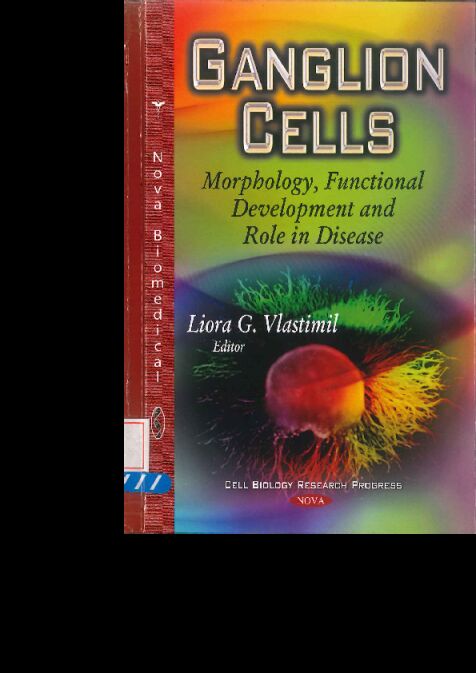
书名:Ganglion cells
出版时间:2014
出版社:Nova Science Publishers, Inc.,
前言
The ability to observe the world around us through sight provides us with many advantages we may take for granted daily. We are able to recognize a hazard well in advance because we see it; we can find allies because we see them. Further, thanks to the perception of the world that gives us sight, we can collect information to help us develop feelings, such as trust in others, love and sensations, like beauty. However, the mechanism to enjoy this capability is really complex, starting with the structure responsible for receiving, processing and transmitting information to the brain. This book discusses the ways in which ganglion cells are used in the nervous system, as well as its morphology, functional development and role in diseases.
Chapter 1 - The orderly, retinotopic mapping of retinal ganglion cell (RGC) axon terminals within the visual centers of the brain is critical to functional visual perception. More than 50 years ago, Roger Sperry developed the chemoaffinity model to explain the intrinsic ability of regenerating RGC axons to find and synapse in the appropriate retinotopic organization within the optic tectum in the goldfish, Carassius auratus. He proposed that orthogonal gradients of signaling molecules could function as Cartesian coordinate systems within the retina and brain to specify physical addresses of RGCs and their post-syanptic targets. These chemoaffinity molecules, subsequently identified as ephrins (EFN) and tyrosine kinase ephrin receptors (EPH), have been shown to play a vital role in establishing topographic maps of connectivity throughout the visual and other sensory systems within the central nervous system. This chapter presents a comprehensive review of the discovery, structure, signal transduction, expression patterns and transcriptional regulation of EPH receptors, ephrin ligands and EPH/EFN signaling in RGCs during visual system development and in diseases affecting the optic nerve.
Chapter 2 - Mammalian photoreception requires the presence of photosensitive cells in the retina. This process takes place thanks to a protein (opsin), which contains a cromophore. Rods and cones allow mammals, and other multiple species, to see the world around them. Rods and cones were thought to be the only photoreceptors until the last decades. The discovery of a new opsin (melanopsin) inside other retinal cells has finished with the traditional exclusivity of rods and cones as photosensitive cells. In mammals, these ceils are localized in the Ganglion Cell Layer. There is a ganglion cell type that contains this photopigment, the melanopsin ganglion cells, commonly known as ipRGCs (intrinsically photosensitive retinal ganglion cells). These cells appear to have a key role in regulating certain aspects of the visual system not related to image formation, as well as various physiological functions fundamental for the organism: Melanopsin is an important regulator of the circadian clock.
Earlier studies showed how blind individuals with degenerated rod and cone photoreceptors still maintained photoentrainment and the pupillary light reflex. The presence of another photoreceptor was obvious. Melanopsin-containing cells were found in mouse and human retinal ganglion cells, but other animals had amacrine and horizontal cells that also expressed melanopsin. Melanopsin ganglion cells were regarded as the new type of photoreceptor. However, recent studies indicate that ipRGCs are composed of different subtypes. The relation between subtype and function is not always clear. Some of these subtypes share targets in the central nervous system (or even share physiological functions), but they have important morphological differences.
Nowadays, the scientific community accepts the role of the different ipRGCs in non-visual processes, whereas rods and cones are involved in image formation. It is very interesting to study the differences between melanopsin retinal ganglion cells and classical photoreceptors, since their physiological functions are not the only differences. In addition, their molecular requirements and their photochemical properties show a different evolutionary origin. Understanding the evolution and functions of visual and non-visual systems is crucial to understand the functional differences among opsins.
Chapter 3 - The DBA/2J mouse is a common animal model of glaucoma. The intraocular pressure increases with age, and retinal ganglion cells (RGC) degenerate, usually starting at an age of approximately six months. In this chapter, the authors show how RGC degeneration in two-year-old DBA/2J mice has almost reached an end-point. The authors investigated visual function in these animals using electroretinography (ERG) and visual evoked potentials (VEP), and the authors checked the number of remaining RGC by retrograde staining. Almost no RGC were left in the retina, and VEP were hardly recordable. Surprisingly, also ERG amplitudes of scotopic a-waves and b-waves, photopic b-waves and oscillatory potentials were decreased significantly by approximately 40% compared to amplitudes measured in age-matched C57BL/6J mice. The latencies were not changed in DBA/2J mice compared to controls, and so were the ratios between amplitudes of a-waves, b-waves and oscillatory potentials. The author's results indicate that, in addition to degeneration of RGC, also photoreceptors are affected by pathological processes in the eye caused by the mutations present in DBA/2J mice.
Chapter 4 - Dorsal root ganglion (DRG) neurons are constituents of the peripheral sensory nervous system, and methods for their primary culture from embryonic, neonatal, and adult animals have been established. Because some biological properties of DRG neurons can change with maturation and aging, adult DRG neurons appear to be a better choice for studies on axonal regeneration after injury and peripheral neuropathies than immature neurons. In dissociated cell culture, each of the ganglion neurons is mechanically and enzymatically isolated and seeded in a substrate-coated culture dish. Because of the good yield of ganglion neurons with high purity and viability, various assays can be performed on these neurons (e.g., cell attachment, cell viability, neurite outgrowth activity, electrophysiology, and immunocytochemistry). In explant culture, ganglia associated with nerve fibers are embedded in a collagen gel or Matrigel, and the number and length of neurites outgrowing from nerve-transected terminals are measured. Because cell-cell interactions are maintained in an explanted tissue, it is likely that an explant culture system mimics nerve regeneration in vivo better than a dissociated cell culture system. Using these culture systems, the authors investigated mechanisms of action of several different molecules that regulate axonal regeneration (e.g., ciliary neurotrophic factor, galectin-1, exendin-4, and chondroitin sulfate proteoglycans). In addition, these culture methods have been applied to animal models of aging and diseases (e.g., diabetes, G_M2 gangliosidosis, and systemic lupus erythematosus) to elucidate the pathogenesis of neurological disorders that result from those conditions.
查看更多
目录
Preface vii
Chapter 1 EPH-Ephrin Signaling in Retinal Ganglion Cells 1
Deborah C. Otteson and Tihomira D. Petkova
Chapter 2 Nonvisual Ganglion Cell Subtype: Which Kind of Cells Are they? And Where Do They Come from? 71
Javier Vicente, Pedro de la Villa and Francisco Germain
Chapter 3 Detailed Insights into Functional Retinal Neurodegeneration of Aged DBA/2J Glaucoma Mice 103
Sven Schnichels and Peter Heiduschka
Chapter 4 What Have We Learned from Cultured Adult Dorsal Root Ganglion Neurons? 125
Kazunori Sango, Naoko Niimi, Masami Tsukamoto, Kazunori Utsunomiya, Kunihiko Sakumi, Yusaku Nakabeppu, Toshihiko Kadoya and Hidenori Horie
Index 149
查看PDF
查看更多
馆藏单位
中国医科院医学信息研究所