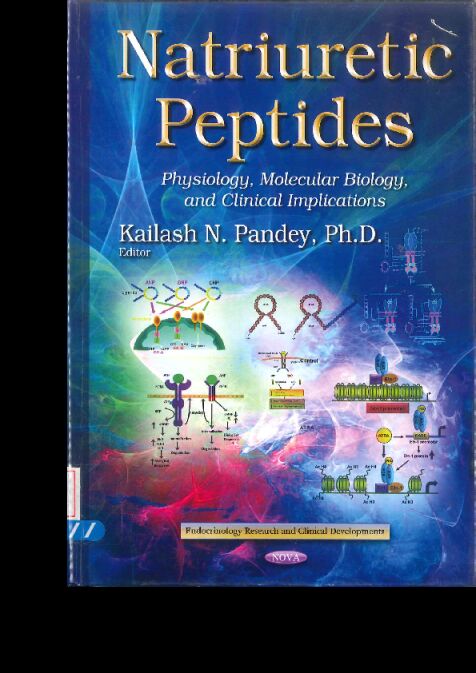
书名:Natriuretic peptides
ISBN\ISSN:9781633210806,1633210804
出版时间:2014
出版社:Nova Publishers,
前言
Since the pioneer discovery of de Bold and his colleagues in 1981, the advances in the field of natriuretic peptides and their receptor have been experienced in a continuous growth fashion. Now, the natriuretic peptide field has proved itself as a mature discipline in the biomedical arena. In the past thirty-four years, countless studies have provided an energetic impetus to explore this emerging area with respect to the cellular, molecular, and clinical aspects of natriuretic peptides and their receptors. Elucidation of the underlying mechanisms by which natriuretic peptides and their receptors elicited biological, physiological, and pathophysiological responses have provided hallmark significance and novelty to delineate both cGMP-dependent and independent signaling cascades. After ligand binding to the receptor, numerous sequential steps take place, which have been regarded important events for controlling overall hormone responsiveness, receptor activity, and transmembrane signaling to achieve ultimate hormone-receptor function(s). This book discusses the current knowledge and recent developments to navigate cellular, molecular, and clinical aspects of natriuretic peptides and their receptors in health and disease.
State-of-the-art technology in cell and molecular biology have been applied and also being continued to delineate the studies of natriuretic peptides and their receptors in terms of expression, function, and regulation both in vitro and in vivo systems. Concurrently at the same time, the field has experienced and undergone a resurgence, endured in large part by the advent of molecular biological approaches to generate the transgenic and gene-targeted (gene-knockout and gene-duplication) mutant mouse models. The genetically engineered transgenic and gene-targeted mouse models have clearly demonstrated that the absence of the functional natriuretic peptides and/or their cognate receptors could lead to not only elevated high blood pressures but cause severe hypertensive heart disease in the experimental animals similar to those seen in untreated human hypertensive patients. The genetically engineered mouse models have been useful to reveal not only the actual functions of natriuretic peptides and their receptors genes but more critically their modifying interactions with other genes. The current and past studies have led to the increasing importance of natriuretic peptides and their receptors in health and disease in bedside diagnosis, treatments, and therapeutics advancements. The book presents a comprehensive look and consists of assessments of the past and current status and future prospects of the ongoing activities in fourteen chapters of the natriuretic peptides and their receptor systems. After the discovery of three different but structurally-related natriuretic peptides and three specific cognate receptors, in particular, their combined therapeutic as well as diagnostic potentials in hypertension and cardiovascular diseases have initiated the need of an overall comprehensive compilation of the current status of this field.
In spite of tremendous progress and growth, still there have been reluctance to the advancement and full consideration of the natriuretic peptides and their receptors as the therapeutic treatment options. It is with this goal and spirit that the contributions of renowned and pioneering scientists and investigators have been compiled in this book to highlight more focused and detailed information regarding the growth of the field of natriuretic peptides and their specific receptors. The book comprises the contributions from eminent investigators and scientists who are nationally and internationally recognized in their area of research expertise, and presents a wide range of reviews spanning the research works done on the family members of natriuretic peptides and their receptors. Each chapter provides a comprehensive summary of the accomplished experimental findings and future perspectives and direction of research to be performed in this vital and important cardiovascular field.
The chapters in this book address key aspects of the natriuretic peptides and their receptors that high light the key areas in this field. Together, these chapters represent an overview of the status of the natriuretic peptides and their receptors from the past to the current accomplishments and exciting future investigations. I gratefully acknowledge and thank all the contributors for their genuine and painstaking efforts and quality of works they have presented. I am also indebted to the contributors for their support, encouragement and cooperation throughout the development and progress of this book. The interaction and correspondence with many of these colleagues made this undertaking a remarkable memorable assignment, which at time was an ambitious task yet enjoyable learning experience and educational accomplishments.
I sincerely thank and offer my deep appreciation to numerous investigators and researchers who have carefully conducted and published a large volumes of works on the natriuretic peptides and their receptor system, but due to space limitation their contributions was not listed in this book. I sincerely thank all the present and pervious members of my laboratory for their numerous and valuable contributions. Finally, I would like to recognize my wife Kamala Pandey for her efforts in helping me in the preparation of this book. Kailash N. Pandey, Ph.D. Department of Physiology, SL-39 Tulane University Health Sciences Center, School of Medicine, 1430 Tulane Ave, New Orleans, LA 70112 Tel: (504) 988-1628 Fax: (504) 988-2675 Email: kpandey@tulane.edu
查看更多
目录
Preface vii
Chapter 1 Natriuretic Peptides 1
Chapter 2 Cellular, Molecular and Clinical Aspects of Natriuretic Peptides and Their Receptors in Health and Disease 31
Chapter 3 MANP: A Novel Designer Natriuretic Peptide GC-A Activator for the Treatment of Hypertension and Heart Failure 77
Chapter 4 Atrial Natriuretic Factor Receptor Guanylate Cyclase: The Journey 101
Chapter 5 Natriuretic Peptide Receptor: Structure and Signaling Mechanism 119
Chapter 6 Physiology and Patho-Physiology of Signal Transduction via Cardiac Natriuretic Peptides and Guanylyl Cyclase-A 137
Chapter 7 Natriuretic Peptide Receptor-C in Physiology and Pathophysiology 155
Chapter 8 ARM, the ATP-Regulated Module of ANF-RGC Guanylate Cyclase: Structure and Function 175
Chapter 9 Natriuretic Peptides: Predictive, Diagnostic and Prognostic Implications in Cardiovascular Diseases with Particular Regard to Acute Cardiovascular Events 201
Chapter 10 Natriuretic Peptides Receptors: Molecular Biology, Phisiology and Clinical Implication 217
Chapter 11 Natriuretic Peptides Modulate Inner Ear Function 237
Chapter 12 Mechanisms of Action of Guanylin Peptides 259
Chapter 13 N-Terminal Pro-B-Type Natriuretic Peptide: A Biomarker of Cardiac Dysfunction during Human Fetal Life 277
Chapter 14 Transcriptional Control Mechanisms of Guanylyl Cyclase/Natriuretic Peptide Receptor A Gene 301
Index 331
查看PDF
查看更多
馆藏单位
中国医科院医学信息研究所