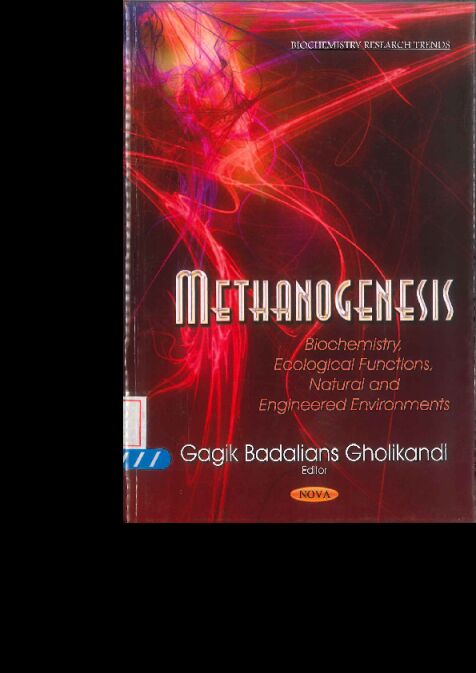
书名:Methanogenesis
责任者: Gagik Badalians Gholikandi. | Sadabad, Hamed Rasouli.
出版时间:2014
出版社:Nova Science Publishers, Inc.,
前言
The combustible gases have been emitted from natural and geological sources since ancient time. It was the experiments of Alessandro Volta on combustible air achieved from swampy and oozy areas that created interests to guide scientific researches according to these gases, and consequently, led to exploration and recognition of the methane gas as an important member of this group. The ancients, i.e., the Greeks, Persian, and Indian discovered natural gas. They were excited by the burning springs created when natural gas seeped from the ground cracks and was ignited by lightning. Sometimes they built temples around these everlasting flames and worshipped the fire. About 2,500 years ago, the Chinese recognized that they can use natural gas as a source of energy. The Chinese transported the gas by pipes from shallow wells and burned it under large pans to evaporate sea water for salt production.
Methane is one of the most effective gases that have affected human's life especially as a satisfactory source of energy. Nowadays, the industrial development and increasing demand to other energy sources than oil and coal brought methane gas into the front as a substitute for them. The most growing use of natural gas is for the electrical power generation. At atmospheric pressure one cubic meter of biogas is equivalent to about 0.6 liters of the fuel oil.
On the other hand methane, an important greenhouse gas, has built up rapidly in the atmosphere since the nineteenth century and is capable of harming or destroying the planet if there are uncontrolled emissions. A global increase in the occurrence of extreme weather events has led to an increasing awareness of the potential role of anthropogenic sources of greenhouse gases in climate change. The rapid urbanization and industrialization in recent decades, evidently predicts the requirement for efficient systems for conversion of the generated wastes such as agricultural, domestic and industrial solid waste, and wastewater into useful end products. The common preferred process for the waste sludge stabilization is the anaerobic digestion, due to the related energy recovery from sludge, i.e., biogas production and anaerobically-digested sludge application, i.e., agricultural and industrial uses. Consequently, the environmental problem caused by sewage sludge can be solved in a sustainable way; thus allows water and stabilized sludge to utilize for reuse and reclamation purposes. However, the anaerobic treatment process of wastewater and stabilization of waste sludge may also create an environmental problem, i.e., greenhouse gases uncontrolled emissions, especially carbon dioxide and methane. Bio-electrochemical systems are also capable to treat organic waste solids and wastewater, and generate electrical energy simultaneously. These technologies present many exciting opportunities and chronologically contain different challenges to be utilized in various applications.
These facts make us to take a more precise look at the need to recycle waste rather than simply find ways to dispose of it. Nowadays, the world is confronted with the twin challenges of fossil-fuel depletion and greenhouse gases emissions. Therefore, numerous scientists and engineers are obliged to investigate various solutions in order to optimize the methanogenesis process in different environments and to overcome the methane production and utilization problems.
However many attractive features can be offered by anaerobic systems, i.e., low operating and maintenance costs, biogas production, low energy and labor requirement, low sludge production, and high efficiency of organics removal; they unfortunately encountered unwarranted reputation as an unstable and difficult to control process. Owing to complexity of the anaerobic digestion process, there has been a growing demand to simulation and monitoring by means of different modeling approaches, i.e., mathematical modeling and software tools. Artificial neural network (ANN) is one of these methods that have been employed to simulate engineered environments performance in different operation conditions.
This book aims at the methanogenesis process occurrence from different points of view, describing its ecological functions and possible environmental impacts, providing an assessment of the existing related technologies and techniques, and highlighting various aspects of bio-energy generation in seven chapters.
In the first chapter a brief review to methanogenesis biochemistry and the sources of methane (natural and engineered environments) as well as its impacts on the environment has been presented. The second chapter discusses the nonbacterial methanogenesis mechanisms and its significance. The third chapter describes the methanogenesis process in a novel engineered environment, i.e., electrolysis-enhanced anaerobic baffled reactor. The modeling of anaerobic digestion by means of numerical methods and software tools has been proposed in fourth and fifth chapters. Chapter six discusses the anaerobic waste sludge digestion and the related affecting parameters. Finally, bio-electrochemical processes and techniques for bio-energy generation have been discussed in seventh chapter.
The main goal of this book is to gather different updated viewpoints according to the methanogenesis process from scientifically and technologically diverse areas in order to present students, researchers, managers and engineers with useful knowledge in this regard. Editor: Assoc. Prof. Dr. Gagik Badalians Gholikandi Faculty of Water Engineering and Environment Shahid Beheshti University, A. C, Tehran, Iran g.badalians@yahoo.com Co-editor: Homed Rasouli, MSc. Faculty of Water Engineering and Environment Shahid Beheshti University, A. C, Tehran, Iran
查看更多
目录
Preface vii
Chapter 1 An Overview of the Methanogenesis Process Occurrence in Natural and Engineered Environments 1
Gagik Badalians Gholikandi and Hamed Rasouli Sadabad
Chapter 2 Nonbacterial Biotic Methanogenesis, Possible Mechanisms and Significance 19
Eszter Tuboly, Andrds Meszdros and Mihdly Boros
Chapter 3 Methane Production Yield and Performance Assessment of Conventional and Electrolysis-Enhanced ABR (EABR) 51
Gagik Badalians Gholikandi and Shervin Jamshidi
Chapter 4 Mathematical Modeling of Acetoclastic Methanogenesis in Two-Phase Biogas-Plants 79
Ivo Muha, Johannes Schneider and Gabriel Wittum
Chapter 5 Biogas Production with Emphasis on Methanogenesis Process: An Investigative View to Applications of Artificial Neural Networks Modeling 113
Mohammad Azimipour, Gagik Badalians Gholikandi and Hamidreza Masihi
Chapter 6 The Anaerobic Sludge Digestion Process 149
Hamidreza Masihi, Gagik Badalians Gholikandi and Mohammad Azimipour
Chapter 7 Bioenergy Generation: Methanogenesis in Bio-Electrochemical Systems 173
Zahra Tizmaghz, Amirreza Arashi and Gagik Badalians Gholikandi
Index 197
查看PDF
查看更多
馆藏单位
中国医科院医学信息研究所