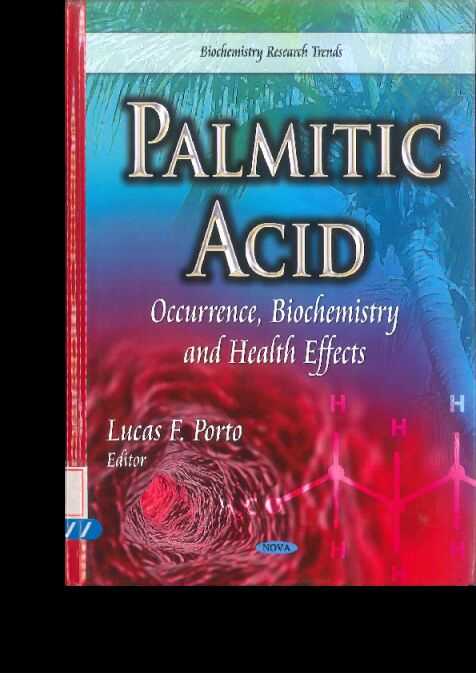
书名:Palmitic acid
出版时间:2014
出版社:Nova Science Publishers, Inc.,
前言
This book discusses the occurrence, biochemistry, and health effects of palmitic acid.
Chapter 1 - Fatty acids have traditionally been described as artery clogging species that is detrimental to overall health. The most prevalent fatty acid is palmitic acid (PA); a sixteen carbon chain fatty acid that is ubiquitous in biological systems. PA is prevalent in most eukaryotic cell membranes and in the mitochondria derived from the Krebs' cycle utilizing acetyl-coenzyme A as its precursor. PA is found in a variety of plants with a high amounts in coconut oil. Many cosmetics, shampoos, and commercialized beauty products contain PA providing structure and substance to the gel or reagent.
An emerging field of study is the esterified form of PA or methyl palmitate, as it is involved in biological signaling in the central nervous system. More specifically, methyl palmitate or palmitic acid methyl ester can cause arterial vasodilation and is thought to be involved in neurotransmission, as well as modulate vascular tonicity in cerebral circulation. Methyl palmitate has also been implicated as a neuroprotective agent in both models of focal and global cerebral ischemia; however, the exact mechanism(s) are still unknown. The authors will focus on the known pharmacology, biochemistry, and clinical implications of PA and other related fatty acids (i.e. Non-esterified v. esterified fatty acids) commonly found in daily diets. Additionally, cellular target(s) of PA will be discussed as it relates to improvement of disease states, synthesis, and possible health implications/benefits of methyl palmitate in biological systems.
Chapter 2 - Palmitic acid (PA), one of the most abundant saturated fatty acid (SFAs) within plants, humans, animals, microbial (bacteria), fungal, and marine organisms, constitutes ~16 to 45 % of the lipid profile. The impressive abundance of PA throughout nature could be attributed partly to its critical role in membrane lipid structural functionality, formation of subcellular cysteine residue linkages and RNA posttranslational modifications in eukaryotic and prokaryotic cells. PA has been demonstrated to undergo β-oxidation to produce short and medium chain fatty acids to maintain homeostasis in response to endogenous and exogenous cues. Further, non-esterified PA is known to mediate numerous biochemical and antimicrobial pathways towards the betterment of human health. Although the importance of PA in human health and nutrition are established, critics attest that excessive dietary PA may be "unhealthy" and even detrimental. Current microbiological and epidemiological studies suggest that PA produces specific health benefits that are not common to all other SFAs. For example, studies suggest that PA may activate nitric oxide and superoxide, thus functioning as an antimicrobial agent against some strains of bacteria, algae, and helminthes and certain foodborne pathogens. This chapter reviews the occurrence, biochemistry, and subsequent health implications of PA.
Chapter 3 - In the last few decades, disagreement between opinions and findings concerning the ability of palmitic acid (PA) and other saturated fatty acids (SFAs) to raise cholesterolaemia has led to discussions on whether PA, which has been positively related to high serum cholesterol levels, could increase the risk of cardiovascular diseases. This study aims to review the PA content of meat, dairy products, fish, and other food of animal origin in the human diet and discusses nutritional issues related to the occurrence of this fatty acid (FA) in these foods due to different diet supplementation. Meat and dairy products are considerable dietary sources of SFAs, such as PA. In most industrialized countries, a high meat or dairy intake contributes to a higher than recommended SFA intake. Palmitic and myristic acids are common FAs in meat and dairy products, making up about 30-40% of total FA intake and are the main factors responsible for raising cholesterol levels; indeed, strong evidence indicates that these two SFAs increase serum cholesterol concentrations in humans. Stearic acid is partially converted to oleic acid in vivo and has not been shown to elevate blood cholesterol, while lauric acid is not as potent as PA at raising concentrations of total cholesterol and LDL cholesterol in humans. The occurrence of PA in animal origin food is influenced by both genetic and environmental factors, such as the composition of the animal's diet, its digestive system and its biosynthetic processes. The FA profile in food of animal origin mainly reflects dietary lipid sources and has the potential to play a valuable role in human nutrition by manipulating the composition of animal fat through diet. In order to explain the variability in FA composition in food of animal origin, this review examines different nutrition trials that have studied the effects of PA supplementation on the lipid profile of animal origin food.
Chapter 4 - Palmitic acid or hexadecanoic acids is the most abundant saturated fatty acid in human nutrition and represents about 17.6g per day in the United Kington diet. It is the first fatty acid produced during the lipogenesis. During this process, glucose is converted to fatty acids, which then react with glycerol to produce triacylglycerols. Palmitic acid mainly occurs as its ester in triglycerides, especially in palm oil (40-44 %) but also in lard (20-30 %), dairy products (25-40 %) and cocoa butter (25-27 %). One of the main applications of palmitic acid in the food industry has been the formulation of interesterified fats, used as a replacement of trans fats. In breast milk, native lard, enzyme-directed and randomly chemically interesterified plant fats, palmitic acid is predominantly esterified to triacylglycerol, center or β-position, in native palm oil and cow's milk, it is mainly at the external or α-positions. A higher palmitic acid absorption is obtained with formulas rich in palmitic acid esterified in triacylglycerol sn-2 position, than with those containing palmitic acid predominantly esterified in the sn-1,3 positions. These specific fatty acids distributions in triacylglycerol, determine the physical properties of the fat, which affects its absorption, metabolism and distribution into tissues. Many authors claim that a palmitic acid intake may promote increased risk of hypercholesterolemia, liver disease, type 2 diabetes, insulin resistance and toxicity. However, more recent investigations on the topic seem to have reconsidered the negative role of the dietary saturated fatty acids as a risk factor for cardiovascular diseases and show that not only the type of fat, but also that the triglyceride structure plays a role in these diseases.
Chapter 5 - Current dietary recommendations are based on a reduced saturated fatty acid (SFA) consumption to prevent cardiovascular disease (CVD). The role of individual SFA in metabolic disease is not fully understandable. One type of SFA present in many common foods (dairy, meat, palm and coconut oil) is palmitic acid (16:0). A number of epidemiological studies have shown that the populations who consume large amounts of atherogenic SFA (especially palmitic, myristic, lauric) have elevated levels of LDL and HDL-cholesterol. Saturated fatty acid exert their atherogenic and thrombogenic effect through increased production of LDL, very-low-density lipoproteins particles and apolipoproteins A1, with a decrease of LDL- receptors specific activity, and an increase in platelet aggregation. The total cholesterol/ HDL-cholesterol ratio, the best overall indication of potential effects on coronary heart disease (CHD) risk is nonsignificantly affected by consumption of palmitic acid (PA). Compared with lipid effects, the influence of SFA intake on inflammation markers is less well explored. The associations between circulating and tissue PA and dietary intake of PA are diverse and most likely reflecting endogenous metabolism. Status of PA is not in intake-response relationship biomarker, probably partly due to conversion of 16:0 to 16:1 by steaoryl-CoA-desaturase (SCD-1). Increased SFA intake has been associated with increased SCD-1 activity in which may predict mortality. Palmitoylation is the process involved in protein-membrane interactions and signal transduction. Increases in dietary intake of PA decrease fat oxidation and daily energy expenditure with slight increases in adiposity. Evidence for the effects of SFA, particularly PA consumption on insulin resistance, vascular function, type 2 diabetes, and stroke is various. It is considered that circulating PA, as nonesterified fatty acids stimulate insulin resistance by decreasing phosphorylation of the insulin receptor and insulin receptor substrate-1. In muscle cells, PA decrease oxidation of fatty acids and glucose which elevates fatty acid and glucose levels in tissues and blood, and decreases adiponectin production, which may both promote insulin resistance. It was shown that 16:0 and 14:0 stimulate β-cells and endothelial dysfunction. The incidence of type 2 diabetes was associated with total SFA levels of plasma cholesterol esters (also demonstrated for 16:0 levels independently) and phospholipids (also for 16:0 and 18:0). In skeletal muscle phospholipids, PA has been negatively associated with insulin sensitivity and diabetes type 2. Systematic reviews on prospective cohort studies indicated that CHD risk has not been directly associated with SFA intake, although is associated with a dietary habits, high in SFA-rich foods. Taken together, there is collective convincing evidence for decreased CHD risk when replacing SFA with polyunsaturated fats. Differences in cardiometabolic risk appear greater between food groups and overall dietary patterns rather than between separate SFA.
Chapter 6 - Palmitic acid (C_16:0) is one of the major fatty acids (FAs) forming virtually all natural lipids. Both in eu-, and prokaryotes, C_16:0 forms various lipid classes, which serve either as the lipid background of storage fats and oils, or the hydrophobic matrix of cell membranes, or the components of cuticle waxes and polymers. Non-esterified C_16:0 does not occur in living cells, and it is present there only as an acyl residue in various lipid classes, such as mono-, di-, and triacylglycerols, glyco-, phospho-, and sphingolipids, wax and steryl esters etc., where it esterifies the hydroxy groups of glycerol backbone or other alcohols (sphingosine, higher and lower aliphatic alcohols etc.). Palmitic acid is known to be a primary higher FA synthesized in the cell, while nearly all other FAs of natural lipids are the products of its further modification caused by elongation, desaturation, insertion of various functional groups, such as methyl, hydroxy, oxo, epoxy, etc. As a saturated FA, C_16:0 is used by the cell for regulating its functional state by shifting the membrane fluidity under adverse environmental conditions and thus providing a necessary molecular species composition of the membrane polar lipids. Among the latter, such classes as phosphatidylinositols, phosphatidylserines, and other highly polar lipids are particularly rich in palmitic acid. In accordance, its content in plant lipids rises as they became less TLC-mobile, more difficultly extractable, or tightly bound. It is evident that further screening of plant lipids as regards this index is of considerable interest.
Chapter 7 - Human breast milk provides the optimum nutrition for infants. Designed to provide balanced nutrition, human breast milk naturally meets the needs of growing infants in the first months after birth. In human breast milk, and in most infant formulas, approximately 50% of the energy is supplied to newborns as fat, of which more than 98% is in the form of triglycerides. Triglyceride synthesis occurs in the mammary gland. The fatty acids are specifically positioned to sn1, sn2 or sn3 positions on the glycerol backbone to yield the structure-specific triglycerides that are found in human milk. Palmitic acid (C16:0) is the predominant saturated fatty acid, comprising 17-25% of the fatty acids in mature human milk. Surprisingly, the positioning of palmitic acid is highly conserved across populations, and approximately 70-75% of palmitic fatty acids are esterified to the sn2 position of the triglyceride (sn2 palmitate).
Clinical and pre-clinical studies over the last three decades have provided increasing evidence that this specific positioning of palmitic acid on the triglycerides in human milk has a significant holistic effect on optimal infant development and well-being that is related to the increased absorption of both palmitic acid and calcium: softer stools, increased bone strength, increased beneficial gut flora, controlled intestinal health, and reduced infant crying. All of these contribute to the benefits of infant wellbeing.
The overall aim of the current review is to expand the understanding of the role of palmitic acid and its specific sn2 position in infant nutrition.
Chapter 8 - Palmitic acid, either in its triglyceride form or hydrolysed as a free fatty acid or an ester, needs to be extracted from its source, processed and isolated to obtain useful products. The objective of this work is to consider the use of SCF (supercritical fluid) processing as a method to extract and process palmitic acid and/or its derivatives. A phase behaviour analysis, in supercritical CO_2, ethane and propane, at temperatures close to the critical point of the solvent show moderate solubility of palmitic acid and tripahnitin at pressures below 50 MPa and total solubility of methyl and ethyl palmitate at pressures below 25 MPa. Analysis of the phase behaviour considered and studies presented in the literature have shown that SCFs can be widely applied to the processing of palmitic acid containing compounds. In particular SCFs can fractionate a mixture of acids or their derivatives according to the chain length, it can de-acidify an edible oil and it is able to fractionate a mixture containing palmitic acid and other compounds. Additionally, SCFs can also be used to extract palmitic acid containing triglycerides from plant material. SCFs, in particular CO_2, are thus excellent alternative solvent to traditional organic solvents and should be considered when processing palmitic acid containing products.
Chapter 9 - In this review the major saturated fatty acid, palmitic acid, of Virgin Olive Oil (VOO) was studied. This oil is one of the oldest known vegetable oils and it plays a fundamental role in human nutrition around the Mediterranean basin. This nature juice is the only edible oil of great production obtained by physical methods from the fruit Olea europaea L. Consideration of VOO as a natural functional fat is related to the presence of palmitic acid. Updating of its levels in Virgin olive oils throughout the Tunisian olive oil as well as information on expecting levels in other products from olive tree establish the author's view point. Studies on levels palmitic acid upon maturity stage in the oil are also discussed.
Major analytical practices are given in brief. Palmitic acid (C16:0) is the principal saturated fatty acid in olive oil, responsible for its figeability at low temperature.
Few are the exceptions as palmitic acid content depends heavily on the genetic factor. Palmitic fatty acids, important for the nutritional properties of an olive oil, showed a crucial rule in the characterization of olive oils.
查看更多
目录
Preface vii
Chapter 1 Fatty Acids in Vascular Health 1
Reggie Hui-Chao Lee, Carl S. Wilkins, Alexandre Couto e Silva, Stephen E. Valido, Celeste Yin-Chieh Wu and Hung Wen Lin
Chapter 2 Occurrence, Biochemical, Antimicrobial and Health Effects of Palmitic Acid 17
Melissa Johnson and Daniel A. Abugri
Chapter 3 Palmitic Acid: Effect of Diet Supplementation and Occurrence in Animal Origin Food 45
P. G. Peiretti
Chapter 4 General Aspects of Palmitic Acid 63
Deusdelia Teixeira de Almeida, Mariana Melo Costa and Sabrina Feitosa
Chapter 5 Palmitic Acid As a Cardioraetabolic Risk Factor 105
Danijela Ristic-Medic and Vesna Vucic
Chapter 6 Palmitic Acid in Higher Plant Lipids 125
R.A. Sidorov, A.V. Zhukov, V.P. Pchelkin and V.D. Tsydendambaev
Chapter 7 Palmitic Acid in Infant Nutrition 145
Fabiana Bar-Yoseph, Yael Lifshitz, Tzafra Cohen and Ita Litmanovitz
Chapter 8 Processing of Palmitic Acid and Its Derivatives Using Supercritical Fluids 159
C. E. Schwarz
Chapter 9 Palmitic Acid in Tunisian Olive Oil: Updating and Perspective 211
Ghayth Rigane and Ridha Ben Salem
Index 219
查看PDF
查看更多
馆藏单位
中国医科院医学信息研究所