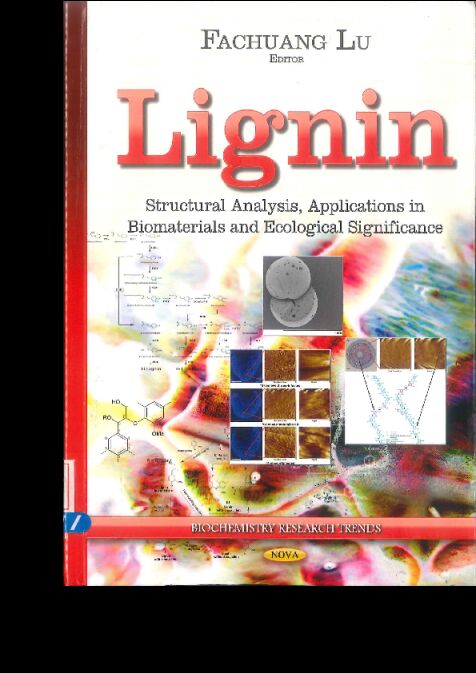
书名:Lignin
出版时间:2014
出版社:Nova Publishers,
前言
As one of the major and crucial components of plant cell walls, the lignin polymer constitutes about 15 to 25% of woody plants and is the second most abundant renewable bioresource on the earth. Lignins produced on a large scale from the pulping industry are mostly burned to recover chemicals and energy. With the increased interest in converting lignocellulosic biomass to fuels or chemicals, even more lignins could be available, offering considerable opportunity to use this abundant aromatic natural resource for production of chemicals and materials. This book aims to provide updated knowledge and research results on selected topics including analytical methods, structural characterization of lignin preparations, and applications of lignins (such as in bio-absorbents, biocomposites, and soil conditioners).A\Advancements in science and technology relating to lignin applications relies on vital and adequate information about lignins themselves, which requires versatile and sophisticated analytical methods specifically for lignins. Many methods have been developed for lignin characterization. The 1992 book, Methods in Lignin Chemistry, edited by S. Y. Lin and C. W. Dence, summarized most of the available analytical methods relating to lignins at that time. Significant advances in lignin analytical methods have been made since then. In particular, advanced NMR techniques in multi-dimensional NMR experiments, as well as improvements in heteronuclear NMR, and the availability of high magnetic field instrumentation with sensitive cryoprobes, can all be applied to tremendously improve our knowledge of lignin structure, as illustrated in the recent book, Lignin and Lignans: Advances in Chemistry, edited by C. Heitner, D. R. Dimmel, and J. A. Schmidt. Meanwhile, traditional degradative methods for lignin analysis still play an important role in lignin-related research and new alternative methods continue to emerge providing new insights into lignin structure and the associated biosynthetic pathways. The Derivatization Followed by Reductive Cleavage (DFRC) method, developed in 1997, is one example of a recent analytical methods for lignin characterization with many unique features. It has been use widely in lignin-related fields and has been briefly reviewed in the past; Chapter 2 in this book now presents the most comprehensive account of the DFRC method and its applications.A\Lignin's composition, functionality, purity, molecular weight and degree of cross-linking, which are highly dependent upon the origins of lignin and the methods used to prepare it, largely determine its physicochemical properties and impinge on the subsequent potential applications. The ratio of syringyl/guaiacyl (S/G) units is commonly used to describe a lignin's composition and to predict its reactivity under various processing conditions, whereas the molecular weight and molecular weight distribution of lignin are important characteristics that affect lignin's chemical and physical properties. Chapter 3 proposes accurate and reliable methods for analysis of nitrobenzene oxidation products from lignin (for S/G ratio determination) by high performance liquid chromatography and for measurement of lignin molecular mass (and its distribution) by size-exclusion chromatography. Structural characterization and thermal properties of lignins from enzymatic hydrolysis of lignocellulosics, lignins potentially available at large scale from bioethanol production, are given in Chapter 4. Utilization of enzymatic hydrolytic lignins for making biodegradable composites is described in Chapter 5. In Chapter 6, a detailed evaluation is provided on physicochemical properties of lignins from various sources and processing methods. Currently the most available industrial lignin is the kraft lignin produced as a byproduct of the kraft pulping process to produce chemical pulp from wood. Therefore conversion of kraft lignin into various chemicals, materials and liquid fuels has been and still is the focus of research related to utilization of natural polymers. In the past, significant effort has been devoted to research and development in this area with limited success. However, increasing social concerns on the depletion of fossil oil reserves, and the greenhouse effect caused by burning fossil fuels, revives research and innovation activities relating to the use of renewable and carbon-neutral resources including lignocellulosic biomass. Compared to carbohydrates, lignin is structurally more complicated and difficult to utilize effectively. Although there are some lignin-derived products made commercially, mostly from lignosulfonates and used as dispersants, the great potential of lignins (especially kraft lignin and hydrolytic lignin) as renewable feedstocks has not been realized.A\This book by no means covers all aspects related to lignin applications; it provides brief reviews on selected applications of lignin (Chapter 1, general; Chapter 13, bio-oils; Chapter 14, soil ecosystems) and recent research results on lignin applications in the areas of environmental science (Chapters 8 and 9), agricultural biotechnology (Chapter 7), and materials science (Chapters 10-12). Specifically, Chapter 1 briefly reviews commonly used methods for detection, characterization, and quantification of lignin as well as various applications of lignins; Chapter 7, deals with kraft lignin structure and its enzymatic modification for applications as biocides, biocomposites, and biosorbents; Chapters 8 and 9 present unpublished results from recent studies on using kraft lignin or porous lignin products to remove pollutants from water; Chapters 10-12 discuss physicochemical and thermal properties of modified kraft lignin, and potential applications of esterified kraft lignin in making biocomposites; Chapter 13 is related to pyrolysis of lignins to produce fuels and chemicals; Chapter 14 reviews the role of lignin in soil ecosystem services. Overall, this book is expected to serve as a textbook for students and a reference for scientists in the field of lignin chemistry and applications.A\I sincerely thank the contributing authors for their effort in presenting the updated knowledge and advances in their respective fields. Kindest thanks are also extended to my colleagues John Grabber and Jane Marita from the USDA Dairy Forage Research Center, Maggie Phillips, Steven Karlen, and Alden Voelker from DOE Great Lakes Bioenergy Research Center, University of Wisconsin-Madison, for their reviewing and proof-reading. My special thanks are given to John Ralph for his constructive discussion and suggestions.
查看更多
目录
Preface vii
Chapter 1 Polyvalent Lignin: Recent Approaches in Determination and Applications 1
Chapter 2 The DFRC (Derivatization Followed by Reductive Cleavage) Method and Its Applications for Lignin Characterization 27
Chapter 3 Structural Characterization of Lignin by Syringyl to Guaiacyl Ratio and Molecular Mass Determination 67
Chapter 4 Structural Characterization and Thermal Properties of Enzymatic Hydrolysis Lignins 91
Chapter 5 Fully Biodegradable Composites of Poly(butylene Succinate)/Enzymatic Hydrolysis Lignin: Structure, Thermal and Mechanical Properties 111
Chapter 6 Physicochemical Properties and Potential Applications of Lignins from Various Sources 127
Chapter 7 Kraft Lignins from Spent Cooking Liquors: Structural and Biotechnological Application 161
Chapter 8 Novel Developments on the Valorization of Lignin-Containing Paper Mill By-Products for the Preparation of Porous Biopolymers 193
Chapter 9 Kraft Lignin As an Adsorbent to Remove Heavy Metal Ions from Water 231
Chapter 10 Lignin-Based Thermoplastic Composites and Compatibilization Methods 253
Chapter 11 Esterified Kraft Lignin: A Potential Coupling Agent for Wood Plastic Composites (WPC) 283
Chapter 12 Comparison of Physicochemical and Thermal Properties of Esterified and Non-Esterified Kraft Lignins for Biocomposite Application 309
Chapter 13 The Pyrolysis Behavior of Lignins: Contemporary Kinetics Overview 329
Chapter 14 Lignin Controls on Soil Ecosystem Services: Implications for Biotechnological Advances in Biofuel Crops 375
Index 417
查看PDF
查看更多
馆藏单位
中国医科院医学信息研究所