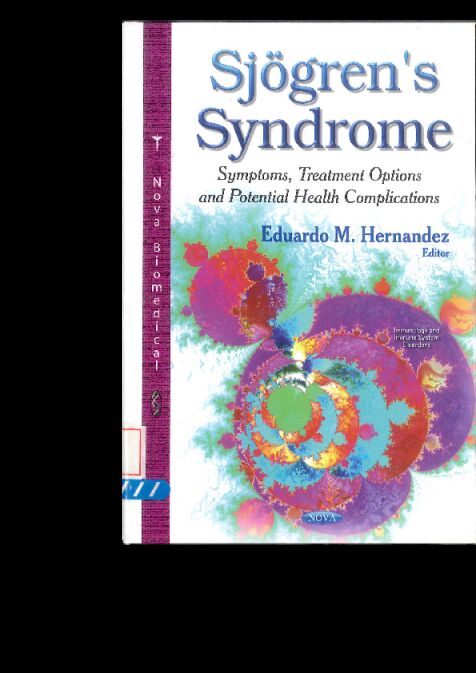
书名:Sjogren s syndrome
责任者: Eduardo M. Hernandez.
ISBN\ISSN:9781631178597,1631178598
出版时间:2014
出版社:Nova Science Publishers, Inc.,
前言
Sjogren's syndrome (SS) is a multi-system exocrinopathy. Its etiology remains unknown and it has an autoimmune pathogenesis. Although SS has been reported in young children and men, it is more frequent in middle-aged women. SS may occur alone, defined as primary SS, or in association with another autoimmune disease, defined as secondary SS. SS has a wide variety of glandular and extra-glandular manifestations affecting almost every organ. Despite its apparently inoffensive initial manifestations, SS can become a disabling and potentially life-threatening disease. This book discusses Sjogren's syndrome in detail, and provides further insight on topics that include the clinical manifestation and management of SS; the symptoms and diagnosis; health related quality of life in patients with SS; the involvement SS has in the central nervous system; and new aspects of mechanism of salivary glans dysfunctions in SS.A\Chapter I — Objective: To describe the relationship between intake of omega-3 fatty acids (ω3) and symptom severity in patients with primary Sjogren's Syndrome.A\Methods: This exploratory cross-sectional study recruited adult Sjogren's patients during routine office visits to a faculty rheumatology practice, when subjects provided data on their diet during the previous year, reported their current symptoms, and gave consent for investigators to review their medical records to ascertain prescribed therapy for Sjogren's syndrome. Patients completed a previously validated semi-quantitative food-frequency questionnaire, and they reported symptom severity (ocular sicca, oral sicca and overall Sjogren's-related symptoms) on three separate visual analog scales ranging from 0 to 100 (lowest to highest severity). A standard nutritional table indicating the ©3 content of common foods was applied to the food frequency data to estimate average daily ω3 consumption. Spearman's correlation coefficient was used to test the relationship between ω3 intake and symptom severity in patients receiving secretagogue therapy (e.g., cevimeline or pilocarpine), as well as in untreated patients. The Kruskal-Wallis test was used to compare symptom severity in 3 groups: pharmacologically treated patients, untreated patients reporting high intake of ©3 (>500mg/d), and untreated patients reporting low intake of ω3 (<500mg/d).A\Results: Among the 30 study subjects, the average daily intake of ω3 was 495±780mg/d (mean±SD). The average ocular, oral, and overall symptom severity scores were 56±29, 61±31, and 60±29, respectively. None of the correlations between ω3 intake and symptom severity were statistically significant (p<0.05) in either pharmacologically treated patients (n=12) or untreated patients (n=18). The mean ocular severity scores were 56, 53, and 57 in treated patients, untreated high-intake patients (n=6), and untreated low-intake patients (n=12), respectively. The corresponding oral severity scores were 56, 49, and 72, and the overall severity scores were 55, 49, and 70. While none of the differences in symptom severity across the 3 groups were statistically significant, the results do suggest possible beneficial effects of high ω3 intake for oral and overall symptoms that are roughly equivalent to the benefits of secretagogue therapy.A\Conclusion: This exploratory investigation suggests the possibility that high intake of ω3 may have a beneficial effect on symptoms in patients with primary Sjogren's Syndrome who are not receiving secretagogue therapy. A larger study is needed to confirm or reject this hypotheses. A confirmatory result would make it worth considering ω3 supplementation as an alternative to pharmacologic therapy.A\Chapter II - Primary Sjogren's syndrome (PSS) is a multi-system, immune-mediated, condition of unknown aetiology characterized by dryness of the eyes and mouth, pain and disabling fatigue. Other organs such as the skin, the nervous system, the lungs and the kidneys can also be affected. PSS is also associated with a markedly increased risk of lymphoma development. The health-related quality of life of patients with PSS is significantly impaired and the direct and indirect health economic cost associated with the condition is substantial.A\The true prevalence of PSS is unknown but is estimated to be between 0.1-0.4% of the adult population with a strong female bias. The diagnosis is often delayed with PSS patients presenting to their doctors after suffering from the symptoms for many years. Improved links between rheumatologists, ophthalmologists, oral medicine specialists, dentists, opticians, and general practitioners can facilitate early diagnosis and reduce risk of long-term disability.A\The American European Consensus Group (AECG) classification criteria 2002 are the current gold standard for the classification of PSS, although provisional American College of Rheumatology (ACR) criteria have recently been published. The development of consensus criteria by the ACR-European League Against Rheumatism (EULAR) working group to bring together the two criteria is in progress. Additionally, salivary gland ultrasound may also be an important component of the diagnostic criteria in the near future. Salivary gland sialometry, sialochemistry, tear osmolarity may be useful adjuncts, and the discovery of new diagnostic biomarkers is an area of active research.A\Optimal assessment of patients with PSS, should encompass not only objective parameters such as abnormalities in blood tests and changes in tear and salivary flow, but also patient-reported outcome measures and impact on quality of life. Symptoms of PSS are often non-specific, therefore these symptoms must be actively explored. The recent development of EULAR outcome measurement tools for the assessment of systemic disease activity and patient-reported outcome has greatly facilitated standardised assessment of PSS in clinics and in research.A\Management of PSS can be broadly classified into interventions targeting the glandular or systemic manifestations of the disease. Evidence-based strategies in PSS management remain elusive, instead, treatments are often based on empirical evidence or experience of the treating clinicians. The effective management of fatigue remains a major challenge. Recent advances in the understanding of PSS pathogenesis have led to the study of several biological therapies for the PSS with some encouraging data. Finally, optima] management of patients with PSS requires expertise from different disciplines such as ophthalmology, oral medicine and restorative dentistry.A\Chapter III - Sjogren's syndrome (SS) is a multi-system exocrinopathy. Its etiology remains unknown and it has an autoimmune pathogenesis. Although SS has been reported in young children and men, it is more frequent in middle-aged women, with a sex ratio of 9:1. SS may occur alone, defined as primary SS, or in association with another autoimmune disease, defined as secondary SS. SS has a wide variety of glandular and extra-glandular manifestations affecting almost every organ. Despite its apparently inoffensive initial manifestations, SS can become a disabling and potentially life- hreatening disease. Glandular manifestations vary according to the gland in question. The best predictor for SS is dry mouth (xerostomia), the most common SS symptom, followed by dry eyes. The low salivary flow increases susceptibility to bacterial and fungal diseases and often results in oral candidiasis. Dry eye (keratoconjunctivitissicca) is the most common ocular symptom. The main systemic manifestations are fatigue, dry airways, dry skin, dry vagina, dyspepsia, peripheral neuropathies, and autoimmune thyroiditis. Lymphoma, mostly of mucosa-associated lymphoid tissue type, is a characteristic but unusual feature that appears in approximately 5% of SS patients. The multiple manifestations of the syndrome and its insidious onset hamper its diagnosis. Besides the above symptoms, some objective signs are measured to make the definitive diagnosis of SS, using: ocular tests, notably Schirmer's I test and/or the Rose Bengal score; labial salivary gland biopsy, for assessing focal sialadenitis; scintigraphy, sialography, or unstimulated salivary flow, for evaluation of salivary gland involvement; and tests to detect the presence of Ro/SSA and/or La/SSB autoantibodies in serum.A\Chapter IV - In primary Sjogren's Syndrome (pSS), health-related quality of life (HRQoL) and sexual health are impaired and correlated.A\HRQoL in pSS is similarly altered in respect to patients with not Sjogren Sicca Syndrome (nS-SS) (presenting ocular and oral dryness, with negative autoantibodies and lip biopsy).A\As expected, in pSS and ns-SS, HRQoL is related to the involvement of salivary and lachrymal glands, causing mainly dryness. In pSS and nS-SS, HRQoL is associated with anxiety and fatigue and, only in pSS, with depression. Pain, muscle skeletal concerns, and lung involvement are other determinants of HRQoL in pSS.A\In women with pSS and nS-SS, sex health and ability, similarly altered, are affected by gynecological concerns, such as vaginal and vulvar dryness, more than by muscle-skeletal symptoms and, importantly, are related to impaired HRQoL.A\Chapter V -Primary Sjogren's syndrome (pSS) (or Sjogren's syndrome) is a chronic autoimmune inflammatory disease characterized primarily by involvement of the exocrine glands. Multiple organs may also be affected, causing a highly variable spectrum of clinical manifestations. Most patients have less severe extraglandular symptoms such as fatigue, polyarthralgia and diffuse myalgia, while others develop serious systemic impairments including pneumonitis, vasculitis, peripheral neuropathy, glomerulonephritis and lymphoma. The disease predominantly affects females, with a peak incidence between 40-60 years-old, and its prevalence in the general population is approximately 0.1-0.5%. The etiology is unknown, but the autoimmune nature of SS is supported by the production of multiple circulating autoantibodies, mainly anti-Ro/SSA and anti-La/SSB. Peripheral nervous system (PNS) involvement is a well-recognized injury in this disease, which affects 10-20% of pSS patients. It is characterized by peripheral symmetric axonal sensorimotor polyneuropathy or pure sensory neuropathy. Central nervous system (CNS) involvement in pSS, although uncommon (0.3-6%), may aggravate the patient's clinical condition and lead to motor and cognitive sequelae. Retrospective studies assessing CNS damage in pSS suggest that the neurological manifestations are highly heterogeneous.A\In this chapter, the frequency, pathogenesis, clinical features, diagnosis, differential diagnosis and treatment of the central nervous system involvement in pSS are reviewed.A\Chapter VI - Sjogren's syndrome, an autoimmune disease characterized by exocrine gland dysfunction leading to dry mouth and dry eye diseases, is typified by lymphoplasmacytic infiltrations and a progressive destruction of the salivary and lacrimal glands. Despite an ever-increasing focus on identifying the underlying etiology of Sjogren's syndrome, defining factors that initiate this autoimmune disease and mechanisms that develop the following exocrine gland dysfunction remain a mystery.A\The original explanatory concept for the pathogenesis of Sjogren's syndrome proposed a specific, self-perpetuating, immune mediated loss of acinar and ductal cells as the principal cause of salivary gland dysfunction. Accordingly, apoptosis, fibrosis and atrophy of the salivary glands would represent consequences of salivary gland hypofunction.A\In this chapter the authors highlight the possible involvement of regenerating gene (Reg) in regeneration and destruction of salivary gland acinar and ductal cells in Sjogren's syndrome. Reg gene was originally isolated as a gene specifically overexpressed in regenerating pancreatic islets and constitute a growth factor family (Reg family). Reg gene product (Reg protein) is important in the pathophysiology of various human inflammatory diseases such as diabetes, inflammatory bowel disease(s), and Sjogren's syndrome. The authors describe how the salivary gland dysfunction is initiated and maintained, and how it can be regenerated or progressed mediated by Reg gene and Reg protein. They also touch on recent aspects of potential molecular mechanisms underlying immune-mediated salivary gland dysfunction prior to glandular destruction and atrophy, resulting in the symptoms of dryness in Sjogren's syndrome.
查看更多
目录
Preface vii
Chapter I Omega 3 Fatty Acids and Primary Sjogren's Syndrome: Overview and Exploratory Investigation 1
Chapter II An Overview of the Clinical Manifestations and Management of Primary Sjogren's Syndrome 13
Chapter III Sjogren's Syndrome Symptoms and Diagnosis 57
Chapter IV Health-Related Quality of Life and Sexual Health in Patients with Sjogren's Syndrome and with Not- Sjogren's Sicca Syndrome 83
Chapter V Involvement of the Central Nervous System in Sjogren's Syndrome 103
Chapter VI New Aspects of Mechanism of Salivary Gland Dysfunction in Sjogren's Syndrome 125
Index 159
查看PDF
查看更多
馆藏单位
中国医科院医学信息研究所