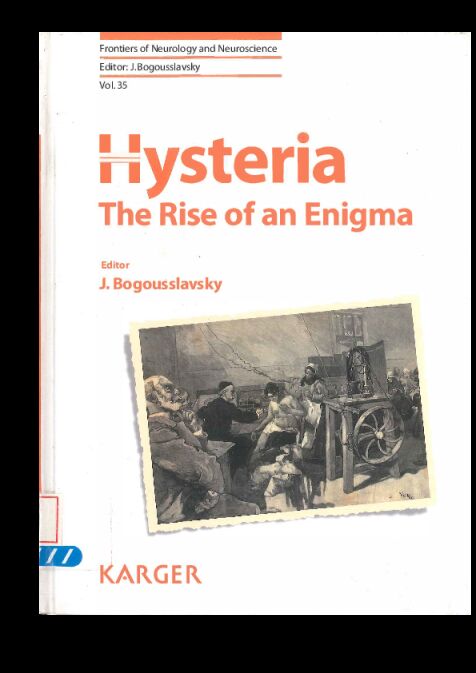
书名:Hysteria
责任者:J. Bogousslavsky. | Bogousslavsky, Julien.
ISBN\ISSN:9783318026467,3318026468
前言
Hysteria and enigma: a nice rhyme! Hysteria is perhaps the condition which best illustrates the tight connections between neurology and psychiatry. While this link has recently renewed interest in hysteria, it has in fact been present since early studies in the 19th century, mainly through the work of Jean-Martin Charcot and his collaborators at La Salpetriere. Indeed, the great names of neurology and psychiatry studied hysteria with Charcot, which include Pierre Janet, Joseph Babinski, Paul Richer, Georges Gilles de la Tourette, and Sigmund Freud. At the time, the border between psychism and the brain was more permeable than what it would become in the 20th century, during which, unfortunately, hysteria commonly was considered as a neurological condition by psychiatrists and as a psychiatric condition by neurologists. This grotesque paradox probably reflected the fear, sometimes even repulsion, that hysteria generated in many people, including doctors. Nobody wanted to deal with it. The fact that the term 'hysterical' has a negative meaning in popular language is a good example of the reputation of the condition, which was systematically associated with demoniac possession until the 18th century. Part of Freud's legacy is to have been able to replace this devilish flavor by the gross concept of 'conversion', indeed another religious term, but which suggests a (presumably more tolerable) somatic problem rather than a psychological one. 'Conversion' has had such a fortune that it even colonized textbooks and insurance classifications made by people who would be horrified to realize that they are just pure Freudian zealots.
The present developments in the 21st century seem to correspond to a reductionist brain-centric approach to the psyche, which may not necessarily lead to significant advances in the understanding of hysteria and psychological conditions. Functional magnetic resonance imaging is now progressively being considered as the new truth about the brain, despite its technical limitations, its wide tendency to be overinterpreted, and its philosophical paradigm which a priori implies that psychism and the mind are selectively located within the brain. We now have a new generation of Gall-type scientists, who pretend to localize love, faith, or crime in specific areas of the brain. Moreover, it is most comical to see that the finding of brain areas being activated or deactivated during certain thoughts and feelings, as shown by such a technique, indeed came up as a major discovery, as if there had been doubt about it. These findings have inevitably led to new beliefs and dogmas, such as the fact that thoughts would exclusively take place in the brain. Perhaps one should re-read the Nobel prize winner and great philosopher Henri Bergson, who claimed that neither perception nor memory were located in the brain. For him, the issue of 'location' was a wrong problem for such functions, a problem which only reflected the preeminence of space coordinates in modern-day science. I am pretty sure that the actual new positivists of brain research would diagnose madness here! We should nevertheless remember that with whatever technique, including functional magnetic resonance imaging, we can only measure the presence or absence of activity in an organ, without addressing the more interesting issue of whether what we measure is a cause or a consequence of the function we study. Perhaps the future of a better understanding of hysteria lies beyond these organ-centered approaches?
I am very grateful to the international panel of experts who made this book possible, in which we review the origins and developments of the concepts of hysteria: an ever-changing enigma. Julien Bogousslavsky, Montreux
查看更多
目录
Foreword vii
Boiler, F. (Bethesda Md.)
Preface ix
Bogousslavsky.J. (Montreux)
Before Charcot 1
Pearce, J.M.S. (Hull)
Socioeconomic Background of Hysteria's Metamorphosis from the 18th Century to World War I 11
Edelman, N. (Nanterre); Walusinski, O. (Brou)
'Fin-de-Siede' Epidemiology of Hysteria 20
Luaute, J.-R (Romans)
Clinical Manifestations of Hysteria: An Epistemological Perspective or How Historical Dynamics Illuminate Current Practice 28
Medeiros De Bustos, E.; Galli, S.; Haffen, E.; Moulin,T. (Besancon)
Jean-Martin Charcot and His Legacy 44
Bogousslavsky, J. (Montreux)
Hypnosis and the Nancy Quarrel 56
Piechowski-Jozwiak, B. (London/Warsaw); Bogousslavsky, J. (Montreux)
The Girls of La Salpetriere 65
Walusinski, O. (Brou)
Public Medical Shows 78
Walusinski, O. (Brou)
Emma Bovary, Hedda Gabler, and Harold Brodkey Would Not Have Lived without Charcot: Hysteria in Novels 90
Kaptein, A.A. (Leiden)
Traces of Hysteria in Novels 99
Haan, J. (Leiderdorp/Leiden); Koehler, P.J. (Heerlen)
Sigmund Freud and Hysteria: The Etiology of Psychoanalysis? 109
Bogousslavsky, J. (Montreux); Dieguez, S. (Fribourg)
Paul Sollier, Pierre Janet, and Their Vicinity 126
Walusinski, O. (Brou)
Criticism of Pithiatism: Eulogy of Babinski 139
Poirier, J; Derouesne, C. (Paris)
The Borderland with Neurasthenia ('Functional Syndromes') 149
Paciaroni, M. (Perugia); Bogousslavsky, J. (Montreux)
World War I Psychoneuroses: Hysteria Goes to War 157
Tatu, L. (Besancon); Bogousslavsky, J. (Montreux)
Hysteria around the World 169
Carota, A. (Genolier/Basel); Calabrese, P. (Basel)
History of Physical and 'Moral'Treatment of Hysteria 181
Broussolle, E.;Gobert, F; Danaila,T.;Thobois, S. (Lyon);Walusinski, O. (Brou); Bogousslavsky, J. (Montreux)
'Hysteria'Today and Tomorrow 198
LaFrance, W.C., Jr. (Providence, R.I.)
Author Index 205
Subject Index 206
查看PDF
查看更多
馆藏单位
中国医科院医学信息研究所