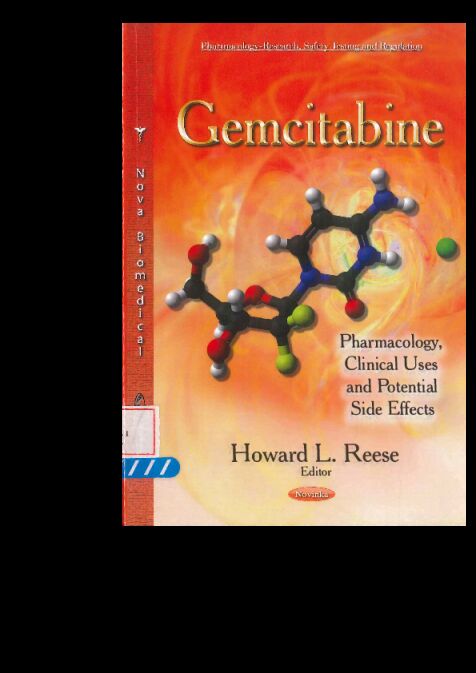
书名:Gemcitabine
出版时间:2014
出版社:Nova Science Publishers, Inc.,
前言
Gemcitabine was synthesized in the 1980s at Lilly Research Laboratories (Eli Lilly and Co., Indianapolis, IN). It was initially developed as an antiviral agent, but it had an extremely narrow therapeutic index due to its cytotoxicity against the parental cell lines. As it presented wide activity against various solid tumors it was then evaluated as an anticancer drug. This pyrimidine antimetabolite was firstly approved in 1996 by the Food and Drug Administration (FDA) for the treatment of pancreatic cancer. It is currently used for the treatment of many other malignancies such as lung cancer, breast cancer, lymphoma, bladder cancer, mesothelioma and ovarian cancer. This book discusses the molecular pharmacology, and the pharmacogenetics of gemcitabine. It also discusses the antineoplastic mechanism of gemcitabine on tumor cells; the systemic adverse effects; and provides detail on the clinical uses gemcitabine has on breast cancer.
Chapter I - Gemcitabine (2',2'-difluorodeoxycytidine, dFdC) was developed during the early 80's. This pyrimidine antimetabolite was firstly approved in 1996 by the Food and Drug Administration (FDA) for the treatment of pancreatic cancer. Today, its uses include pancreatic cancer, ovarian cancer, breast cancer, non-small cell lung cancer and bladder cancer.
Gemcitabine acts during the G1 and S phases of the cell cycle. It is a prodrug that must enter the cell by human nucleoside transporters (hNTs), mainly through human equilibrative nucleoside transporter subtype 1 (hENT-1). Once inside the cell, it is phosphorilated to deoxycytidine mono-, di- and tri- phosphate.
The major active metabolite is deoxycytidine triphosphate (dFdCTP), which inhibits DNA synthesis through its incorporation into the replicating chain and DNA polymerase inhibition. Moreover, deoxycyti-dine diphosphate (dFdCDP) inhibits ribonucleotide reductase (RR). The enzyme responsible for gemcitabine metabolites inactivation is cytidine desaminase (CDA), which forms the inactive metabolite 2'2'difluoro-deoxyuridine (dFdU). Pharmacogenetics has demonstrated a relevant role in gemcitabine response. Differences in the expression or the activity of transporters (hENT1, hCNT1) and enzymes involved in gemcitabine metabolism may lead to changes in efficacy and toxicity. For example, hENT-1 deficiency cells have shown to be resistant to gemcitabine.
Infusion rate has also been proposed as a factor that may influence gemcitabine response, since it has been observed that lower infusion rate increase intracellular concentration of the drug.
The most common adverse effects as a single agent are myelo-suppression, nausea/vomiting, hepatic transaminitis, flu-like syndrome, rash and peripheral edema. In clinical practice gemcitabine is combined with other antineoplastic drugs, so adverse reactions' rates can vary in different schedules. Less frequent toxicities like interstitial pneumonia, hemolytic uremic syndrome, capillary leak syndrome, radiation recall, myopathy and thrombotic microangiopathy have also been reported.
In the current review, the authors discuss molecular pharmacology, pharma-cogenetics and adverse reaction profile of gemcitabine.
Chapter II — The aim of this chapter is to provide updated information on the mechanisms by which gemcitabine acts on tumor cells with different TP53 gene backgrounds. Currently, the genetic backgrounds of tumors and patients have been taken into account to ensure efficient treatment. In this context, the TP53 gene status has been shown to play a pivotal role in the action of a large panel of antitumor agents, and several mutations have been found to confer new functions to the mutant p53 protein, which interferes in the treatment response, Among the antitumor drugs that are currently used in chemotherapy, gemcitabine has been demonstrated to be one of the most promising due to its lower toxicity and good tolerability. This compound is a pyrimidine nucleoside antimetabolite agent that is effective against a variety of human malignancies, including tumors of non small cell lung, bladder, breast, pancreas, ovarian and others. Although the relationship between gemcitabine treatment success and the TP53/p53 status has been poorly investigated, it is known that the p53 protein recognizes gemcitabine after it has been incorporated into the cell. The literature has described that when administered alone, the effects of gemcitabine are independent of the TP53/p53 status; however, different pathways are activated for each tumor type, Some data support that when administered with other antineoplastic drugs or radiotherapy, the TP53/p53 status is important for gemcitabine cytotoxicity.
Chapter III - Gemcitabine is a deoxycytidine analogue with significant activity against solid tumors and few hematological malignancies. It is currently approved for metastatic, ovarian, bladder and non-squamous, non-small cell lung cancers. Hematological toxicity of gemcitabine is the most common adverse drug reaction with <5% incidence of myelosuppression. Thrombocytopenia is the most frequently suppressed cell line although clinically.
Significant bleeding is rare. Hemolytic uremic syndrome, first reported in 1994 by Casper et al. has had a reported incidence of 0.08% in patients on Gemcitabine. No consistent risk factors have been identified and most of the reported cases have been confounded by the presence of advanced malignancy. Absence of a dose or duration effect on the occurrence of HUS suggests temporal relation with gemcitabine with no current evidence for a contributory role. Pulmonary toxicity may occur in up to one fourth of the patients treated with gemcitabine and varies from dyspnea, alveolar infiltrates to diffuse alveolar damage, ARDS, interstitial pneumonitis and non-cardiogenic pulmonary edema. A post marketing surveillance of Japanese patients revealed an incidence of ILD of about 1.7%.
Grade 4 pulmonary toxicity has been clubbed under an umbrella term, "Gemzar Lung" with an incidence of 0.06% to 8% of the treated patients and a mortality rate of 20%. Other less common adverse effects include nausea, vomiting, anorexia, diarrhea, reversible transaminase elevation and flu like symptoms. Mild elevation in transaminases has been reported in more than 40% cases. Close monitoring of liver function tests are recommended during therapy with gemcitabine. Dermatological reactions attributed to gemcitabine occur at a frequency of 25% and mostly occur in the form of self-limiting rash. Other less reported cutaneous effects include pseudocellulitis, a non-necrotizing inflammation of dermis and hypodermis, livedo reticularis, scleroderma like changes, Sweet's syndrome and toxic epidermal necrolysis.Radiation recall is a peculiar phenomenon, common with gemcitabine in patients previously radiated. It is an inflammatory response distributed across the radiation portal, usually involving the skin but can affect the lungs, mucus membranes and other organs.CNS toxicity is not reported with gemcitabine since it does not cross the blood brain barrier; however posterior reversible encephalopathy syndrome has been reported in association with gemcitabine therapy.
Chapter IV - Gemcitabine, a nucleoside analogue, has an established efficacy as single agent as well as in combination in the treatment of metastatic breast cancer. It was originally investigated for its antiviral effects but has since been developed as an anticancer therapy. Earlier use of anthracycline and taxane agents as adjuvant or neoadjuvant chemotherapy resulted resistance, making further options a concern. Gemcitabine, is a promising drug because of its activity and good tolerability in metastatic breast cancer, it has produced a benefit in overall response rates in a first-line setting and in studies limited to second or third-line therapy. Its action is associated with a favorable toxicity profile which is mainly hematological.
查看更多
目录
Preface vii
Chapter I Gemcitabine: Molecular Pharmacology, Pharmacogenetics and Adverse Reaction Profile 1
Chapter II Antineoplastic Mechanism of Gemcitabine on Tumor Cells with Different TP53/p53 Subtypes 63
Chapter III Gemcitabine: Systemic Adverse Effects 79
Chapter IV Gemcitabine: Clinical Uses in Breast Cancer 97
Index 105
查看PDF
查看更多
馆藏单位
中国医科院医学信息研究所