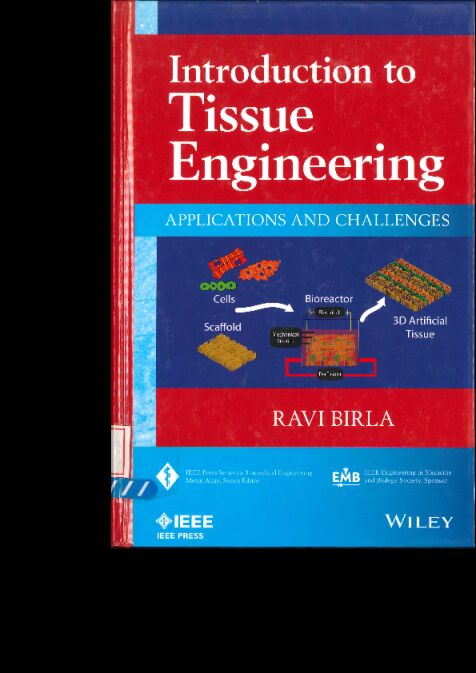
书名:Introduction to tissue engineering
ISBN\ISSN:9781118628645,1118628640
出版时间:2014
出版社:John Wiley & Sons Inc.,
前言
This book is designed to serve as a textbook for a one-semester tissue engineering class, offered at the senior-undergraduate or first-year graduate level. The first six chapters of the book are focused on covering fundamental principles of tissue engineering and include cell sourcing, biomaterial development, tissue fabrication technology, vascularization strategies, and bioreactors for tissue engineering. These topics are at the heart of tissue engineering. The latter Chapter 3 are focused on applications of tissue engineering, which include development of 3D artificial trachea, 3D artificial bladder, and 3D artificial liver tissue.
The contents of this book are modeled after classes I teach in the Department of Biomedical Engineering at the University of Houston. I teach several classes, one of which is an introductory class in tissue engineering: BIOE 5323—Introduction to Tissue Engineering. BIOE 5323 is designed to serve as an introduction to the field of tissue engineering and is taken by senior undergraduate and first-year graduate students. When I first started teaching BIOE 5323, I put together lecture notes to provide students with a foundation in tissue engineering. Over time, these lecture notes were converted into book chapters and eventually combined into a complete textbook.
The book is designed as a textbook for use in a classroom setting. It is designed as a first text in tissue engineering and as such, does not rely on any other prerequisite classes. The book is self-contained and covers fundamental principles that are necessary to understand tissue engineering. The book is well suited for a one-semester class designed for undergraduate students at the senior level or first-year graduate students.
There is a large question bank that has been included in the book. The questions have been designed to test students' understanding of the principles of tissue engineering and their ability to apply these principles toward the fabrication of 3D artificial tissue. Therefore, all the questions are assay-based questions which require critical thinking; many of the questions are open-ended and can have multiple correct responses. These questions are designed to probe students and test their creativity in designing processes to fabricate 3D artificial tissue. Ravi BIrla
查看更多
目录
Preface xiii
Acknowledgments xv
List of Abbreviations xvii
Important Terminology and Concepts xxi
1 Introduction to Tissue Engineering 1
1.1 Introduction to Tissue Engineering, 2
1.2 Chronic Shortage of Donor Organs, 3
1.3 The Tissue Engineering Paradigm, 4
1.4 Definition of Tissue Engineering, 5
1.5 Process of Bioengineering 3D Artificial Tissue, 9
1.6 Design Principles for Tissue Engineering, 12
1.7 Building Blocks of Tissue Engineering, 14
1.8 Scientific and Technological Challenges, 15
1.9 Functional Assessment of Artificial Tissue, 16
1.10 Seminal Papers in Tissue Engineering, 18
1.11 Applications of 3D Artificial Tissue, 20
1.12 Two-Dimensional Versus Three-Dimensional Culture, 22
1.13 Integration of Core Technologies, 22
1.14 Growth of Tissue Engineering, 24
1.15 Disciplines in Tissue Engineering, 26
1.16 Tissue Engineering and Related Fields, 28
Summary, 33
Practice Questions, 34
References, 35
2 Cells for Tissue Engineering 40
2.1 Cells and Tissue Engineering, 41
2.2 Cell Structure and Function, 43
2.3 The Dynamic Extracellular Matrix, 47
2.4 Cell Signaling, 48
2.5 Cellular Junctions, 50
2.6 Mammalian Tissue and Artificial Tissue, 52
2.7 Cell Sourcing, 52
2.8 The Cell Transplantation Process, 55
2.9 Cells for Cell Transplantation, 58
2.10 Mode of Action of Cells During Cell Transplantation, 59
2.11 Cell Transplantation and Tissue Engineering, 60
2.12 The Cell Culture Process, 61
2.13 Applications of Monolayer 2D Cell Culture, 64
2.14 Cell Culture Versus Tissue Engineering, 65
2.15 Introduction to Stem Cell Engineering, 66
2.16 Human Embryonic Stem Cells, 70
2.17 Induced Pluripotent Stem Cells, 71
2.18 Adult Stem Cells, 72
Summary, 72
Practice Questions, 73
References, 74
3 Biomaterials for Tissue Engineering 84
3.1 Definition of Biomaterials, 85
3.2 Scheme for Biomaterial Development, 88
3.3 Historical Perspective on Biomaterials, 90
3.4 Tensile Properties, 92
3.5 Modulation of Tensile Properties, 95
3.6 Material Degradation, 97
3.7 Biocompatibility, 100
3.8 Biomimetic Biomaterial, 104
3.9 Classification of Biomaterials, 106
3.10 Biomaterial Platforms, 108
3.11 Smart Materials, 113
3.12 The Dynamic Extracellular Matrix, 114
3.13 Idealized Biomaterial, 116
Summary, 118
Practice Questions, 119
References, 121
4 Tissue Fabrication Technology 130
4.1 Introduction to Tissue Fabrication Technologies, 131
4.2 Self-Organization Technology, 133
4.3 Cell Sheet Engineering, 135
4.4 Scaffold-Based Tissue Fabrication, 137
4.5 Cell and Organ Printing, 140
4.6 Solid Freeform Fabrication, 142
4.7 Soft Lithography and Microfluidics, 143
4.8 Cell Patterning, 145
4.9 Idealized System to Support Tissue Fabrication, 148
Summary, 149
Practice Questions, 150
References, 151
5 Vascularization of Artificial Tissue 156
5.1 Introduction, 157
5.2 Seminal Publications in Angiogenesis Research, 159
5.3 Vascularization Defined, 160
5.4 Molecular Mechanism of Vasculogenesis, 161
5.5 Molecular Mechanism of Angiogenesis, 163
5.6 Molecular Mechanism of Arteriogenesis, 164
5.7 Therapeutic Angiogenesis, 166
5.8 Tissue Engineering and Vascularization, 167
5.9 Conceptual Framework for Vascularization During Artificial Tissue Formation, 169
5.10 In Vivo Models of Vascularization, 172
5.11 Idealized Vascularization Strategy for Tissue Engineering, 174
5.12 Flow Chart and Decision Making, 176
5.13 Biologically Replicated Vascularization Strategies, 179
5.14 Biologically Mediated Vascularization Strategies, 181
5.15 Biologically Inspired Vascularization Strategies, 184
Summary, 186
Practice Questions, 187
References, 188
6 Bioreactors for Tissue Engineering 193
6.1 Introduction to Bioreactors, 194
6.2 Bioreactors Defined, 195
6.3 Classification of Bioreactors, 197
6.4 Design Considerations, 200
6.5 Idealized Bioreactor System, 202
6.6 Bioreactors and Tissue Engineering, 205
6.7 Bioreactors for Mammalian Cell Culture, 207
6.8 Bioreactors for Scaffold Fabrication, 209
6.9 Bioreactors for Scaffold Cellularization, 212
6.10 Perfusion Systems, 215
6.11 Bioreactors for Stretch, 219
6.12 Electrical Stimulation, 221
Summary, 226
Practice Questions, 227
References, 230
7 Tracheal Tissue Engineering 237
7.1 Structure and Function of the Trachea, 238
7.2 Congenital Tracheal Stenosis, 240
7.3 Genetic Regulation of Tracheal Development, 241
7.4 Post Intubation and Post Tracheostomy Tracheal Stenosis, 243
7.5 Treatment Modalities for Tracheal Stenosis, 245
7.6 Design Considerations for Tracheal Tissue Engineering, 247
7.7 Process of Bioengineering Artificial Tracheas, 247
7.8 Tissue Engineering Models for Artificial Tracheas, 250
7.9 Tracheal Tissue Engineering—An Example of a Clinical Study, 253
7.10 Tracheal Tissue Engineering—A Second Example of a Clinical Study, 255
Summary, 258
Practice Questions, 258
References, 260
8 Bladder Tissue Engineering 265
8.1 Bladder Structure and Function, 266
8.2 Neurogenic Bladder Dysfunction, 267
8.3 Surgical Bladder Augmentation, 269
8.4 Development of the Urinary Bladder, 270
8.5 Design Considerations for Bladder Tissue Engineering, 270
8.6 Process of Bioengineering Artificial Bladders, 271
8.7 Cell Sheet Engineering for Bladder Tissue Engineering, 273
8.8 Small Intestinal Submucosa (SIS) for Bladder Tissue Engineering, 275
8.9 Plga as a Biomaterial for Bladder Tissue Engineering, 278
8.10 Acellular Grafts for Bladder Tissue Engineering, 280
8.11 Organ Models for Bladder Tissue Engineering, 283
8.12 Clinical Study for Bladder Tissue Engineering, 284
Summary, 285
Practice Questions, 286
References, 288
9 Liver Tissue Engineering 295
9.1 Structure and Function of the Liver, 296
9.2 Acute Liver Failure, 297
9.3 Liver Transplantation, 299
9.4 Liver Regeneration, 301
9.5 Liver Development, 302
9.6 Design Considerations for Liver Tissue Engineering, 303
9.7 Process of Bioengineering Artificial Liver Tissue, 303
9.8 Stem Cells for Liver Tissue Engineering, 305
9.9 Surface Patterning Technology for Liver Tissue Engineering, 307
9.10 Biomaterial Platforms for Liver Tissue Engineering, 309
9.11 Fabrication of 3D Artificial Liver Tissue, 309
9.12 Vascularization for Liver Tissue Engineering, 311
9.13 Bioreactors for Liver Tissue Engineering, 312
9.14 Spheroid Culture for Liver Tissue Engineering, 313
Summary, 314
Practice Questions, 315
References, 317
Index 323
查看PDF
查看更多
馆藏单位
中国医科院医学信息研究所