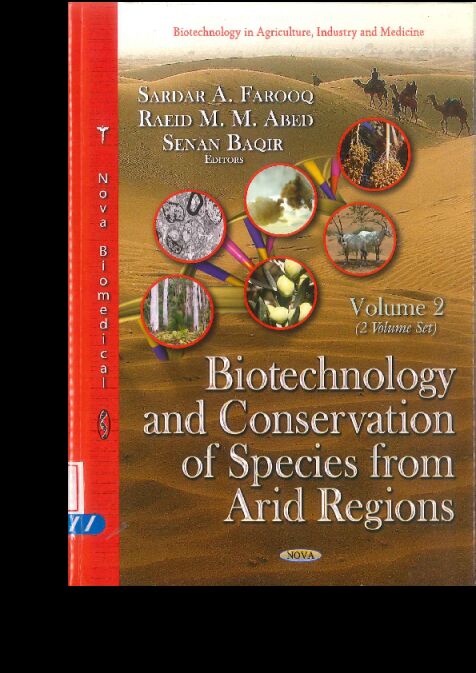
书名:Biotechnology and conservation of species from arid regions. v. 2.
责任者:Sardar A. Farooq | Raeid Abed and Senan Baqir
出版时间:2014
出版社:Nova Publishers,
摘要
In the modern strategy of development, biotechnology assumes a major role in every country, more so in the arid regions. In spite of significant contributions to biotechnology by the developed nations, the information available for the arid zones is scant. Combining biotechnology and conservation is a novel idea of the editors of this book, who have collected articles on the species of the arid zones (e.g. Camel, Arabian Oryx, Date palm etc.). The book aims to explore aspects related to the diversity, conservation and biotechnology of bacterial, plant and animal species from arid regions. Having to tolerate extreme environmental conditions, these species have developed unique adaptation strategies that can be utilized for biotechnology and their conservation poses a serious challenge. Research on plant and animal species from arid environments has received scarce attention in most major biotechnology books. This book is designed to bring together reviews from the biotechnology scientists from universities, government research institutes and private sector laboratories, policy makers and industry leaders who are interested in exploring the biotechnological applications of species from arid regions. It is assured that the chapters will represent various developing countries that fall within the arid zone. The book will be very useful for students, research scholars and scientists from all over the world, who are interested in biotechnology, environmental biology and conservation. (Imprint: Nova)
查看更多
目录
Preface xi
Biotechnology and Conservation of Species from Arid Regions. Volume 1 1
Chapter 1 Scope of Biotechnology in Oman 3
Chapter 2 Stem Cells: Therapeutic Alternatives of Nervous Tissue Injuries in the Neurotmesis of Sciatic Nerve in Rabbits 23
Chapter 3 Comparison of Omentum Pedicle and Autogenous Bone Marrow Stromal Cells Implantation Effectiveness on Peripheral Nerve Regeneration 31
Chapter 4 Immunolocalization of Androgen Receptor in the Ovary of the Bedouin Goat (Capra hircus) in Non-Breeding Season 43
Chapter 5 Reference Values for Haematological, Biochemical and Physiological Parameters in Arabian Oryx 47
Chapter 6 Trials on Treatment of Cryptosporidiosis in BALB/c Mice. Shedding of Oocysts 65
Chapter 7 A Microsatellite Population Genetic Analysis of the Small-Scaled Grouper, Epinephelus polylepis, in the Gulf of Oman and Arabian Sea 71
Chapter 8 Histopathological Effects of Variable Doses of Hydroxyurea in Male Swiss Rats 93
Chapter 9 Relationship between Age, Breed, Body Weight, Gestational Status and Parity on the Body Condition Score of Omani Breeding Camels 101
Chapter 10 First Report about Growth, Partial Record Egg Production and Morphological Characters of a Newly Characterized Native Saudi Chicken Lines Hajar 1 and Hajar 2 105
Chapter 11 Lizards Biodiversity in Arid Regions of Iraq 115
Chapter 12 Environmental Changes and Their Effects on the Fate of Sea Turtle Reproductive Potential and Conservation 125
Chapter 13 Analysis of Heavy Metal in Eggshells of Green Turtles, Chelonia mydas, by Scanning Electron Microscopy and X-Ray Microanalysis 137
Chapter 14 Distribution of Rh Blood Group in Tabuk, Kingdom of Saudi Arabia 145
Chapter 15 A Comparison between Representative Types of Platyhelminthes in Their Nervous Components 151
Chapter 16 Effect of the Nature of the Feeding Resource on In Vitro Gas Production Kinetics Using Rumen Fluid of Slaughtered Dromedary 161
Chapter 17 Dietary Manipulation of the Patty Acid Content of Farmed Red Hybrid Tilapia, Oreochromis sp. 169
Chapter 18 Determination of the Botanical and Geographical Origins of Honey in Northern Oman 181
Chapter 19 Establishment of Short and Long-Term Storage Protocol for Oil Palm (Elaeis guineensis Jacq.) Polyembryoids 193
Chapter 20 ISSR Phylogenetic Diversity of Sorghum bicolor (L.) Moench Accessions from Different Regions in Sudan 199
Chapter 21 Genetic Variability and Molecular Fingerprinting of Some Wild Egyptian Gramineae Plants 209
Chapter 22 Genetic Distance and Its Association with F1 Interspecific Hybrids Performance and Heterosis for Yield Components and Fiber Properties in Cotton 223
Chapter 23 Biolistic Delivery of Plasmid DNA in Omani Date Palm 237
Chapter 24 The Genomic DNA Structure in Somatic Embryogenesis of Date Palm (Phoenix dactylifera L.) by Flow Cytometric, RAPD and AFLP Analysis 241
Biotechnology and Conservation of Species from Arid Regions. Volume 2 253
Chapter 25 AFLP Genotyping for Plant Genetic Resources Use in Crop Improvement: Models for Predicting Hybrid Performance among Accessions from the USDA Alfalfa Core Collection 255
Chapter 26 Somatic Embryogenesis from Offshoot of Different Cultivars of Date Palm (Phoenix dactylifera L.) of Three Regions of Southern Algeria 275
Chapter 27 Managing High Altitude Forests for Climate Change Mitigation and Biodiversity Conservation: Lessons for the Management of Forests in Al Jebel Al Akhdar Mountain Range in Oman 287
Chapter 28 Adaptive Strategy of Pistacia atlantica Desf. Subsp. atlantica Populations: Foliar Epidermal Micromorphology 303
Chapter 29 Antimicrobial Compounds from Ethano-Medicinal Plants of Oman 311
Chapter 30 Antioxidant Content of Hot Pepper from the US DA National Collection 327
Chapter 31 The Bio-Toxic Effect of Essential Oils of Peganum harmala L. (Zygophyllaceae) on the Schistocerca gregaria (Forskal, 1775) (Orthoptera-Acrididae) 337
Chapter 32 Effect of Tannins on In Vitro Gas Production and Digestibility of Feedstuffs from North African Arid Zone 347
Chapter 33 Polyphenols Content and Antioxidant Properties of Extracts from Selected Hypotensive Plants in Algeria 363
Chapter 34 Antimicrobial Bioactive Compound Isolated from Podaxis pistillaris in Southern Iraq 371
Chapter 35 Biocide Effects of Alkaloids and Saponins Extracted from Narcissus broussonetii (Larg.) (Amaryllidaceae) on Bemisia tabaci (Gennadius) (Homoptera:Aleyrodidae) 381
Chapter 36 Existence for Two Ploidy Levels in a Relict Olive Population of Hoggar (Algeria) 393
Chapter 37 Kinetic Study of Enzymatic Hydrolysis of Starch Isolated from Sorghum Grain Cultivars by Various Methods 401
Chapter 38 Effect of Starch Isolation Methods on Starch Recovery and Physicochemical Properties for Algerian Sorghum (Sorghum bicolor L. Moench) 411
Chapter 39 Growing Tomato in Salty Soil: Screening 419
Chapter 40 Vinblastine Production Induced by Tryptophan in Callus Culture of Catharanthus roseus L. 431
Chapter 41 Antimutagenic Potential of Olive Oil on Chromosomal Aberrations in Viciafaba Root Tip 441
Chapter 42 Reduction of Water Stress Effect by Seaweed Liquid Extract Used As Foliar Spray of Triticum durum Variety Karim 447
Chapter 43 Indigenous Bacterial Consortia from Oil Wells and Their Role in In-Situ Microbial Enhanced Oil Recovery 455
Chapter 44 Biosurfactant Mediated Microbial Enhanced Oil Recovery and Potential for Application in Some Omani Oil Fields 471
Chapter 45 Improving the Catalytic Properties of Pectinase from Bacillus licheniformis KIBGE-IB 21 by Entrapment in Calcium Alginate Beads 489
Chapter 46 Potential of Microbial Biotechnology in Heavy Oil Enhanced Recovery 495
Chapter 47 Screening and Antimicrobial Activity of Actinomycetes Strains Isolated from Extreme Ecosystems of Algeria 507
Chapter 48 Microbial Cellulases and Its Potential Applications in Oman 515
Chapter 49 Application of Molecular Biology Methods in Identifying Biosurfactant Producers from Oil Contaminated Sites 527
Chapter 50 The Influence of Bacterial Solution on the Mineral Surface Characterization 541
Editor's Contact Information 555
Index 557
查看PDF
查看更多
馆藏单位
中国医科院医学信息研究所