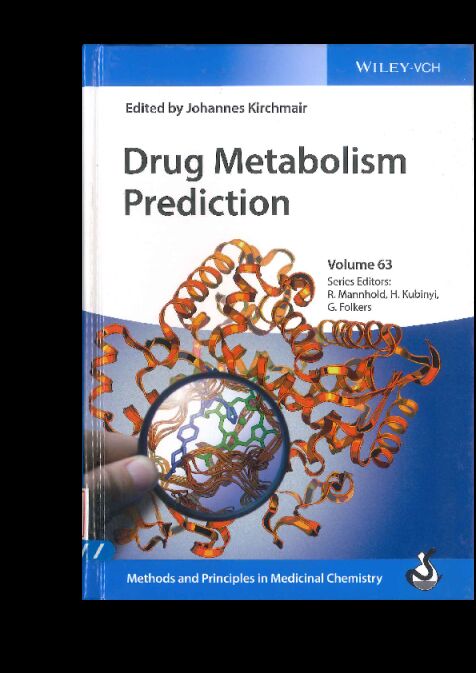
书名:Drug metabolism prediction
分类号:医药、卫生
页数:xxiv, 511 pages :
前言
In addition to mediating cell metabolism, the metabolic system developed in animals and humans for the chemical conversion of xenobiotics. Over millions of years, a plethora of oxidizing, hydrolyzing, conjugating, and other enzymes were optimized by evolution. Modification, degradation, and/or conjugation, in many cases to polar products, enable a safe elimination from the organism. Whereas many plant products are toxic, there are only rare examples that the metabolic system converts harmless natural substances into toxic entities. The situation changed about two centuries ago, after the advent of synthetic organic compounds: many of them contain structural features that the metabolic system cannot handle in the same manner as natural products, In only a few generations, evolution did not have enough time to optimize the enzymes for this new challenge. Of course, also potential drug candidates offer such a challenge to the metabolic system. The development of many compounds must be discontinued because of severe side effects of some toxic metabolites, most often chemically reactive compounds [1]. Some metabolites, even formed in only minor amounts, may cause idiosyncratic toxicity, rarely observed but with fatal consequences for the individual.
Chemical features that are easily metabolized are responsible for short biological half-life of some potential drug candidates; on the other hand, lack of such moieties might cause a half-life that is too long for safe use of the drug. In addition, such compounds as well as highly lipophilic analogs have a higher risk to form toxic metabolites. Thus, it is most important to understand metabolic pathways and to have tools to predict which compounds might be generated. This necessity applies especially for the common oxidation of xenobiotics by various cytochrome P450s (CYPs). Three approaches are suited to achieve this task: theoretical treatment, by calculating the accessibility and chemical reactivity of the chemical features of the compound; molecular modeling, especially pharma-cophore searches and docking, using 3D structures of the cytochrome binding pockets; and empirical approaches, using the large databases of known metabolic pathways. All these methods have their pros and cons, and none of them seems to be perfect. Especially species selectivity, to conclude from animal results to humans, and the relative amount of certain metabolites are difficult or even impossible to predict.
The introduction of this book provides an overview of the role of metabolism in drug development, followed by a part on software and databases for the study of metabolism. The next part discusses computational approaches for the study of the most important metabolic enzymes, the cytochrome P450 enzymes. 3D structures, substrate recognition and binding, and theoretical and experimental methods for the study of ligand-protein interactions are discussed in this part The chapters of the next part go into more detail with respect to the sites and products of metabolism, using either molecular interaction fields or structure-, reactivity-, and knowledge-based approaches. The important aspect of enzyme inhibition and induction is discussed in the next chapters, using quantitative structure-activity relationships and pharmacophore-based methods; separate chapters discuss the role of P-gp-mediated disposition and the prediction of toxic effects of metabolites. Last but not least, three chapters describe experimental approaches, that is, in vitro models for the study of metabolism and drug—drug interactions and experimental metabolite detection and profiling.
We are very grateful to Johannes Kirchmair for having accepted our invitation to edit this book, which will be of great importance and practical value for all scientists involved in drug research. Our thanks also go to all chapter authors for their valuable contributions, as well as to Frank Weinreich and Heike Nothe at Wiley-VCH for their engagement in this project and in our entire book series "Methods and Principles in Medicinal Chemistry." Dusseldorf Raimund Mannhold, Weisenheim am Sand Hugo Kubinyi, Zurich Gerd Folkers June 2014
查看更多
目录
List of Contributors XVII
Preface XXI
A Personal Foreword XXIII
Part One Introduction 1
1 Metabolism in Drug Development 3
1.1 What? An Introduction 3
1.2 Why? Metabolism in Drug Development 4
1.2.1 The Pharmacological Context 4
1.2.2 Consequences of Drug Metabolism on Activity 6
1.2.3 Adverse Consequences of Drug Metabolism 7
1.2.4 Impact of Metabolism on Absorption, Distribution, and Excretion 10
1.3 How? From Experimental Results to Databases to Expert Software Packages 11
1.3.1 The Many Factors Influencing Drug Metabolism 11
1.3.2 Acquiring and Interpreting Experimental Results 13
1.3.3 Expert Software Tools and Their Domains of Applicability 14
1.3.4 Roads to Progress 16
1.4 Who? Human Intelligence as a Conclusion 17
References 19
Part Two Software, Web Servers and Data Resources to Study Metabolism 27
2 Software for Metabolism Prediction 29
2.1 Introduction 29
2.2 Ligand-Based and Structure-Based Methods for Predicting Metabolism 30
2.3 Software for Predicting Sites of Metabolism 38
2.3.1 Knowledge-Based Systems 38
2.3.2 Molecular Interaction Fields 39
2.3.3 Docking 39
2.3.4 Reactivity Models 40
2.3.5 Data Mining and Machine Learning Approaches 41
2.3.6 Shape-Focused Approaches 42
2.4 Software for Predicting Metabolites 43
2.4.1 Knowledge-Based Systems 44
2.4.2 Data Mining and Machine Learning Approaches 46
2.4.3 Molecular Interaction Fields 46
2.5 Software for Predicting Interactions of Small Molecules with Metabolizing Enzymes 46
2.6 Conclusions 48
References 49
3 Online Databases and Web Servers for Drug Metabolism Research 53
3.1 Introduction 53
3.2 Online Drug Metabolism Databases 54
3.2.1 DrugBank 57
3.2.2 HMDB 59
3.2.3 PharmGKB 59
3.2.4 Wikipedia 60
3.2.5 PubChem 61
3.2.6 Synoptic Databases: ChEBI, ChEMBL, KEGG, and BindingDB 61
3.2.7 Specialized Databases: UM-BBD, SuperCYP, PKKB, and PK/DB 63
3.2.8 Online Database Summary 64
3.3 Online Drug Metabolism Prediction Servers 65
3.3.1 Metabolite Predictors 66
3.3.2 SoM Predictors 66
3.3.3 Specialized Predictors 68
3.3.4 ADMET Predictors 70
3.3.5 Web Server Summary 71
References 71
Part Three Computational Approaches to Study Cytochrome P450 Enzymes 75
4 Structure and Dynamics of Human Drug-Metabolizing Cytochrome P450 Enzymes 77
4.1 Introduction 77
4.2 Three-Dimensional Structures of Human CYPs 78
4.3 Structural Features of CYPs 78
4.3.1 CYP-Electron Transfer Protein Interactions 81
4.3.2 Substrate Recognition Sites 82
4.3.3 Structural Variability and Substrate Specificity Profiles 83
4.3.3.1 CYP1A2 83
4.3.3.2 CYP2A6 85
4.3.3.3 CYP2C9 85
4.3.3.4 CYP2D6 86
4.3.3.5 CYP2E1 87
4.3.3.6 CYP3A4 87
4.4 Dynamics of CYPs 88
4.4.1 Active Site Flexibility 88
4.4.2 Active Site Solvation 93
4.4.3 Active Site Access and Egress Pathways 93
4.4.4 MD Simulations of CYPs in Lipid Bilayers 96
4.5 Conclusions 96
References 97
5 Cytochrome P450 Substrate Recognition and Binding 103
5.1 Introduction 103
5.2 Substrate Recognition in the Catalytic Cycle of CYPs 103
5.3 Substrate Identity in Various Species 104
5.4 Structural Insight into Substrate Recognition by CYPs 107
5.4.1 CYP1A1, CYP1A2, and CYP1B1 108
5.4.2 CYP2A6 108
5.4.3 CYP2A13 109
5.4.4 CYP2C8 110
5.4.5 CYP2C9 112
5.4.6 CYP2D6 112
5.4.7 CYP2E1 113
5.4.8 CYP2R1 113
5.4.9 CYP3A4 115
5.4.10 CYP8A1 115
5.4.11 CYP11A1 116
5.4.12 CYP11B2 118
5.4.13 CYP19A1 118
5.4.14 CYP46A1 119
5.4.15 General Insights from Protein-Ligand Crystal Structures 119
5.5 The Challenges of Using Docking for Predicting Kinetic Parameters 120
5.6 Substrate Properties for Various Human Isoforms 120
5.6.1 Kinetic Parameters K_m and K_cat and Their Relationship with Substrate and Protein Structure 124
5.7 Conclusions 128
References 128
6 QM/MM Studies of Structure and Reactivity of Cytochrome P450 Enzymes: Methodology and Selected Applications 133
6.1 Introduction 133
6.2 QM/MM Methods 135
6.2.1 Methodological Issues in QM/MM Studies 136
6.2.1.1 QM/MM Partitioning 136
6.2.1.2 QM Methods 137
6.2.1.3 MM Methods 138
6.2.1.4 Subtractive versus Additive QM/MM Schemes 139
6.2.1.5 Electrostatic QM/MM Interactions 139
6.2.1.6 QM/MM Boundary Treatments 139
6.2.1.7 QM/MM Geometry Optimization 140
6.2.1.8 QM/MM Molecular Dynamics and Free Energy Calculations 140
6.2.1.9 QM/MM Energy versus Free Energy Calculations 141
6.2.2 Practical Issues in QM/MM Studies 141
6.2.2.1 QM/MM Software 141
6.2.2.2 QM/MM Setup 142
6.2.2.3 Accuracy of QM/MM Results 143
6.2.2.4 QM/MM Geometry Optimization 143
6.2.2.5 Extracting Insights from QM/MM Calculations 144
6.3 Selected QM/MM Applications to Cytochrome P450 Enzymes 144
6.3.1 Formation of Cpd I from Cpd 0 146
6.3.1.1 Conversion of Cpd 0 into Cpd I in the T252X Mutants 148
6.3.2 Properties of Cpd 1 151
6.3.2.1 Cpd I Species of Different Cytochrome P450s 154
6.3.3 The Mechanism of Cytochrome P450 StaP 155
6.3.4 The Mechanism of Dopamine Formation 160
6.3.4.1 The Electrostatic Effect is Not Due to Simple Bulk Polarity 163
6.4 An Overview of Cytochrome P460 Function Requires Reliable MD Calculations 163
6.5 Conclusions 164
References 165
7 Computational Free Energy Methods for Ascertaining Ligand Interaction with Metabolizing Enzymes 179
7.1 Introduction 179
7.2 Linking Experiment and Simulation: Statistical Mechanics 180
7.2.1 A Note on Chemical Transformations 182
7.3 Taxonomy of Free Energy Methods 183
7.3.1 Pathway Methods 183
7.3.1.1 Pathway Planning: Using the State Nature of the Free Energy Cycle 184
7.3.1.2 Free Energy Perturbation 185
7.3.1.3 Bennett Acceptance Ratio 185
7.3.1.4 Thermodynamic Integration 186
7.3.2 Endpoint Methods 186
7.3.2.1 Molecular Mechanics-Generalized Born Surface Area (MM-GBSA) 186
7.3.2.2 Linear Interaction Energy 187
7.3.2.3 QM Endpoint Methods 187
7.3.3 Summary of Free Energy Methods 187
7.4 Ligand Parameterization 188
7.5 Specific Examples 189
7.5.1 Cytochrome P450 (CYP) 189
7.5.2 Chorismate Mutase 192
7.6 Conclusions 192
References 193
8 Experimental Approaches to Analysis of Reactions of Cytochrome P450 Enzymes 199
8.1 Introduction 199
8.2 Structural Data and Substrate Binding 199
8.3 Systems for Production of Reaction Products and Analysis of Systems 200
8.3.1 In Vivo Systems 201
8.3.2 Tissue Microsomal Systems 201
8.3.3 Purified CYPs in Reconstituted Systems 201
8.3.4 Membranes from Heterologous Expression Systems 202
8.3.4.1 Mammalian Cells 202
8.3.4.2 Insect Cell Systems (Using Baculovirus Infection for Expression) 202
8.3.4.3 Microbial Membrane Systems 202
8.4 Methods for Analysis of Products of Drugs 203
8.4.1 Separation Methods 203
8.4.1.1 High-Performance Liquid Chromatography 203
8.4.1.2 Other Separation Methods 204
8.4.2 Analysis Methods 204
8.4.2.1 HPLC-UV 204
8.4.2.2 LC-MS 205
8.4.2.3 LC-MS/MS 205
8.4.2.4 LC-HRMS 205
8.4.2.5 NMR 205
8.4.2.6 Other Spectroscopy of Metabolites 206
8.5 Untargeted Searches for CYP Reactions 208
8.6 Complex CYP Products 208
8.7 Structure-Activity Relationships Based on Products 210
8.7.1 SARs Based on Chemical Bond Energy 211
8.7.2 SARs Based on Docking 211
8.7.3 Knowledge-Based SAR 212
8.8 SAR of Reaction Rates 213
8.9 Other Issues in Predictions 213
8.10 Conclusions 214
References 214
Part Four Computational Approaches to Study Sites and Products of Metabolism 221
9 Molecular Interaction Fields for Predicting the Sites and Products of Metabolism 223
9.1 Introduction 223
9.2 CYP from a GRID Perspective 224
9.3 From Lead Optimization to Preclinical Phases: the Challenge of SoM Prediction 226
9.3.1 MetaSite: Accessibility Function 227
9.3.2 MetaSite: Reactivity Function 229
9.3.3 MetaSite: Site of Metabolism Prediction 230
9.3.4 MetaSite: Validation and Case Studies 231
9.3.5 MetaSite: Prediction of CYP Inhibition 234
9.3.6 MassMetaSite: Automated Metabolite Identification 236
9.4 Conclusions 239
References 241
10 Structure-Based Methods for Predicting the Sites and Products of Metabolism 243
10.1 Introduction 243
10.2 6 A Rule 243
10.3 Methodological Approaches 245
10.4 Prediction of Binding Poses 247
10.5 Protein Flexibility 249
10.6 Role of Water Molecules 254
10.7 Effect of Mutations 256
10.8 Conclusions 258
References 259
11 Reactivity-Based Approaches and Machine Learning Methods for Predicting the Sites of Cytochrome P450-Mediated Metabolism 265
11.1 Introduction 265
11.2 Reactivity Models for CYP Reactions 268
11.2.1 Hydroxylation of Aliphatic Carbon Atoms 268
11.2.2 Hydroxyiation and Epoxidation of Aromatic and Double Bonded Carbon Atoms 271
11.2.3 Combined Carbon Atom Models 273
11.2.4 Comprehensive Models 273
11.3 Reactivity-Based Methods Applied to CYP-Mediated Site of Metabolism Prediction 274
11.3.1 Methods Only Applicable to Carbon Atoms 274
11.3.2 Comprehensive Methods 276
11.4 Machine Learning Methods Applied to CYP-Mediated Site of Metabolism Prediction 278
11.4.1 Atomic Descriptors 278
11.4.2 Machine Learning Methods and Optimization Criteria 279
11.5 Applications to SoM Prediction 280
11.5.1 Isoform-Specific Models 281
11.5.2 Isoform-Unspecific Models 283
11.6 Combinations of Structure-Based Models and Reactivity 284
11.7 Conclusions 285
References 286
12 Knowledge-Based Approaches for Predicting the Sites and Products of Metabolism 293
12.1 Introduction 293
12.2 Building and Maintaining a Knowledge Base 295
12.3 Encoding Rules in a Knowledge Base 299
12.4 Ways of Working with Rules 301
12.5 Using the Logic of Argumentation 303
12.6 Combining Absolute and Relative Reasoning 307
12.7 Combining Predictions from Multiple Sources 310
12.8 Validation and Assessment of Performance 312
12.9 Conclusions 314
References 314
Part Five Computational Approaches to Study Enzyme Inhibition and Induction 319
13 Quantitative Structure-Activity Relationship (Q5AR) Methods for the Prediction of Substrates, Inhibitors, and Inducers of Metabolic Enzymes 321
13.1 Introduction 321
13.2 In Silico QSAR Methods 322
13.2.1 Experimental Variability 323
13.2.2 Data Curation and Manipulation 324
13.2.3 Molecular Descriptors 324
13.2.4 Training SAR, QSAR, and Machine Learning Models 325
13.2.5 Local versus Global QSAR Models 525
13.2.6 SAR and Classical QSAR Methods 326
13.2.7 Machine Learning QSAR Methods 327
13.2.8 Model Assessment and Validation 327
13.2.8.1 Assessing the Predictive Ability of QSAR Models 327
13.2.8.2 Applicability Domains of QSAR Models 328
13.3 QSAR Models for Cytochrome P450 328
13.3.1 Inhibition QSAR 328
13.3.1.1 SAR 328
13.3.1.2 Classical QSAR Models 329
13.3.1.3 Machine Learning QSAR Models 333
13.3.1.4 Classification Models 334
13.3.1.5 3D QSAR Models 335
13.3.2 Enzyme Induction QSAR 336
13.4 Conjugative Metabolizing Enzymes 357
13.4.1 Uridine Diphosphate Glucosyltransferase (UGT) QSAR 338
13.4.2 Sulfotransferases QSAR 338
13.5 In Vitro Clearance QSAR 339
13.6 Conclusions 340
References 341
14 Pharmacophore-Based Methods for Predicting the Inhibition and Induction of Metabolic Enzymes 351
14.1 Introduction 351
14.2 Substrate and Inhibitor Pharmacophore Models 354
14.2.1 Cytochrome P450 enzymes 354
14.2.1.1 CYP1A2 354
14.2.1.2 CYP2B6 355
14.2.1.3 CYP2C9 356
14.2.1.4 CYP2C19 357
14.2.1.5 CYP2D6 358
14.2.1.6 CYP3A4 359
14.2.1.7 CYP3A5 and CYP3A7 360
14.2.2 UDP-Glucuronosyltransferases (UGTs) 361
14.2.2.1 UGT1A1 361
14.2.2.2 UGT1A4 361
14.2.2.3 UGT1A9 361
14.2.2.4 UGT2B7 362
14.2.3 Interference with Recently Identified Phase I Metabolic Enzymes 362
14.3 Inducer Models 363
14.3.1 Hetero- and Autoactivation 363
14.3.1.1 CYP2C9 363
14.3.1.2 CYP3A4 364
14.3.2 Nuclear Receptors 364
14.3.2.1 Pregnane X Receptor 364
14.3.2.2 CAR 366
14.4 Conclusions 366
References 368
15 Prediction of Phosphoglycoprotein (P-gp)-Mediated Disposition in Early Drug Discovery 373
15.1 Introduction 373
15.2 QSAR Modeling of Compounds Interacting with Transporters 376
15.2.1 Experimental Data and Assays 376
15.2.2 Descriptors Used in P-gp Substrate Identification 378
15.2.3 QSAR Methods Used in P-gp Substrate Identification 380
15.3 Influence of Compound Structure on P-gp Substrate Identity 380
15.4 QSAR Models for P-gp Substrates 385
15.5 Application to Drug Discovery 388
15.6 Conclusions 391
References 392
16 Predicting Toxic Effects of Metabolites 397
16.1 Introduction 397
16.2 Methods for Predicting Toxic Effects 401
16.2.1 Predicting Metabolites 401
16.2.2 Predicting Relative and Absolute Metabolism Likelihoods and Rates 401
16.2.3 Utilizing Pharmacogenetic Data to Anticipate Dose, Rate, and Time Information in an Individual Patient 402
16.2.4 Predicting the Effect of the Resulting Metabolites 402
16.2.4.1 Bioactivity-Based Mechanistic Models 403
16.2.4.2 Incorporating Pathway Information into Toxicity Models 404
16.2.4.3 Toxicogenetic and Pharmacogenomic Approaches 406
16.2.4.4 Knowledge-Based Systems 407
16.2.4.5 Reactive Metabolites 407
16.2.5 Current Scientific and Political Developments Regarding Metabolism and Toxicity Prediction 408
16.3 Conclusions 408
References 409
Part Six Experimental Approaches to Study Metabolism 413
17 In Vitro Models for Metabolism: Applicability for Research on Food Bioactives 415
17.1 Introduction 415
17.1.1 Bioavailability 416
17.1.2 Intestinal Absorption 416
17.1.3 First-Pass Metabolism 418
17.2 Classification of In Vitro Models for Metabolism 418
17.3 Modifications via Gut (Colon) Microflora 419
17.3.1 Background Information 419
17.3.2 In Vitro Models 420
17.3.2.1 Fecal Slurry 421
17.3.2.2 Isolated Pure Bacterial Cultures 421
17.3.2.3 Complex Intestinal Models (TIM-2) 421
17.4 Intestinal (Gut Wall) Metabolism 421
17.4.1 Background Information 421
17.4.2 In Vitro Models 422
17.4.2.1 Tissue Intact Models 423
17.4.2.2 Subcellular and Cellular Models 423
17.5 Hepatic Metabolism 423
17.5.1 Background Information 423
17.5.2 In Vitro Models 424
17.5.2.1 Supersomes: Recombinant Phase I and Phase II Enzymes 424
17.5.2.2 Microsomes 424
17.5.2.3 S9 Fractions 426
17.5.2.4 Hepatocyte Cell Lines 426
17.5.2.5 Primary Cultures: Cryopreserved Hepatocytes 427
17.5.2.6 Cryopreserved Hepatocytes versus Microsomes 428
17.5.2.7 Hepatocytes in Culture 429
17.6 Pharmacokinetic Data Obtainable from In Vitro Metabolism Models 431
17.6.1 Pharmacokinetic Analysis 431
17.6.1.1 Measurement Methodology: Substrate Depletion versus Metabolite Formation 432
17.6.1.2 Mathematical Models for Metabolism: Well-Stirred, Parallel Tube, and Dispersion Models 432
17.7 Assay Validation 433
17.7.1 Selection and Preparation of Reference Compounds 433
17.7.2 Analytics 434
17.7.3 Theoretical Steps to Establish an In Vitro Model 434
17.8 Conclusions 435
17.8.1 What Can We Summarize from the Literature? 435
17.8.2 What Questions We Wish to Have Answered Will Determine Which Model We Select 436
References 438
18 In Vitro Approaches to Study Drug-Drug Interactions 441
18.1 Introduction 441
18.1.1 Additional Factors Influencing Drug Metabolism 442
18.2 Inhibition of Drug Metabolism 444
18.2.1 In Vitro Models for Predicting Inhibition of Drug Metabolism 444
18.2.1.1 Human Liver Microsomes 445
18.2.1.2 S9 and Cytosol 456
18.2.1.3 Recombinant Enzymes 457
18.2.1.4 Primary Hepatocytes 458
18.3 Transcriptional Regulation of Metabolism 460
18.3.1 Gene Induction Pathways 460
18.3.2 Gene Repression/Suppression 462
18.3.3 In Vitro Models for Predicting Induction of Drug Metabolism Enzymes 463
18.3.3.1 Ligand Binding Assays 463
18.3.3.2 Gene Reporter Assays 465
18.3.3.3 Cellular Models for Induction Studies 466
18.3.3.4 Induction Assays in Cellular Models 468
18.3.3.5 Treatment with Control and Test Compounds 470
18.3.3.6 Gene Expression in Cellular Models for Induction 471
18.3.3.7 Enzymatic Activity in Metabolically Competent Cellular Models of Induction 474
18.4 Next-Generation Models and Concluding Remarks 474
References 477
19 Metabolite Detection and Profiling 485
19.1 Introduction 485
19.2 Chromatography 486
19.3 Mass Spectrometry 487
19.4 Sample Preparation for LC-MS-Based Metabolite Profiling 490
19.5 Metabolic Profiling by LC-MS 491
19.5.1 Metabolic Stability and Cytochrome P450 Inhibition Assays 491
19.5.2 Metabolite Profiling, Detection, and Identification from In Vivo and In Vitro Studies 492
19.5.3 Reactive Metabolite Detection 496
19.6 Conclusions 496
References 497
Index 499
查看PDF
查看更多
馆藏单位
中国医科院医学信息研究所 中科院文献情报中心