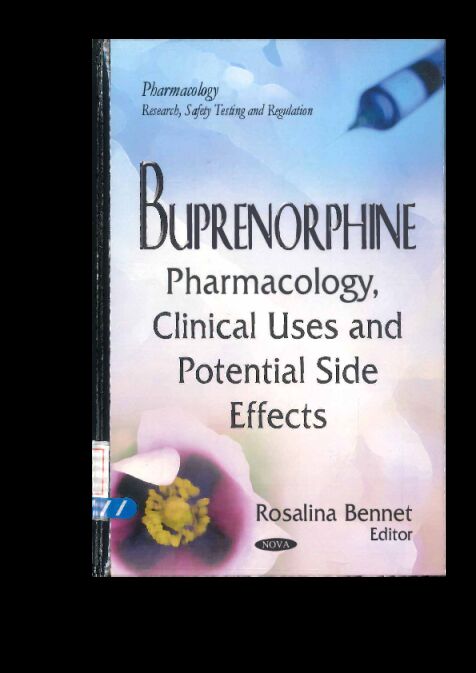
书名:Buprenorphine
ISBN\ISSN:9781633211360,1633211363
出版时间:2014
出版社:Nova Publishers,
前言
This book begins by reviewing the pharmacology of buprenorphine and co-ingredient naloxone; its use in addiction medicine and pain management; and clinical challenges, with special emphasis on drug-drug interactions (pharmacokinetic and pharmacodynamic), safety concerns, and buprenorphine misuse. The book continues to discuss the role of buprenorphine as an analgesic; the application of buprenorphone in acute and chronic pancreatitis; and the substitution maintenance treatment of opioid dependence with buprenorphine and naloxone.
Chapter 1 - Buprenorphine was introduced in the United States as an injectable analgesic in 1981 and treatment option for opioid dependence in 2002; a transdermal formulation was approved for pain management in 2010. Following the introduction of this variety of dosage forms, buprenorphine use and misuse have increased significantly. This article reviews the pharmacology of buprenorphine and со-ingredient naloxone; use in addiction medicine and pain management; and clinical challenges, with special emphasis on drug-drug interactions (pharmacokinetic and pharmacodynamic), safety concerns, and buprenorphine misuse. Buprenorphine accessibility for nonmedical use is widespread in some settings, and burgeoning prescription and abuse rates have led to multiple reports of overdoses and fatalities associated with its use. Buprenorphine abuse potential, prevalence and patterns of misuse, and risk factors associated with fatal overdose are discussed. Given the epidemic of prescription drug misuse, practitioners have an increasing need for clinical monitoring for compliance and misuse of controlled substances, including buprenorphine. Most guidelines recommend urine drag testing, but monitoring of buprenorphine presents special challenges to laboratories and practitioners interpreting results. Compliance and abuse monitoring for buprenorphine may be performed by different test methodologies, with immunoassay and mass spectrometry methods in most frequent use; each technology offers unique advantages and disadvantages. Testing of other specimen types for buprenorphine including blood, oral fluid, hair, sweat, breath, and meconium is feasible. The disposition of buprenorphine and its metabolites in each specimen type varies and may impact specific testing methodology. Interpreting drug tests requires understanding of buprenorphine's unique properties and factors that influence detection. Considerations include metabolic and dispositional patterns in tissues, and differences in the use of specific formulations or routes of administration (e.g., injection, sublingual, or transdermal) for specific applications.
Chapter 2 - Potent opioids have different efficacy, particularly opioids such as buprenorphine may have advantages due to unique pharmacodynamics and pharmacokinetics. Prospective studies have demonstrated the benefits to buprenorphine in several clinical situations. However, randomized control trials are few and far between and need to be done to demonstrate these advantages. Buprenorphine appears to be a safe potent opioid with few drug interactions and reduced risk for respiratory, cardiac, gastrointestinal, sexual and cognitive adverse effects. Certain populations and clinical situations favor the use of buprenorphine as a first line opioid.
Chapter 3 - Buprenorphine is a semi-synthetic derivate of thebaine. Buprenorphine has both analgesic and antihyperalgesic systemic effects but the exact mechanism of the different modalities remains unknown. It has three known receptor binding mechanisms. First Buprenorphine is an μ-opioid receptor agonist. Secondly Buprenorphine shows partial agonistic activity at the opioid receptor-like receptor 1 (ORL1)-receptor that induces a pronociceptive effect, for example useful in the treatment of hyperalgesia. Its antagonistic activity at the third receptor, the к-opioid receptor, might explain the less sedative and psychomimetic effects compared to morphine or fentanyl.
Buprenorphine is metabolised by the liver into norbuprenorphine. The latter is a μ-opioid, δ-opioid and nociception receptor full agonist, as well as a κ-opioid receptor partial agonist. After glucuronidation, both glucuronides are eliminated mainly through excretion into the bile.
A higher-dose sublingual form (up to 2 mg) is indicated for detoxification and long-term replacement therapy in opioid dependency. It is also a good alternative to sustained-release opioids such as morphine and oxycodone. The transdermal form is indicated for the treatment of severe cancer pain and severe non-cancer pain not responding to non-opioids. But also in orthopaedic surgery e.g., in elderly, it is proven an effective tool for pain control. The intravenous formulation is used in continuous postoperative pain treatment.
Conflicting results have been published on the efficacy and duration of various opioids (including buprenorphine) in prolonging the duration of local anaesthetics. The regional use of buprenorphine has been described in neuraxial and peripheral blocks as adjuvants. Local buprenorphine application, e.g., to the stellate ganglion, is also described in chronical pain management.
Buprenorphine can be sleep-inducing which can be an advantage when pain is accompanied with sleeplessness. Other clinical indications are pregnancy, maxillofacial surgery, treatment in non-suicidal self-injury, vasectomy surgery, and due the euphoria and anxiolytic effects it can be used as an alternative antidepressant in patients with depression due to pain.
The adverse effects are similar to those of other opioids. The most important side effect is nausea and vomiting, in particular when initiated at high doses.
Another important side- effect is respiratory depression but due to a relatively long half-life, this depression is characterised by a ceiling effect. The combination with alcohol and/or benzodiazepines however, can lead to fatal respiratory depression.
A "precipitated withdrawal" is described when buprenorphine is used in persons with a physically dependency for full-agonist opioids, who are not already in withdrawal.
Buprenorphine is a common used opioid that provide effective pain relief in cancer and non-cancer patients. As an adjuvant used in regional anesthesia, it is likely to? prolong the peripheral nerve block duration.
Chapter 4 - Pancreatitis is an inflammation of the pancreas. The most common causes are alcohol consumption and gallstone related. Interestingly, pancreatitis is the most incidence observed in patients following abdominal surgery. The most frequently symptoms of pancreatitis are severe abdominal pain, nausea and vomiting. Heart and respiratory function may also be affected. How to reasonably choose a safe, effective and low-dependent analgesic is a big problem faced by the doctors. Analgesics will not affect the recovery of the disease if the patients have chronic or acute inflammation, however it will release the symptoms and make the patients more comfortable. In general, more than one type of analgesics are used in treating pancreatitis, such as acetaminophen, non-steroidal anti-inflammatory drug and opioid etc., which is greatly controversial in clinical application because of the side effects such as ulcers associated with their use. In addition, some studies have shown that the use of opioid may conceal the changes of the disease and because their spasmogenic effects will increase the patients' ache, this in turn increases the sphincter pressure of oddi in abdominal cavity. The biliary tract pressure increase seems to be related with dosage and plasma concentration of opioid and seems to be apparently regulated by the Mu (μ) receptor.
There is a subclass of opioid drug called buprenorphine hydrochloride, along with its relatively outstanding pharmacologic character to be gradually known, buprenorphine can be used as substitute for the drug dolantin in treating the abdominal ache associated with acute and chronic pancreatitis. The use of burprenorphine can be an alternative choice to treat the aching of acute pancreatitis which has less side effects. Compared with other analgesia plans, buprenorphine can reduce analgesia metering needed, and which has no obvious differences in the risk of both the appearances of pancreatitis complication and clinical adverse events. According to the current clinical studies, buprenorphine is the suitable choice for treating the aching of acute pancreatitis, and compared with other analgesia drugs that are not belonging to opioid category. Currently for acute paroxysm associated with chronic pancreatitis, the common suggestions for treatment do not provide enough analgesia effect. Therefore the German Guide suggest the use of dolantin, buprenorphine and procaine administered intravenously as a treatment plan for the abdominal pain resulting from pancreatitis. It is very difficult to control the intractable aching of chronic pancreatitis, but fortunately, it has been reported that buprenorphine is very effective in alleviating the pain that is felt by the patients with chronic pancreatitis. The use of buprenorphine is a simple, safe and effective way compared with current drugs used in treating abdominal ache as a result of pancreatitis.
Chapter 5 — Aim: To present medical assisted treatment of opiate dependence with substitution medicament Buprenorphine/Naloxone (Suboxone®) in Bosnia and Herzegovina, with which we may prevent social excluding of young individuals who were opiate dependants.
General overview: Until recently there was no solution for long-term and comprehensive treatment of young persons who suffer from opiate dependency. This is not illness that impairs only psychical health of addicts with possible life threatening consequences, but this is serious problem in whole society because of aftereffects that lead young people in social excluding: delinquencies, criminals, violations and imprisonments. In health care institutions there are no capacities for the stationary treatment for longer term, what is necessary for the treatment of drug dependence, and less adequate solution is seating in penal and upbringing institutions, which, besides stigmatizing young proteges, it excludes young addicts from normal social life in addition. The most modern medically assisted method of substitution treatment of opiate dependants with medical substance BupTenorphine/Naloxone (Suboxone®) has been implemented. This medicament with its characteristics offers possibility for out-patient treatment. With this it is possible to achieve prompt and effective results of detoxification and weaning of opiates. Treated opiate dependants become "clear minded", qualified for the all professional and social activities, what improves significantly quality of family and social relationship. With this way the treatment in the institutions can be avoided, therefore it preventing social excluding of young person's treated with this method.
Conclusion: Medical assisted treatment of opiate dependence with Buprenorphine/Naloxone is implementing outpatient program with involvement of close family members who are not drug dependants. It brings back "clear mind" to treated young opiate addicts, it does not stigmatize but it re-socialize and in that way it is preventing social excluding of young opiate dependant persons.
查看更多
目录
Preface vii
Chapter 1 Buprenorphine: Clinical Use, Abuse and Compliance Monitoring 1
Chapter 2 The Emerging Role of Buprenorphine As an Analgesic 115
Chapter 3 Buprenorphine 141
Chapter 4 The Application of Buprenorphine in Acute and Chronic Pancreatitis 157
Chapter 5 Substitution Maintenance Treatment of Opioid Dependence with Buprenorphine/Naloxone Method As Prevention of Social Excluding of Young People: Tuzla Model 173
Index 195
查看PDF
查看更多
馆藏单位
中国医科院医学信息研究所