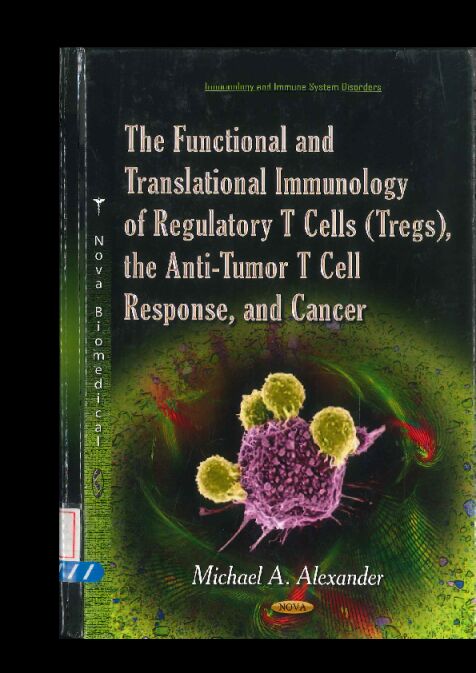
书名:The functional and translational immunology of regulatory t cells (tregs), the anti-tumor t cell response, and cancer
责任者:Michael A. Alexander.
出版时间:2014
出版社:Nova Science Publishers, Inc.,
前言
Prior to the discovery and characterization of regulatory T cells (Tregs) tumor immunologist were unable to understand why anti-tumor T cells were present in the tumor mass, but ineffective at removing the tumor. Once it was understood that Tregs prevented autoimmunity, it was clear that the T cell immune response to cancer was vulnerable to regulation. Because cancer cells were previously normal functioning cells of the body, the T cell system that is responsible for immunosurveillance pauses to evaluate a situation where the cellular antigens it detects are not quite self, but part self/part non-self. These are called "neoantigens" and can be recognized by the T cell immune system. As a consequence, some of the cells are destroyed and their proteins processed by antigen presenting cells (APC). Non-self peptides associated with the tumor are presented by APC and induce a CD4 T cell response. Tregs, which arrive at this site as soon as the first CD4 T cell responds and secretes IL-2, begin their involvement in this process. All of this probably happens within the time it took to read the last few sentences. T cells have the ability to evaluate situations where cells are found that express either an irregular cell membrane or have viruses budding from them. They do what they are genetically programmed to do and that is to kill unfamiliar cells, which prepares the immune system to assimilate that cell. The assimilation part has to do with antigen processing and presentation and is the purview of the granulocyte/monocyte series of cells such as macrophages and DCs or APCs. When normal or pre-cancerous cells are killed by this process APCs also present self-antigens (peptides) that activate Tregs through their anti-self peptide T cell receptor. With that being said, the job of Tregs is to prevent the destruction of normal cells, which means preventing autoimmunity. Tregs react to the situation and respond as they do to minor inflammatory situations where they protect normal cells that are damaged until they return to their original state. Tregs protect these cells from destruction by the T cell immune system through a series of elaborate effector mechanisms. Because pre-cancerous and cancer cells express normal cellular proteins, Tregs act as if they were damaged cells and should be protected from the T cell immune system, which is determined to kill them. While this is happening the cancer continues to grow and despite the fact that the cancer cells are expressing tumor antigens recognized by the T cell immune system, Tregs continue to protect them because they are still recognized as self. They do this by eliminating responding anti-tumor T cells and in some cases, convert these responding T cells into tumor-specific Tregs. Tumor-specific Tregs attach themselves to the tumor and protect it using newly acquired effector mechanisms. This scenario occurs in almost every case of cancer because if it did not, the cancer would have been eliminated by the T cell immune system long before it became deadly.A\Now along come immune-based cancer treatments (immunotherapy) that hold the promise of not only painless outpatient treatments for the disease, but also the end of chemically based treatments (chemotherapy) that have serious side effects for the patient. However, it turns out that most of the successful immune cell-based treatments (adoptive T cell therapy, dendritic vaccines, and hematopoietic stem cell transplantation) for cancer are susceptible to the influence of Tregs. In light of the information that will be described in this text, this is no surprise, but what is really important is how to regulate Treg control of the T cell immune system in a positive fashion during immunotherapy. The information to positively regulate Tregs in order to increase the effectiveness of immunotherapeutic cancer treatment is available and has to be implemented in order for these immune-based therapies to live up to their expectations. One of the many problems associated with controlling Tregs as far as cancer treatment is concerned has to do with a term called "cellular plasticity." This term refers to a cell's adaptation (execution of genetically programmed options) to different biological environments while performing specific functions. Therefore, the ability of Tregs to appear (advanced mobility) from the circulatory system (thymus -derived natural or innate Tregs) or be created (conversion from naive/antigen-specific T cells or adaptive Tregs) at a moment's notice is a genetically programmed response and being such, it invariably is susceptible to manipulation. Despite their "cellular plasticity" and susceptibility to manipulation, Tregs play an essential role in normal functioning of the immune system. In fact, if Tregs were removed from the body, death by fatal autoimmune reactions or infection would follow shortly thereafter. In addition, there would not be any births because Tregs create maternal tolerance that allows the fetus, which is part self and part non-self to come full-term and be born.A\One of the most important things Tregs do as far as the immune system is concerned is that they create homeostasis, which is the normal balance between helpful and harmful effects of the immune system as it protects the body. Homeostasis is the most salient, but almost unnoticed aspect of Treg function because Tregs silently eliminate leftover responding T cells from infections, which prevents autoimmune bystander killing of normal cells. In addition, Tregs secrete substances (lymphokines, adenosine, etc.) that reduce responding T cell division, preventing the generation of autoimmune disease-causing anti-self T cell receptors by somatic mutation. Tregs also play a positive role during anti-cancer immune-based therapy where the patient's immune system is removed by radiation and/or chemotherapy and has to recover during the treatment. In this case, despite the fact that almost all of them are removed during this procedure (lymphodepletion), the few Tregs that survive manage to control the re- population process enough to inhibit auto-reactive T cells that would induce autoimmune disease in the patient. Given this information about homeostatic control of the T cell immune response, complete removal of Tregs to allow an anti-tumor T cell response to be effective is out of the question. Tumor immunologists now realize that the creation of immunity to cancer using immunotherapy that leads to the destruction of the tumor and a remaining T cell memory to prevent a recurrence cannot occur without involvement and control of Tregs. The function of cells involved in this process is controlled by cell membrane receptor activation of intracellular translational pathways. These pathways interact with the nucleus that in turn produces transcriptional proteins, which control cellular behavior such as secretion of lymphokines, cell proliferation, or differentiation. The purpose of this text is to expose the transcriptional pathways associated with the behavior of not only Tregs, but also anti-tumor T cells, and the tumor itself. Understanding the basic biochemical pathways that govern the T cell immune response to cancer can lead to the development of new immune cell-based cancer therapies that live up to the promise of a treatment that can achieve a lifelong remission of cancer.A\There are two reasons why this topic that focuses the inhibition of the anti-tumor T cell response by Tregs is so important. Those are what is happening now and what will happen in the future as far as the development and treatment of cancer is concerned. As this is being read, right now in someone's (you, me, or anyone) body a small group of cancerous cells are surrounded by T cells. Instead of trying to eliminate the cancer cells, these T cells are paralyzing and killing other T cells that have come to attack the cancer. This continues as the cancer grows and is eventually discovered by that person or their physician. More than likely, the cancer cells have escaped from their primary location and are colonizing (metastasizing) in other parts of the body. After testing comes diagnosis and sometime in the future cancer treatment is imminent. If this cancer treatment involves immunotherapeutic treatments such as bone marrow transplantation, adoptive cell (T cells or dendritic cells) therapy, chemotherapy, or a combination of both, the function of Tregs could determine if the treatment is successful (life) or unsuccessful (death). In some cases such as bone marrow transplantation, the Tregs may not even belong to the patient. In this case, donor Tregs can be used to prevent the donor's T cells from attacking the recipient's tissues while killing the tumor. The attack of normal recipient tissues by the donor's T cells is an almost always-fatal disease and side effect of this type of cancer treatment called, graft vs. host disease or GVHD. However, during other forms of immunotherapy for cancer Tregs attack the immune cells used as therapy thus inhibiting the effectiveness of the treatment. As far as cancer is concerned, what maybe happening in our bodies now and what to do about it in the future is the essence of this discussion about the immunological function and translational pathways of Tregs, anti-tumor T cells, and tumor cells. This topic is not only important for us as individuals, but also for a global society where everyone is a potential cancer victim.A\This book is a natural extension of the first book called, Immune-based Cancer Treatment. The T lymphocyte Response for several reasons. First of all, it directly addresses one of the main problems associated with the immunotherapeutic treatment of cancer mentioned in the first book, which is caused by the regulatory T cell system or Tregs. Secondly, the first book describes the origin and function of the immune cells (T cells, NK cells, monocytes, macrophages, and dendritic cells) involved in the anti-tumor T cell response in detail. It demonstrated that all of these cells contain subpopulations, which contribute to not only how the cellular immune system functions, but also how these subpopulations are integral components of the immune system as it responds to cancer. The other similarity this book has to the first is the fact that there are no diagrams or illustrations. This is a purposeful attempt by the author to have the reader visualize in their mind the activities of cells during this very important immune response. Diagrams and illustrations do serve a purpose in that they show the reader what the author wants them to see. In this case, the imagination is used to create a world best thought of as an assemblage of cells and biochemical reactions occurring for one purpose and one purpose only and that is to eradicate a collection of cancerous cells determined to cause death. In order to really understand this struggle between the immune cells of the body and cancer, the mind has to visualize the cells and conditions they find themselves in during an anti-tumor T cell response, recreate that response based on the given information, and then use the imagination to see interactions between the cells. Mind-visualization is used by scientists to bridge gaps in information that may allow them to create alternative theories and develop new ideas based on what may happen. This book is intended to do that very same thing in the minds of not only established scientists, but also students of tumor immunology and cancer physicians. The last real chapter in the book called, Treg Immunobiology as it Relates to the Anti-tumor T cell Response During Immune cell- based Cancer Treatment contains information concerning the role Tregs play in the execution of immunotherapeutic treatments for various types of cancer. It suggests several ways to manipulate the translational pathways in Tregs to initiate an anti-tumor T cell immune response to cancer. The idea behind the suggestion is to temporarily turn an anti- inflammatory cell (Treg) into an inflammation-inducing cell (TH17) in order to jump-start the anti-tumor T cell immune response. Despite the fact that the T cell immune system is not a car with a drained battery when it comes to cancer (or is it?), the idea seemed like a good one at the time. The hope is that this book may inspire non-traditional thinking about a problematic topic (T cell immune response to cancer) that needs non-traditional ideas to solve.
查看更多
目录
Foreword ix
Acknowledgments xiii
Introduction xv
Chapter 1 The Immunobiology and Translational Immunology of Regulatory T Cells 1
Chapter 2 Autoimmunity, Tregs, and the Anti-Tumor T Cell Immune System 27
Chapter 3 Treg Effector Mechanisms 67
Chapter 4 Treg Immunobiology as It Relates to the Anti-Tumor T Cell Response during Immune Cell-Based Cancer Treatment 129
Chapter 5 The Functional and Translational Immunology of Regulatory T Cells (Tregs), the Anti-Tumor T Cell Response, and Cancer: Chapter Review 175
References 193
Author Contact Information 225
Index 227
查看PDF
查看更多
馆藏单位
中国医科院医学信息研究所