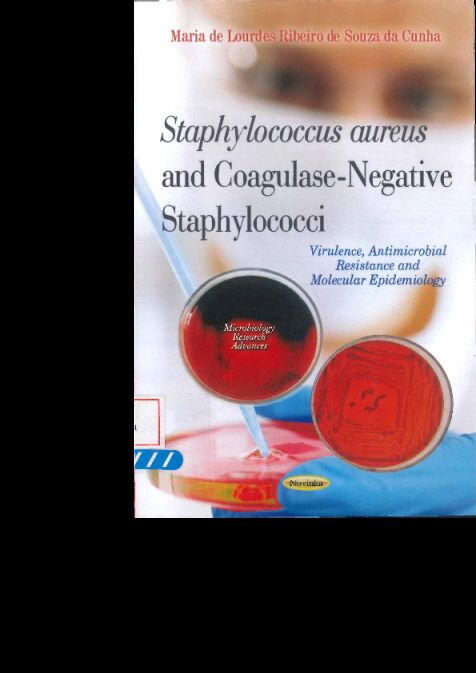
书名:Staphylococcus aureus and coagulase-negative staphylococci
责任者:Maria de Lourdes Ribeiro de Souza da Cuncha.
出版时间:2014
出版社:Nova Publishers,
前言
In this book, I decided to discuss studies related to my line of research "Staphylococcus aureus and coagulase-negative staphylococci: virulence, antimicrobial resistance and molecular epidemiology". I became interested in this line of research already as a scientific initiation student during my undergraduate course in Biological Sciences at the State University of Londrina, PR, Brazil, when I began to study the detection of staphylococcal enterotoxins in S. aureus under the supervision of Prof. Dr. Elisa Yoko Hirooka. During my PhD, already as a professor of the Department of Microbiology and Immunology at the Institute of Biosciences (IB), UNESP, Botucatu, SP, Brazil, under the supervision of Prof. Dr. Carlos Alberto de Magalhaes Lopes, I began to work with other species of the genus Staphylococcus, the coagulase-negative staphylococci (CoNS). My research focused on the identification of these species, as well as the phenotypic detection of different virulence factors, including enzymes, biofilm, enterotoxins and antimicrobial resistance in strains isolated from newborns of the Neonatal Unit of the University Hospital (HC), Botucatu Medical School (FMB), SP, Brazil, in collaboration with Prof. Dr. Ligia Maria S. S. Rugolo and, subsequently, with the neonatologists Prof. Dr. Joao Cesar Lyra and Prof. Dr. Maria Regina Bentlin, researchers at the Department of Pediatrics, FMB. After my PhD, I was invited by Dr. Augusto Cezar Montelli to join the research group on peritonitis in peritoneal dialysis, together with Prof. Dr. Pasqual Barretti and Prof. Dr. Jacqueline Teixeira Caramori, the researchers responsible for the Dialysis Unit of HC-FMB, Botucatu, SP, Brazil.
In view of the results of my PhD and of the difficulty in convincing the reviewers of the truthfulness of the results obtained regarding the toxigenicity of CoNS and the need to confirm the results using more reliable genotypic methods, I entered the area of Molecular Biology in collaboration with Prof. Dr. Joao Pessoa Araujo Junior of the Department of Microbiology and Immunology, IB, UNESP, Botucatu, SP, Brazil. In parallel to these projects on pathogenicity factors, I began to study the detection of oxacillin resistance by molecular methods. Thereafter, I entered the area of Molecular Epidemiology in collaboration with Prof. Dr. Carlos Magno Castelo Branco Fortaleza of the Department of Tropical Diseases, FMB, UNESP, Botucatu, Brazil.
The book covers updated topics on the genus Staphylococcus, including the latest discoveries. In each chapter I tried to discuss the results obtained and published during my more than 20 years as a researcher in this area.
The book is divided into eight chapters. The first chapter is a presentation of the genus Staphylococcus and focuses on the current classification, the species described, and the general characteristics of these bacteria. The second chapter discusses the clinical significance of CoNS, which are often classified as mere blood culture contaminants, but are the etiological agents most commonly associated with neonatal infections and peritonitis in patients undergoing peritoneal dialysis. These infections occur mainly in patients submitted to invasive procedures. Catheter-related infections are an example of this scenario. This topic is discussed in chapter 3, with emphasis on diagnostic techniques.
Chapter 4 focuses on the identification of CoNS, which is important for predicting the pathogenic potential and antibiotic susceptibility profile of each species, thus permitting more adequate assessment of the clinical significance of specific species.
Coagulase-negative staphylococci can colonize the surface of catheters. Once adhered, these bacteria proliferate, forming multiple layers, and produce an extracellular polysaccharide that leads to the formation of biofilms which potentiate their pathogenicity. This topic is discussed in chapter 5.
Chapter 6 discusses the virulence factors responsible for the symptoms and severity of infections caused by Staphylococcus spp. These factors include membrane-active toxins, called cytotoxins, and a group of pyrogenic toxin superantigens. In this chapter, I discuss several current aspects related to the virulence of 5. aureus and CoNS, including isolates of different origins, phenotypic and genotypic techniques for the detection of these toxins, and the gene regulation mechanisms involved in their expression.
Another extremely important topic, which is discussed in chapter 7, is the resistance of these microorganisms to antimicrobial agents. Half a century after the description of the first isolates of mefhicillin-resistant Staphylococcus aureus (MRSA) in England, these microorganisms have spread around the world. Although much has been learned about these bacteria, we have been unable to fully eradicate them or to consistently prevent the severe infections caused by these microorganisms. MRSA currently represent a serious threat to public health worldwide due to the rapid dissemination and diversification of pandemic clones that show increasing virulence and antimicrobial resistance. These microorganisms are one of the main causes of healthcare-associated infections and the prevalence of community associated methicillin-resistant Staphylococcus aureus (CA-MRSA) has also been increasing. The epidemiology of MRSA infections is discussed in chapter 8. This chapter highlights the importance of understanding why specific clones predominate in different regions and of identifying individual factors related to their acquisition in order to develop more effective control strategies and to choose more appropriate antimicrobial therapy.
In this book, the topics are explained in a clear and objective manner and should be useful for postgraduate students, physicians and researchers who need to better understand this fascinating group of microorganisms.
查看更多
目录
Acknowledgments ix
List of Abbreviations and Acronyms xi
Preface xv
Chapter 1 The Genus Staphylococcus 1
Chapter 2 Clinical Significance of Coagulase-Negative Staphylococci 7
Chapter 3 Catheter-Related Infections 21
Chapter 4 Identification of Staphylococcus spp 37
Chapter 5 Staphylococcal Biofilms 45
Chapter 6 Staphylococcal Toxins 61
Chapter 7 Antimicrobial Resistance 81
Chapter 8 Epidemiology of Methicillin-Resistant Staphylococcus spp 95
Author's Contact Information 109
Index 111
查看PDF
查看更多
馆藏单位
中国医科院医学信息研究所