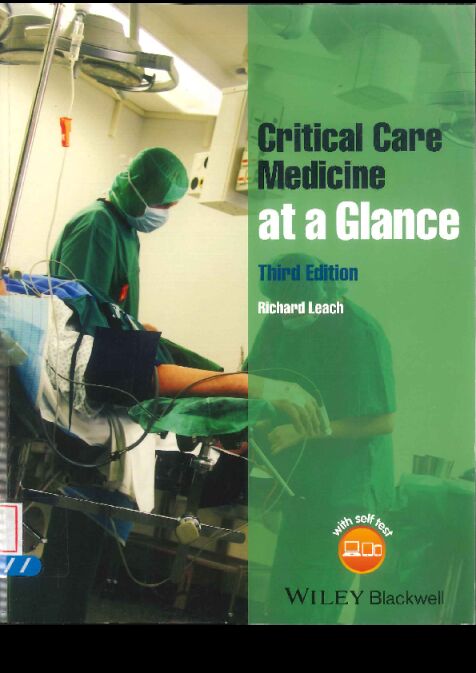
书名:Critical care medicine at a glance
ISBN\ISSN:9781118302767,1118302761
出版时间:2014
出版社:John Wiley & Sons Ltd,
分类号:医药、卫生
版次:3rd edition.
前言
Critical care medicine encompasses the clinical, diagnostic and therapeutic skills required to manage critically ill patients in a variety of settings including intensive care, high dependency, surgical recovery and coronary care units. These disciplines have developed rapidly over the past 30 years and are an integral part of most medical, anaesthetic and surgical specialties. Medical students, junior doctors, nursing and paramedical staff are increasingly expected to develop the skills necessary to recognize and manage critically ill patients, and most will be familiar with the apprehension that precedes such training. Unfortunately, most current texts relating to critical care medicine are unavoidably extensive. It is the aim of Critical Care Medicine at a Glance to provide a brief, rapidly informative text, easily assimilated before starting a new job, that will prepare the newcomer for those aspects of these specialties with which they may not be familiar. These include assessment of the acutely unwell patient, monitoring, emergency resuscitation, oxygenation, circulatory support, methods of ventilation and management of a wide variety of medical and surgical emergencies.
As with other voiumes in the 'At a Glance' series, this book is based around a two-page spread for each main topic, with figures and text complementing each other to give an overview of a topic at a glance. Although primarily designed as an introduction to critical care medicine, it should also be a useful undergraduate revision aid. However, such a brief text cannot hope to provide a complete guide to clinical practice and postgraduate students are advised that additional reference to more detailed textbooks will aid deeper and wider understanding of the subject. On the advice of our readers, the third edition includes new chapters on fluid management, arrhythmias, infection, stroke, jaundice, intestinal obstruction, ascites and imaging; and previous chapters have been extensively updated to include recent guidelines and innovations. As with many new specialties, certain aspects of critical care medicine remain controversial. When controversy exists, I have attempted to highlight the differences of opinion and, with the help of many colleagues and reviewers, to provide a balanced perspective, although on occasions this has proven difficult. Nevertheless, errors and omissions may have occurred and these are entirely our responsibility.
Many colleagues, junior doctors and medical students have advised and commented on the content of Critical Care Medicine at a Glance. I would particularly like to thank my medical colleagues on the acute medical, high dependency and intensive care units at Guy's, St Thomas' and Johns Hopkins Hospitals, and the Anaesthetic Department at St Thomas' Hospital. Special thanks are due to the senior nurses at Guy's and St Thomas' Hospitals and to Mrs Clare Leach for their advice on the many aspects of nursing care so essential in critical care medicine. Finally, I would like to thank all the staff at Wiley-Blackwell, especially Karen Moore and Katrina Rimmer, for all their help and support in producing this text. Richard Leach
查看更多
目录
Preface viii
Acknowledgements ix
Units, symbols and abbreviations x
How to use your textbook xvi
Part 1 General 1
1 Recognizing the unwell patient 2
2 Managing the critically ill patient 4
3 Monitoring in critical care medicine 6
4 The electrocardiogram 8
5 Cardiopulmonary resuscitation 10
6 Oxygen transport 12
7 Shock 14
8 Circulatory assessment 16
9 Fluid management: pathophysiological factors 18
10 Fluid management: assessment and prescription 20
11 Fluid management: fluid choice 22
12 Inotropes and vasopressors 23
13 Failure of oxygenation and respiratory failure 24
14 Oxygenation and oxygen therapy 26
15 Airways obstruction and management 28
16 Non-invasive ventilation 30
17 Endotracheal intubation 32
18 Mechanical ventilation 34
19 Respiratory management, weaning and tracheostomy 36
20 Arterial blood gases and acid-base balance 38
21 Analgesia, sedation and paralysis 40
22 Enteral and parenteral nutrition 42
23 Hypothermia and hyperthermia 44
24 Assessment of the patient with suspected infection 46
25 Bacteraemia, SIRS and sepsis 48
26 Hospital-acquired (nosocomial) infections 50
27 Fever in the returning traveller 52
28 Fever (pyrexia) of unknown origin 54
29 End of life issues 56
Part 2 Medical 59
Cardiac
30 Acute coronary syndromes I: clinical pathophysiology 60
31 Acute coronary syndromes II: investigations and management 62
32 Arrhythmias: tachyarrhythmias 64
33 Arrhythmias: bradyarrhythmias 67
34 Heart failure and pulmonary oedema 68
35 Cardiac emergencies 70
36 Deep venous thrombosis and pulmonary embolism 72
Respiratory
37 Chest imaging and bronchoscopy 74
38 Community-acquired pneumonia 76
39 Hospital-acquired (nosocomial) pneumonia 78
40 Asthma 80
41 Chronic obstructive pulmonary disease 82
42 Acute respiratory distress syndrome 84
43 Pneumothorax and air leaks 86
44 Respiratory emergencies 88
Renal and metabolic
45 Acute kidney injury: pathophysiology and clinical aspects 90
46 Acute kidney injury: management and renal replacement therapy 92
47 Electrolyte disturbances: sodium and potassium 94
48 Electrolyte disturbances: calcium 96
49 Electrolyte disturbances: magnesium and phosphate 98
50 Diabetic emergencies 100
51 Endocrine emergencies 102
Gastrointestinal
52 Gastrointestinal haemorrhage 104
53 Jaundice 106
54 Acute liver failure 108
55 Acute pancreatitis 110
56 Vomiting and intestinal obstruction 112
57 Diarrhoea 114
58 Ascites 116
59 Abdominal imaging 117
Neurological
60 Acute confusional state, coma and status epilepticus 118
61 Stroke 120
62 Other cerebral vascular disorders 122
63 Infective neurological emergencies 123
64 Neuromuscular conditions 124
Infective
65 Specific bacterial infections 126
66 Common adult viral infections 128
67 Common fungal and protozoal infections 130
68 The immune compromised patient 132
Other systems
69 Coagulation disorders and transfusion 134
70 Drug overdose and poisoning 136
Part 3 Surgical 138
71 Trauma 140
72 Head injury 142
73 Chest trauma 144
74 Acute abdominal emergencies 146
75 Obstetric emergencies 148
76 Burns, toxic inhalation and electrical injuries 150
Part 4 Self-assessment
Case studies and questions 152
Case studies answers 155
Appendices
Appendix I Classification of antiarrhythmic drugs 162
Appendix II Pacemaker types and classifications 163
Appendix III Acute injury network staging system 2008 for acute kidney injury (AKI) 164
Appendix IV Rockall risk-scoring system for Gl bleeds 165
Appendix V Child-Pugh grading 166
Appendix VI Typical criteria for liver transplantation 167
Appendix VII Royal College of Physicians' top nutrition tips 168
Index 169
查看PDF
查看更多
馆藏单位
中国医科院医学信息研究所