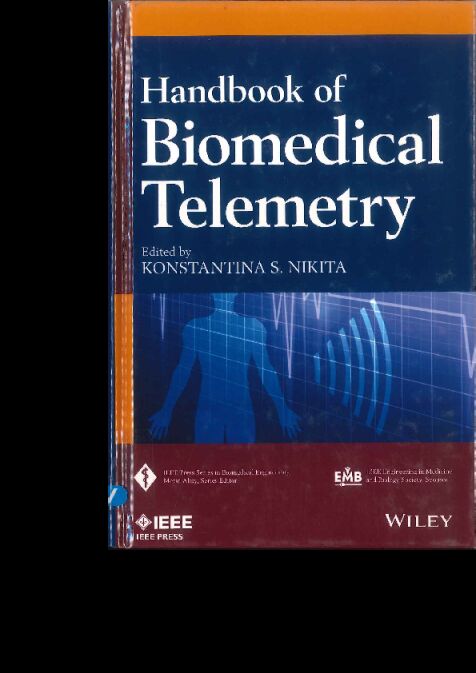
书名:Handbook of biomedical telemetry
责任者: Konstantina S. Nikita.
出版时间:2014
出版社:John Wiley & Sons Inc.,
前言
The word telemetry is derived from the Greek words "tele" = "remote", and "metron"= "measure", and means data measurements allowed to be made at a distance. In other words, data are measured in situ, and further transmitted remotely to a receiving station. Biomedical telemetry permits the measurement of physiological signals at a distance. Physiological signals are obtained by means of appropriate transducers, post-processed, and eventually transmitted to an exterior monitoring and/or control device. The exterior device can be placed on or at a close distance from the subject's body, but can also further communicate with a distant hospital or physicians' station with the help of communication technologies and infrastructure.A\The "Handbook of Biomedical Telemetry" aims to form a complete book in this emerging scientific field, addressing all arising scientific issues and technologies. It includes a comprehensive set of topics, sources and resources and contains generic information, detailed scientific analyses, as well as example applications. To accurately cover the broad range of topics arising within biomedical telemetry, the book comprises 23 chapters, divided into three parts.A\The First Part of the book addresses technologies for the design of biomedical telemetry devices, biomedical sensing, and powering techniques for biomedical telemetry applications.A\The Second Part of the book deals with Propagation and Communication Issues in Biomedical Telemetry, and covers numerical and experimental techniques for body area electromagnetics, inductive coupling, antennas and RF communication, intra-body communication, optical communication, biosensor communication technologies and standards, context-aware sensing and multi-sensor fusion, security and privacy issues, connection between biomedical telemetry and telemedicine, as well as safety issues and exposure assessment to high frequency biotelemetry fields.A\The Third Part of the book presents selected examples of wearable, implantable and ingestible devices, stimulators, integrated mobile healthcare systems, and advanced material-based sensing paradigms for monitoring and therapeutic intervention.A\The material in the book is written for persons at a number of levels. Much of it is introductory for an engineer, but serves to link engineering principles with living systems, such as the material related to sensng and propagation of physiological signals over time and space. Even though the book is expected to enable a diverse group of readers to become acquainted with biomedical telemetry, it also intends to provide highly specialized comprehensive knowledge in the field. As a result, it is mainly intended for persons who are familiar with conventional engineering and biomedical engineering principles. It can be addressed to a wide audience—from advanced undergraduate and postgraduate students pursuing education/degrees in bioengineering / biomedical / communications engineering to practicing engineers, engineering professors, researchers and industry specialists in the fields of communications and biomedical engineering sciences.A\Several chapters have been written by experts in the respective fields, and a great effort has been devoted to secure chapter-to-chapter cohesion and writing style uniformity. As a result, the book contains more perspectives, analyzes more data, incorporates knowledge and research from more disciplines, and uses a wider variety of methodologies.A\An important feature of the work is the breadth and depth of treatment given to the component parts of a biomedical telemetry system and their illustration through numerous application case studies. An overview of the commercially (off-shelf) available equipment related to particular described scenarios is also presented. Human phantoms, spectrum regulations, safety, standards and interoperability issues are presented and supported by relevant resource listings, while major technical challenges related to advanced materials, miniaturization and biocompatibility issues, are also included. KONSTANTINA S. NIKITA
查看更多
目录
PREFACE xxi
ACKNOWLEDGMENTS xxiii
CONTRIBUTORS xxv
1 Introduction to Biomedical Telemetry 1
1.1 What is Biomedical Telemetry? 1
1.2 Significance of Area, 3
1.3 Typical Biomedical Telemetry System, 4
1.4 Challenges in Biomedical Telemetry, 5
1.4.1 Spectrum Regulations, 5
1.4.2 Sensing Technologies, 7
1.4.3 Advanced Materials, 8
1.4.4 Data and Power Circuits, 9
1.4.5 Biocompatibility Issues, 10
1.4.6 Standardization and Interoperability, 11
1.4.7 Privacy and Security, 12
1.4.8 Biomedical Telemetry Toward Telemedicine, 12
1.4.9 Patient Safety, 13
1.5 Commercial Medical Telemetry Devices, 14
1.5.1 Wearable Devices, 14
1.5.2 Implantable Devices, 15
1.5.3 Ingestible Devices, 18
1.6 Overview of Book, 19
References, 23
PART I BIOMEDICAL TELEMETRY DEVICES 27
2 Design Considerations of Biomedical Telemetry Devices 29
2.1 Introduction, 29
2.2 Energy Transfer Types, 30
2.3 Architecture of Inductively Coupled Biomedical Telemetry Devices, 31
2.3.1 Inductive Link Fundamentals, 32
2.3.2 Coupling Compensation, 36
2.3.3 Rectification and Voltage Regulation, 37
2.3.4 Transmitter Power Amplifier, 38
2.4 Data Transmission Methods, 39
2.4.1 Downlink, 39
2.4.2 Uplink, 42
2.5 Safety Issues, 44
2.5.1 Implant Heating, 45
2.5.2 Transmission to Human Body, 46
2.5.3 Transmission from Human Body, 46
2.6 Conclusion, 51
References, 51
3 Sensing Principles for Biomedical Telemetry 56
3.1 Introduction, 56
3.2 Biosensor Structure, 57
3.2.1 Design Constraints, 57
3.3 Electrochemical Biosensors, 59
3.3.1 Amperometric Electrochemical Biosensors, 60
3.3.2 Potentiometric Electrochemical Biosensors, 61
3.3.3 Impedimetric Electrochemical Biosensors, 62
3.4 Optical Biosensors, 63
3.4.1 Integrated Optical Biosensors, 64
3.4.2 Interferometric Architectures, 64
3.4.3 Biosensors Based on Antiresonant Reflecting Optical Waveguides, 66
3.4.4 Biosensors Based on Surface Plasmon Resonance, 66
3.5 Thermal/Calorimetric Biosensors, 67
3.6 Piezoelectric Biosensors, 69
3.7 Other Types of Biosensors, 71
3.7.1 Magnetic Biosensors, 71
3.7.2 Pyroelectric Biosensors, 71
3.7.3 Ion Channel Biosensors, 72
3.8 Conclusions, 72
References, 73
4 Sensing Technologies for Biomedical Telemetry 76
4.1 Introduction, 76
4.2 Noninvasive Sensors and Interfaces, 77
4.2.1 Sensors Using Electrophysiological Signals, 77
4.2.2 Photoplethysmogram Sensor, 79
4.2.3 Pulse Oximeter, 81
4.2.4 Wireless Pressure Monitor, 83
4.2.5 Motion Sensors, 86
4.2.6 Temperature Sensor, 88
4.2.7 Wireless and Wearable Chemical Sensor, 88
4.2.8 Capsule Sensor and Endoscopic Camera, 89
4.3 Invasive and Implantable Sensors, 92
4.3.1 Pressure Sensors, 93
4.3.2 Chemical Sensor, 95
4.3.3 Electroencephalography Sensor, 96
4.3.4 Magnetoelastic Sensor, 97
4.3.5 Surface Acoustic Wave Sensors, 97
4.3.6 Energy- and Power-Harvesting Piezoelectric MEMS Device, 99
4.3.7 Microfluidic Sensors, 99
4.3.8 In-Stick Electrode Sensor, 100
4.4 Conclusion, 101
References, 101
5 Power Issues in Biomedical Telemetry 108
5.1 Introduction and Powering Mechanisms, 108
5.2 Motion-Powered Radio Frequency Identification (RFID) Wireless Sensors, 109
5.3 Noninvasive Wireless Methods for Powering on Sensors, 112
5.3.1 Inductive Coupling, 115
5.3.2 Conformal Strongly Coupled Wireless Powering of Biomedical Devices, 118
5.3.3 Far-Field Wireless Power Harvesting, 125
5.4 Conclusion, 129
References, 129
PART II PROPAGATION AND COMMUNICATION ISSUES FOR BIOMEDICAL TELEMETRY 131
6 Numerical and Experimental Techniques for Body Area Electromagnetics 133
6.1 Introduction, 133
6.2 Electrical Properties of Human Body Tissues, 135
6.3 Numerical Modeling, 139
6.3.1 Numerical Phantoms, 139
6.3.2 Computational Methods, 145
6.4 Physical Modeling, 154
6.4.1 Physical Phantoms, 154
6.4.2 Experimental Equipment and Measurements, 158
6.5 Safety Issues, 164
6.6 Conclusion, 167
References, 168
7 Inductive Coupling 174
7.1 Introduction, 174
7.2 Induction Principles, 175
7.2.1 Magnetic Fields, 175
7.2.2 Inductance and Inductive Coupling, 176
7.2.3 Mutually Coupled Coils, 176
7.2.4 Equivalent Network Models, 177
7.3 Wireless Power Transmission, 178
7.3.1 Resonant versus Nonresonant Inductive Links, 178
7.3.2 Power Transfer Efficiency, 180
7.3.3 Multicoil Inductive Coupling, 182
7.3.4 Power Amplifiers, 185
7.4 Inductive Coupling for Biomedical Telemetry, 186
7.4.1 Design Challenges and Possible Solutions, 186
7.4.2 Optimization of Coil Geometries, 189
7.4.3 Power Absorption in Tissue, 191
7.4.4 Safety Issues, 192
7.5 Inductive Data Transmission, 192
7.5.1 Forward Telemetry, 192
7.5.2 Backward Telemetry, 196
7.5.3 Single Carrier versus Multicarrier, 198
7.5.4 Pulse-Based Data Transmission, 200
7.6 Broader Applications, 201
7.7 Future Research Directions, 202
7.8 Conclusion, 202
References, 203
8 Antennas and RF Communication 209
8.1 Introduction, 209
8.2 Background Information, 222
8.3 On-Body Antennas, 212
8.3.1 Antenna Design, 212
8.3.2 Channel Modeling, 219
8.4 Implantable Antennas, 223
8.4.1 Antenna Design, 223
8.4.2 Channel Modeling, 230
8.5 Ingestible Antennas, 235
8.5.1 Antenna Design, 235
8.5.2 Channel Modeling, 241
8.6 Conclusion and Future Research Directions, 245
References, 246
9 Intrabody Communication 252
9.1 Introduction, 252
9.2 Intrabody Communication Transmission Methods, 256
9.2.1 Galvanic Coupling, 256
9.2.2 Capacitive Coupling, 258
9.3 Dielectric Properties of Human Body, 259
9.3.1 Electrophysiological Properties of Skin, 263
9.4 Experimental Characterization of IBC Channel, 265
9.4.1 Experimental Setup for Galvanic Coupling, 266
9.4.2 Experimental Setup for Capacitive Coupling, 268
9.4.3 Experimental Results for Galvanic Coupling, 268
9.4.4 Experimental Results for Capacitive Coupling, 271
9.5 Introduction to IBC Models, 273
9.5.1 Circuit-Level Approaches, 273
9.5.2 Electromagnetic Models, 279
9.5.3 Computational Models, 280
9.5.4 Theoretical Models of EM Propagation, 281
9.6 IBC Propagation Channel, 282
9.6.1 Path Loss, 282
9.6.2 Dispersion, 286
9.6.3 Modulation Schemes, 289
9.7 Conclusion, 292
Acknowledgments, 294
References, 294
10 Optical Biotelemetry 301
10.1 Introduction, 301
10.2 Optical Technology for Optical Biotelemetry, 303
10.2.1 Selection of Wavelength, 303
10.2.2 Light Source, 304
10.2.3 Light-Detecting Elements, 305
10.2.4 Measures for Optical Noises, 305
10.3 Communication Technology for Optical Telemetry, 306
10.3.1 Analog/Digital Transmission, 306
10.3.2 Modulation Method, 307
10.3.3 Toward Intelligent Transmission, 307
10.3.4 Multiplexing Method, 308
10.4 Propagation of Optical Signal, 309
10.4.1 Optical Characteristics of Body Surface Tissue, 309
10.4.2 Distribution of Indirect Light in a Room, 310
10.4.3 Optical Signal Propagation in Open Space, 313
10.5 Multiplexing in Optical Telemetry, 313
10.5.1 Pulse-Burst Method, 314
10.5.2 Spread-Spectrum Method, 314
10.6 Applications of Optical Telemetry, 316
10.6.1 Transcutaneous Biotelemetry, 316
10.6.2 Optical Body Area Network, 317
10.6.3 Noncontact Measurement of Body Surface Displacement, 319
10.6.4 Ambulatory Telemetry, 321
10.6.5 Multichannel Biotelemetry, 322
10.6.6 Data Transmission between Medical Equipment, 326
10.7 Conclusion, 327
References, 328
11 Biosensor Communication Technology and Standards 330
11.1 Introduction, 330
11.2 Biosensor Application Scenarios, 332
11.2.1 Reference Use Case, 332
11.2.2 System Overview, 334
11.3 Biosensor Communication Technologies, 335
11.3.1 Frequency Spectrum Regulations, 335
11.3.2 Wireless Technologies and Standards, 337
11.3.3 Health Data Interoperability Standards, 348
11.4 Conclusion, 364
References, 365
12 Context-Aware Sensing and Multisensor Fusion 368
12.1 Introduction, 368
12.2 Context-Aware Sensing, 368
12.2.1 Classification of Context-Sensitive Systems, 370
12.2.2 Sensor Technologies, 371
12.2.3 Preprocessing, 371
12.3 Multisensor Fusion, 373
12.3.1 Fusion Architecture and Different Levels of Sensor Data Fusion, 375
12.3.2 Decision-Level Fusion, 378
12.4 Example Application: Stress Measurement, 378
12.5 Conclusion and Future Research Directions, 379
References, 379
13 Security and Privacy in Biomedical Telemetry: Mobile Health Platform for Secure Information Exchange 382
13.1 Introduction, 382
13.2 Digital Security, 383
13.2.1 Host Computer Security, 384
13.2.2 Information Security, 385
13.2.3 Network Security, 387
13.2.4 Biometrics, 388
13.3 Wearable Health Monitoring Systems (WHMS) Platform, 390
13.3.1 System Setup, 390
13.3.2 Voice Interaction, 392
13.3.3 Remote Monitoring Application, 393
13.4 Processing of Physiological Data, 394
13.4.1 DWT and Wavelet Packets, 395
13.4.2 Detecting Unusable ECG Data Portions, 396
13.4.3 Approach on ECG Denoising, 399
13.5 Secure Information Exchange, 400
13.5.1 CEH Scheme, 401
13.5.2 Authentication-Authorization Scheme, 403
13.6 Conclusion and Future Research Directions, 414
Acknowledgment, 415
References, 415
14 Connection Between Biomedical Telemetry and Telemedicine 419
14.1 Introduction, 419
14.2 Biomedical Instrumentation, 420
14.3 Biomedical Telemetry and Telemedicine: Related Work, 421
14.4 Theory and Applications of Biomedical Telemetry, 423
14.5 Integration of Biomedical Telemetry with Telemedicine, 423
14.6 Wireless Communication Protocols and Standards, 425
14.7 Cross-Layer Design of Wireless Biomedical Telemetry and Telemedicine Health Networks, 425
14.7.1 Electromagnetic Spectrum, 425
14.7.2 Interference Management for Biomedical Telemetry Communication Networks, 427
14.8 Telecommunication Networks in Health Care for Biomedical Telemetry, 428
14.8.1 Body Area and Personal Area Networks, 429
14.8.2 Medical Device Connectivity, 430
14.8.3 Biomedical Telemetry Monitoring Devices for Telemedicine, 433
14.9 Future Research Directions and Challenges, 437
14.9.1 Biotelemetry Systems for High-Rate Biomedical Signals, 437
14.9.2 EEG Portable Monitoring and Electrode Design, 438
14.9.3 Bioinspired Approaches, 440
14.10 Conclusion, 440
References, 442
15 Safety Issues in Biomedical Telemetry 445
15.1 Introduction, 445
15.2 Operational Safety, 446
15.2.1 Electrical Hazards, 446
15.2.2 Heat-Related Risks, 448
15.2.3 Failure/Malfunction of Devices, 449
15.3 Product and Device Hazards, 450
15.3.1 Adverse Tissue Reaction and Immune System Rejection Risks, 450
15.3.2 Migration, 451
15.3.3 Security Risks, 451
15.3.4 Development of Cancer, 452
15.3.5 Magnetic Resonance Imaging Incompatibility, 453
15.4 Patient and Clinical Safety, 454
15.4.1 Patient Safety, 454
15.4.2 Clinical Safety, 456
15.4.3 Establishing Clinical Safety, 458
15.5 Human Factor and Use Issues, 458
15.5.1 Use-Related Hazards, 459
15.6 Electromagnetic Compatibility and Interference Issues, 461
15.7 Applicable Guidelines, 464
15.7.1 Development of IEEE C95.1-1991 Standard, 465
15.7.2 International Commission on Non-Ionizing Radiation Protection and Its Role, 466
15.7.3 Issues on Developing Safety Standards, 467
15.7.4 Evolution and Comparison of Guidelines, 468
15.8 Occupational Safety, 471
15.9 Future Research Directions, 472
15.10 Conclusion, 473
References, 474
PART III EXAMPLE APPLICATIONS OF BIOMEDICAL TELEMETRY 479
16 Clinical Applications of Body Sensor Networks 481
16.1 Introduction, 481
16.2 Healthcare Paradigm Shift for Pervasive Sensing, 483
16.3 Usage Scenarios, 484
16.3.1 In the Community, 486
16.3.2 Diagnostics, 487
16.3.3 Perioperative, 490
16.3.4 Extreme Environments, 492
16.4 Opportunities and Future Challenges, 494
16.4.1 User Preferences, 494
16.4.2 Clinical Translation, 495
16.4.3 Practical Considerations, 496
16.4.4 Personalization, 500
16.4.5 Future, 500
16.5 Conclusion, 501
Acknowledgment, 502
References, 502
17 Wearable Health Care System Paradigm 505
17.1 Introduction, 505
17.2 Wireless Wearable Technology in Health Care, 506
17.3 Methods and Design Approach for Wireless Wearable Systems, 509
17.3.1 Design Goal and Considerations, 509
17.3.2 Wireless Technologies Available for Wearable Systems, 510
17.4 Example Wireless Body Area Network (WBAN) Applications in Health Care, 516
17.4.1 Wearable Artificial Pancreas, 516
17.4.2 Functional Electrical Stimulation, 518
17.4.3 Multiparameter Monitoring, 519
17.5 Conclusion, 521
References, 521
18 Epidermal Sensor Paradigm: Inner Layer Tissue Monitoring 525
18.1 Introduction, 525
18.2 Review of Electromagnetic Properties of Human Body, 526
18.2.1 Numerical Expression of Dielectric Properties for Human Tissues, 526
18.2.2 Human Tissue Dielectric Properties, 527
18.3 Propagation Modes for Body-Centric Wireless Communications, 531
18.3.1 Space Wave Analysis for Off-Body Communication, 535
18.4 Human Torso Model for Body-Centric Wireless Communication, 537
18.4.1 Human Torso Model for In-Body Communication, 538
18.4.2 Human Torso Model for On-Body Communication, 539
18.4.3 Human Torso Model for Off-Body Communication, 541
18.5 Two-Layer Model for Internal Organ Monitoring, 542
18.6 Epidermal RF Sensor for Inner Layer Tissue Monitoring, 542
18.7 Extraction of Dielectric Constant, 544
18.8 Conclusion, 546
References, 547
19 Implantable Health Care System Paradigm 549
19.1 Introduction, 549
19.2 Multilayered Model Simulating Human Body, 550
19.3 Cardiac Pacemaker Embedded in Multilayered Models, 554
19.3.1 Modeling and Analytical Method, 554
19.3.2 Link Budget, 557
19.3.3 Antenna Characteristics, 557
19.3.4 Verification by Human Body Model, 558
19.4 Implantable Health Care System Paradigm, 562
19.4.1 Link Budget for Wireless Communication, 563
19.4.2 Calculation of Helical Dipole Antenna, 563
19.4.3 Experiment of Helical Dipole Antenna, 564
19.4.4 Analysis Using High-Resolution Model, 566
19.5 Conclusion and Future Research Directions, 568
References, 570
20 Ingestible Health Care System Paradigm for Wireless Capsule Endoscopy 572
20.1 Introduction, 572
20.1.1 Wireless Capsule Endoscopy and Other Technologies, 573
20.1.2 Need for Computer-Aided Diagnostic System, 573
20.1.3 Results from Recent WCE Methods, 575
20.2 WCE and Endoscopic Imaging, 576
20.2.1 Methods Classification, 576
20.3 Diagnostic Methods and Challenges, 585
20.4 Future Directions: Design New Generation of WCE, 586
20.4.1 Design of New Robotic WCE, 587
20.4.2 Alternative Design, 590
20.5 Conclusion and WCE Global Health Care, 591
References, 591
21 Stimulator Paradigm: Artificial Retina 593
21.1 Introduction, 593
21.2 Telemetry for Artificial Retina, 594
21.3 Intraocular Telemetry Antennas, 595
21.3.1 Fractal Antennas, 598
21.3.2 Meander Antennas, 599
21.3.3 Prototypes and Experimental Results, 603
21.3.4 Biocompatibility and Safety Considerations, 608
21.4 Multicoil Telemetry, 611
21.4.1 Power Transfer Efficiency, 613
21.4.2 Voltage Gain, 614
21.4.3 Frequency Bandwidth, 616
21.5 Future Research Directions: Flexible and Liquid Antennas, 618
21.6 Conclusion, 620
References, 620
22 mHealth-Integrated System Paradigm: Diabetes Management 623
22.1 Clinical Treatment, 623
22.1.1 Blood Glycemic Variability, 624
22.2 Diabetes Treatment through Telemetry, 624
22.3 Problems Related to Current Treatments, 625
22.4 Assessment: State of the Art, 625
22.5 Technological Solution, 626
22.5.1 Sensors for Medicine and Science, 626
22.5.2 Philips IntelliVue MX40 Patient Monitoring, 626
22.5.3 GlucoBand, 627
22.6 METABO System, 627
22.6.1 METABO Challenges, 627
22.6.2 METABO Medical and Technological Vision, 628
22.6.3 System Overview, 628
22.7 Evaluation Methodology: Data Collection and System Testing, 629
22.8 Results, 631
22.9 Conclusion, 631 Acknowledgments, 632
References, 632
23 Advanced Material-Based Sensing Structures 633
23.1 Introduction, 633
23.2 Human-Body-Wearable Antennas, 634
23.2.1 Challenges of Wearable Wireless Device, 634
23.2.2 Role of Antenna in Wireless Body Area Networks (WBANs), 636
23.2.3 Inkjet Printing on Paper Substrate, 637
23.2.4 Antenna on Electromagnetic Band Gap Structure for Wearable Applications, 638
23.2.5 Liquid Ionic Antenna for Biosignal Monitoring Applications, 650
23.2.6 Inkjet-Printed Substrate-Integrated Waveguide, 655
23.3 Carbon-Nanotube-Based Ammonia Detection for Medical Diagnosis, 656
23.3.1 Introduction, 656
23.3.2 Functionalized CNTs, 659
23.3.3 Material Properties and Characterization, 660
23.3.4 Sensor Design, 664
23.3.5 Controlled Sensor Measurement, 667
23.4 Graphene-Based Ammonia Detection for Medical Diagnosis, 670
23.4.1 Introduction, 670
23.4.2 Principle of Operation, 671
23.4.3 Design Example, 671
23.4.4 Inkjet Printing of Graphene Sensor Prototype, 672
23.4.5 Optimization of RGO Thin Film, 676
23.4.6 Gas Sensor Experimentation, 676
23.5 Integrated Wireless Modules, 679
23.5.1 Wireless EKG System Utilizing Low-Power ZigBee Standard, 679
23.5.2 Smart Wireless Integrated Module, 681
23.5.3 Wireless Transmission of CNT-based Sensed Information, 683
23.6 Conclusion, 685
References, 686
INDEX 691
查看PDF
查看更多
馆藏单位
中国医科院医学信息研究所