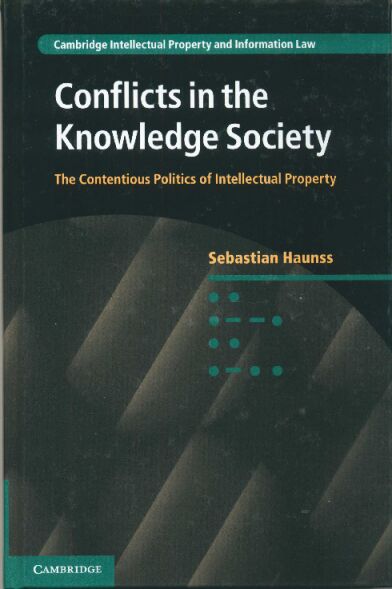
书名:Conflicts in the Knowledge Society
责任者:Sebastian Haunss | Haunss, Sebastian
出版时间:2013
出版社:Cambridge University Press
摘要
On 22 December 1999, about 100 people protested in front of the Thai Ministry of Public Health building demanding that the authorities grant a compulsory licence for ddl, a widely used antiretroviral HIV/ AIDS drug (Limpananont et al. 2009: 146). This was the beginning of a campaign that seven years later mobilized 10,000 people during protests against the US-Thailand Free Trade Area in which the question of compulsory licences and access to medicines played an important role, and which became part of a global mobilization for access to essential medicines (Krikorian 2009). A couple of months earlier, on 11 February 1999, eleven people met in a backroom of the restaurant Rhaetenhaus in Munich to found FFII, the Federation for a Free Information Infrastructure (FFII 1999). This NGO - created with minimal resources and maximal commitment - grew in the next ten years to 850 members and 100,000 supporters, has chapters in twenty European countries and spearheaded the campaign that in 2005 stopped the introduction of software patents in Europe (Eckl 2005; Eimer 2007; Haunss and Kohlmorgen 2009,2010). Also at about the same time a small group of lawyers from US Ivy League law schools started to think about alternatives to the current copyright regime, leading to the establishment of the Creative Commons project in 2001 (Dobusch and Quack 2008).
What do these seemingly unrelated stories have in common? They are examples of mobilizations that question the current regimes governing intellectual property (IP). The Thai AIDS activists had realized that the existence of a seemingly distant international treaty on 'Trade-Related Aspects of Intellectual Property Rights' (TRIPS) was hindering their access to the medication needed to keep the infection at bay, at prices they could afford. The software programmers, entrepreneurs, computer geeks and civil liberties activists had realized that the seemingly arcane matter of software patents was affecting the viability of their business models and the ability to create free and open software like Linux that today drives major parts of the internet infrastructure. And the university-based lawyers had realized that the current copyright regime was effectively closing access to ever larger parts of the knowledge produced inside and outside academia.
The first two cases are examples of IP mobilizations from below. Groups and individuals without formal education in patent or copyright law started to join the game that was until then almost exclusively played by specialized lawyers and officials working in the relevant IP bureaucracies (patent, copyright, trademark offices and the like). In the third case IP specialists developed a project to establish an alternative to the existing copyright framework that quickly reverberated far beyond the legal community, and now involves individuals with various professional backgrounds from many parts of the globe.
The cases are just three examples in a series of similar mobilizations. The struggles against 'biopiracy',i.e. the private appropriation of traditional (indigenous) knowledge (Wullweber 2004), the conflicts about file-sharing in peer-to-peer networks (Krömer and Sen 2006), the coming-together of the access to knowledge (A2K) movement (Krikorian and Kapczynski 2010) and the advent of Pirate Parties in various European countries (Demker 2011) address similar and related issues. Obviously in the past fifteen years a number of conflicts have developed which challenge the normative and institutional frameworks that regulate how knowledge is produced, appropriated and used.
1.1. Why now?
The institutions that govern intellectual property are not particularly new. The Berne Convention for the Protection of Literary and Artistic Works, which governs copyrights and related rights, came into existence in 1886 and was last revised in 1971; the Paris Convention for the Protection of Industrial Property, which governs patents, trademarks and designs, dates back to 1883; and even the Agreement on Trade-Related Aspects of Intellectual Property Rights,which is often seen as the most important recent change in IP governance, was signed back in 1994. Intellectual property rights are obviously not a new political issue. They have been around internationally for more than a century and for much longer periods in national legislations.
But despite this long history, conflicts like the ones mentioned above are relatively new. Obviously there was no timeless consensus about the merits of strong IP rights among states,within national administrations, or in the scholarly community. The tension between strong patent rights and anti-trust legislation,for example, led to several shifts in US IP policies in the twentieth century. The US Supreme Court decision in Henry v. A.B. Dick Co. in 1912 marked the heyday of strong patent rights at the beginning of the twentieth century. In their decision the judges ruled that A.B. Dick Co. were allowed to sell their patented 'Rotary Mimeograph' a stencil-duplicating machine with a licence restriction, 'that it may be used only with the stencil paper, ink, and other supplies made by A.B. Dick Company, Chicago, U.S.A.' (Henry v. A.B. Dick Co. 1912),even though these supplies were not patented themselves. But this over-inclusive position that effectively expanded patent protection far beyond the patented invention did not prevail. For most of the twentieth century strong anti-trust policies in the name of free competition de facto invalidated many patent rights in the USA. Only in the 1980s was this development once more reversed,when the Supreme Court - in light of the growing economic importance of immaterial goods - revalued intellectual property rights as high as or even higher than free competition (Sell and May 2001: 486 ff.). Nevertheless, these ups and downs in the breadth and scope of intellectual property rights have not been accompanied by political mobilizations that involved actors other than the immediate economic stakeholders. They were of interest mostly to the potential rights-holders and their competitors, but there are no accounts of mobilizations resembling the ones mentioned above that predate the late 1990s.
1.2. Politicization of IP
To understand why IP has become a contentious issue it is necessary to take into account several parallel processes:
(1) the growing economic importance of knowledge-based industries,
(2) the growing internationalization of IP issues, exemplified in the increasing number and reach of international treaties and trade agreements that centrally address IP,
(3) the growing attention IP issues receive in non-specialist and high-level political fora,
(4) and the trend to personalize IP rules.
These processes will be discussed in Chapter 2. Taken together these macro and micro processes have facilitated the politicization of IP. Politicization means that, on the one hand, more, and more diverse actors are getting involved in IP issues. Industry, legal specialists, national administrations, patent and trademark offices and specialist courts are being joined by academics, farmers, indigenous people, consumers, political activists and NGOs. On the other hand, the range of issues is expanding and the forms of action are getting more diverse. The issues that are being raised range from biopiracy, to health, access to medicines, fair use, access to knowledge and the limits of patentability. Conflicts are carried out in various arenas, ranging from international organizations, national parliaments and courts to the public sphere, where actors try to influence the policy process by exerting political and economic power, by lobbying and petitioning decision-makers, and by organizing street demonstrations, boycotts and other tactics from the repertoire of contentious politics.
The politicization of IP - and this is the main argument of the book - is embedded in more wide-ranging processes of social change associated with the transformation of industrial societies into knowledge societies. The current conflicts about intellectual property rights are harbingers of a new class of conflicts addressing new cleavages. They reveal a number of underlying conflict lines specific to the type of society that authors have variously labelled the information society (Lyon 1988),network society (Castells 2010a [1996]), post-industrial society (Bell 1999 [1973]), knowledge society (Stehr 1994a), risk society (Beck 1986) or programmed society (Touraine 1972). The one thing that unites these various descriptions of current societies is that their social and economic structures are organized around the creation, valorization and use of knowledge - the term knowledge society is thus the most generic term, capturing the central element that distinguishes these societies from earlier forms.
All processes of large-scale social change alter the overall structures of social conflicts in a society. New cleavages emerge that potentially lead to new conflict constellations in which new collective actors challenge the dominant order of society. The aim of this book is to show how the current conflicts about the international system of intellectual property address key new cleavages of the knowledge society,and to analyse to what degree in these concrete conflicts new collective actors emerge with the ability to contest the dominant order of current knowledge societies.
1.3. The organization of this book
To grasp the scope and the meaning of current conflicts about intellectual property rights it is necessary to understand how the international system of intellectual property rights has historically developed, how it is governed and how it is legitimized. Chapter 2 will thus start with an analysis of the reasons for the current politicization of IP, present an overview of the current and historical institutional frameworks in which intellectual property rights are governed, and discuss legitimizing narratives on which the IP system rests.
The current state of the international IP system is the product of historical developments in which government innovation policies, private interests, market dynamics and other factors have interacted in sometimes more and sometimes less consistent,and sometimes even contradictory ways. The fact that the politics of intellectual property has become an issue so important that it appears on the 2011 G8 meeting's agenda before nuclear safety, climate change, development and peace, is a result of the transformation of our current societies into knowledge societies. To understand this social transformation and the new social conflicts that accompany it I will review in Chapter 3 the most influential theories of the post-industrial (Bell 1999 [1973]),network (Castells 2010a [1996]) and knowledge societies (Stehr 1994a). The focus of this discussion will be on possible cleavages that these authors of theories of the knowledge society identify, and it will be embedded in a more general evaluation of the theoretical literature about the relationship between conflicts and social change. Based on these discussions a preliminary model of the relationship between social conflicts and social change emerges that enables a more systematic assessment of the general conflict lines that the empirical struggles about IP policies address.
Equipped with this theoretical knowledge it is possible to gain insights beyond the level of the concrete policy issues that current empirical conflicts about intellectual property rights and the governance of knowledge address. An empirical analysis, guided by a theory of conflicts and change in the knowledge society, forms the main part of this book. Chapters 4, 5 and 6 present analyses of the four most important conflictual mobilizations about the rules, norms and institutional arrangements that govern the production, use and valorization of knowledge: the conflict about software patents in Europe (Chapter 4), the transnational mobilization for access to medicines (Chapter 5), the emergence of Pirate Parties and the establishment of an alternative bundle of licences to foster access to knowledge,under the label of Creative Commons (both Chapter 6).
These cases have not been selected in a classical comparative perspective to facilitate comparison along a limited set of factors. Instead the four cases represent - maybe not the whole universe, but - the largest, most visible and thus most important contentious mobilizations around issues of intellectual property of the last two decades. Other conflicts such as the more recent ones about the Anti-Counterfeiting Trade Agreement (ACTA), copyright exceptions for blind people or the mobilization against the European Intellectual Property Rights Enforcement Directive never reached a comparable breadth or remained confined to expert committees of the transnational institutions concerned with intellectual property rights.
The conflict about software patents in Europe developed into one of the most contentious issues in the recent history of the European Parliament. It involved more than a thousand committed actors and a support network of several hundred thousand, actively engaged in the contentious interaction. In the course of the conflict new actors established themselves in the field of IP politics and some surprising coalitions were formed. The access to medicines conflict is a prime example of a truly international mobilization, involving several hundred core activ- ists, supported by tens of thousands engaged in local mobilizations. As in the software patents case, here too new actors have stepped onto the stage of international IP politics and a remarkable coalition of NGOs and government actors from developing countries has been formed. The Pirate Parties stand for the integration of some of the conflicts of the knowledge society into the electoral process, and thus for the arrival of these conflicts at the centre of the parliamentary system. Creative Commons is the smallest mobilization in terms of immediately involved activists. But the adoption of its alternative rule-set by millions of users willing to share their works freely on the internet makes it another crucial case to understand the structure and dynamics of current conflicts in the knowledge society.
Together these four cases are paradigmatic cases (Flyvbjerg 2006) for collective mobilizations that address conflicts of the knowledge society. Their analysis follows a common structure which is a consequence of my general assumption of the relationship of conflicts and change in the knowledge society. If changes in important parts of the social structure may lead to the emergence of new cleavages bringing about new kinds of conflicts and new collective actors, then the analysis of each case has to address three questions:
(1) What is the wider social and institutional context of the conflict?
(2) Which actors are involved in the conflict and in what relationship do they stand to each other?
(3) What are the conflict lines addressed in the conflict?
The first question concerns the aspect that changing social structures influence the emergence and persistence of collective actors which in turn attempt to change the social structures they are confronted with. Both co-evolve interdependently. To understand this interplay it is necessary to analyse the context in which the conflicts take place. In which institutional, political, economic and cultural frameworks are the conflicts embedded? What are the relevant social structures that limit the field of opportunities and constraints, and how do these contexts change over time?
Contexts and configurations in which collective action takes place have been the core focus of political process theories. The main idea of this approach (for an overview see Kriesi 2004) is that an analysis of political conflicts should account for the structures, configurations and interaction contexts. Structures encompass the institutional settings that determine channels and ease of access, openness or closure of political institutions, strength and weakness of the executive and other relatively stable aspects like cleavage structures and international contexts that influence the chances of oppositional actors being heard and influence decision-making processes. The institutional structures have often been conceptualized as 'political opportunity structures' (Eisinger 1973). They are complemented by 'discursive opportunity structures' (Koopmans and Statham 1999a: 228) that influence chances to find resonance for one's claims in the public sphere.
The context of collective action also entails the alliance structures and the relationships between protagonists, antagonists and bystanders (Hunt,Benford and Snow 1994). There is thus no strict separation between contexts and actors, since third parties can be part of the action context in which the main protagonists act. Alliance structures may be persistent but are usually less stable than social and institutional structures, and can change more quickly over time and usually differ significantly between policy fields. They have been analysed as policy networks (Adam and Kriesi 2007; Schneider et al. 2009) or advocacy coalitions (Sabatier and Weible 2007) and comprise institutional as well as non-institutional actors that have stakes in a certain policy field. Interaction contexts link structures and configurations to agency and action (Kriesi 2004: 77). Authors have focused here on the strategies of social movements and on a more abstract level on mechanisms that explain how collective actors influence and change policy outcomes (McAdam, Tarrow and Tilly 2001).
The second question is the most central as it concerns the collective actors themselves. Collective actors are the agents of social change, and to understand social conflicts it is necessary to know who mobilizes and who gets mobilized. Who are the actors that address the grievances of the knowledge society? What is their social base? Who are their adversaries and allies? This entails on a material level the network of individuals and organizations involved in conflicts, and on an analytical level the emergence and development of collective actors. How do individuals begin to act together, how do they define common goals and adversaries, and construct a collective identity?
Collective mobilization processes have been researched from many perspectives,with a focus on material resources (McCarthy and Zald 1977),moral convictions (Jasper 1997), organizations (Curtis and Zurcher 1973) or overarching movement dynamics (Koopmans 1993). The most systematic approach to analysing the interplay of various actors in collective action networks has been developed within a social networks perspective (Diani 2000, 2003; Diani and McAdam 2003; McAdam 2003; Saunders 2007). But before collective actors can be observed as empirical actors they have to be constituted. This entails the creation of a collective identity, which is the precondition for a collective actor to be able to establish itself as a collective, as a 'we' that is discernible from other collective actors in a society (Haunss 2001, 2004, 2011). Beyond the level of empirically observable collective actor networks the construction of collective actors is a process that is located mainly on the cognitive level. Melucci has emphasized this aspect in his theory of collective action and has drawn attention to the processes of collective identity through which movement participants define the meaning of their action and the field of opportunities and constraints of this action (Melucci 1995,1996).
The third question finally addresses the fact that,while empirical conflicts are often about very concrete policy goals, these goals are often pursued for much more general reasons. A concrete policy conflict may thus on an underlying level address a much more fundamental social conflict. For example, a conflict about the right to be served at a lunch counter can be at the same time a conflict about fundamental human rights and racist segregation in a society. A conflict about a nuclear power plant can also be a conflict about the general value of an ecological perspective or about citizen participation in a democracy. The extent to which these more abstract levels are also present in concrete conflicts depends largely on how the participants frame this conflict. It is thus necessary to ask, which frames are used to construct the conflict? How do the challengers identify themselves as collective actors? How do they interpret the situation, which aims do they formulate, which opponents and strategies do they name?
The literature that addresses this discursive level of conflicts (Snow et al. 1986; Gamson 1992; Benford and Snow 2000; Snow 2004) defines frame, in adaption of Goffman (1974), as an 'interpretive [schema] that simplifies and condenses the "world out there" by selectively punctuating and encoding objects, situations, events, experiences, and sequences of actions within one's present or past environment' (Snow and Benford 1992: 137). In the simplest form, frames are the interpretations that underpin an actor's argumentation. In a more complex perspective, frames proyide overarching interpretations of the world, and can constitute meaning for actions beyond their immediate context. In political conflicts framing can be differentiated depending on its function in the mobilization process. Snow and Benford identify three core framing tasks,diagnostic, prognostic and motivational framing, on which successful mobilizations depend (Snow and Benford 1988). Diagnostic frames define the problem and often name those that are its source or held responsible for it. Prognostic frames present a solution for the problem and outline tactics and strategies to come to this solution. Motivational frames give reasons for action beyond the simple problem definition. They can offer emotional, personal or situational reasons why it is necessary to act now.
These three general questions concerning the contexts, actors and frames of the conflicts will be addressed in each of the case studies. They all start with a 'thick description' (Geertz 1973) of the conflict that introduces the core actors and informs about some aspects of the institutional and social context of each conflict. From there on each case study follows a slightly different path. Because the four cases each help to understand different aspects of the complex constellation of conflicts and social change in the knowledge society, the analysis will follow to some extent the idiosyncrasies of the individual cases.
The first two cases, which involved large numbers of actors in protracted contentious interactions, will be analysed in more detail than the latter cases, which involved a much smaller group of core actors. Moreover, I will vary the concrete methodological tools used to analyse the contexts, actors and frames of the four conflicts. For example, in the cases of the access to medicines campaign, the Pirate Parties and Creative Commons, where sets of core documents exist in which the main participating actors have stated their positions, I will trace their framing activities using interpretive text-analytical methods. In the software patent case, where such documents are missing for some core actors, but where reliable newspaper reports about much of the claims-making activities are available, I can use a more sophisticated discourse network-analytical tool (Leifeld and Haunss 2012). The specific methodological tools that have been used to analyse the contexts, actors and frames will therefore be introduced in the respective chapters.
After these case studies the final chapter (Chapter 7) summarizes the more general findings of the analysis of the four cases and relates these findings to the theoretical discussions of the first part of this book. What are the general contours of conflict and change in the knowledge society embedded in the empirical conflict? Which similarities and differences exist between the four mobilizations,and what do they tell us about the cleavage structure of the knowledge society and the collective actors that challenge this structure? Based on the empirical knowledge about the contentious mobilizations it will be possible to give the abstract model of conflict and change in the knowledge society a more substantial form.
The mobilizations that originate in the struggles for access to HIV/ AIDS drugs in Thailand,that bring a handful of software programmers to confront the phalanx of transnational IP companies,patent attorneys and EU Commission bureaucrats, that incite medical doctors to raise their voice in the World Trade Organization (WTO) and the World Intellectual Property Organization (WIPO), that make US law professors vanguards of a social movement against intellectual property; these mobilizations address - beyond their concrete policy goals - a set of underlying conflicts of the knowledge society, no longer rooted in the cleavages of the industrial era. In these conflicts new collective actors emerge who challenge the current order of the knowledge society and who try to establish an alternative version of a knowledge society based on democratized access to knowledge and far-reaching limits to the propertization of ideas, knowledge and cultural goods. How this unfolds will be shown in the following pages.
查看更多
目录
List of figures page vii
List of tables viii
Acknowledgements ix
List of abbreviations xi
1 Introduction 1
1.1 Why now? 2
1.2 Politicization of IP 3
1.3 The organization of this book 4
2 The politicization of intellectual property 11
2.1 How IP has become political 12
2.2 The history of intellectual property rights 21
2.3 The current legal and institutional system 26
2.4 Legitimatory narratives 33
2.5 Current developments and conflicts 47
3 Conflict and change in the knowledge society 52
3.1 Information, network or knowledge society? 53
3.2 Theories of the knowledge society 59
3.3 Going beyond the stage model 78
3.4 Theories of social change and conflicts revisited 83
3.5 Change and conflict in the knowledge society 88
4 Software patents in Europe 94
4.1 The institutional context of the software patents conflict 95
4.2 The development of the conflict 99
4.3 The network of actors 119
4.4 Frames 129
4.5 Bringing the threads together 136
4.6 Software patents and the knowledge society 140
5 Access to medicines 143
5.1 The context of the conflict about access to medicines 143
5.2 From TRIPS to Doha 147
5.3 The network of actors 159
5.4 Framing the issue 173
5.5 Context, actors and frames of the access to medicines conflict 181
5.6 Access to medicines - a conflict of the knowledge society 183
6 Pirates and commoners 186
6.1 The rise of Pirate Parties 187
6.2 Pirate frames 194
6.3 Pirates in the knowledge society 200
6.4 Creative Commons 201
6.5 The Creative Commons frame 210
6.6 Creative Commons and the conflicts in the knowledge society 212
7 Conclusion: new cleavages and new collective actors 214
7.1 Patterns of difference and similarity 214
7.2 Beyond policy conflicts - patterns of conflict and change in the knowledge society 223
7.3 A movement in the making? 233
References 237
Interviews 266
Appendix 1: Documents used for the frame analysis
in Chapter 5 269
Index 272
查看PDF
查看更多
馆藏单位
中国标准化研究院国家标准馆