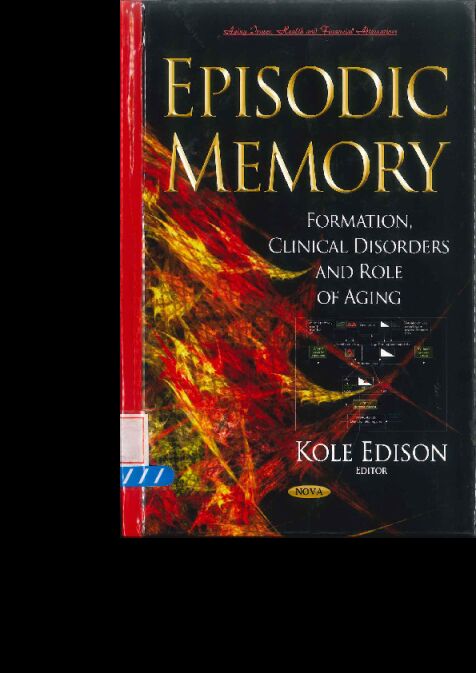
书名:Episodic memory
出版时间:2014
出版社:Nova Science Publishers,
前言
With the population growing older, researchers have become more motivated to find a way for older adults to retain a high level of cognitive functioning for as long as possible. Memory training has been shown to effectively improve memory among older adults and it has been shown to delay decline in memory functioning. It has also been shown to improve their self-efficacy, with respect to memory, and to allay healthy older adults' fears of exhibiting early signs of Alzheimer's disease. This book focuses on episodic memory and the formation, clinical disorders and role of aging on episodic memory.
Chapter 1 - This chapter will review the effectiveness of imagery-related mnemonics in memory training programs designed for healthy older adults and for older adults with mild cognitive impairment. There will be a focus on the way in which age-related changes in visual working memory affect the ability of older adults to utilize imagery-based strategies to improve recall. There will also be a focus on the degree to which laboratory memory training programs improve recall in everyday life.
Chapter 2 - Popular Psychology has accepted the use-it-or-lose-it theory as fact; however, there are two variations of this theory: the cognitive reserve hypothesis and the use-dependency theory. This chapter will consider the evidence for both hypotheses as well as explain how methodological issues may have inadvertently produced evidence for the use-it-or-lose-it theory. A brief review of the literature will be provided and then a discussion of methodological issues will be presented. Current research will then be discussed with regards to possible future methodology which could be used. Finally future perspective on the use-it-or-lose-it theory will be considered. This chapter will focus on episodic memory, specifically recall, encoding, consolidation, retrieval; as well as working memory, executive functioning, metacognition and memory self-efficacy.
Chapter 3 - This chapter provides an overview of the existing theories of declarative memory and the hippocampal complex. In particular, the authors combined theories/models of hippocampal functioning and declarative memory (i.e. the Standard Model of Consolidation, the Spatial Map Theory, the Relational Theory, the Multiple Trace Theory, the Dual-Process Theory, and the Perceptual-Mnemonic Feature Conjunction Model) into a comprehensive unified framework. It is shown that these theories cannot fully explain the findings from empirical studies that examine the role of the medial temporal lobe in declarative memory. Therefore, the goal of this chapter was to integrate the findings reported in the literature into a comprehensive unified framework of recognition and recall. This model not only considers long-term memory and the medial temporal lobe, but also its relations with the prefrontal cortex and working memory. The proposed model implies mat a familiar object, odor, sound or internal thought of a stimulus can activate an episodic representation. This is reconstructed in the hippocampus by a combination of associated polymodal stimulus information such as visual object features via the perirhinai cortex, visuospatial (contextual) information via the parahippocampal cortex, and temporal information via perirhinai cortex and associative cortices. This results in an episodic recollection. For complete conscious recollection, i.e. recognition in case of a familiar stimulus or recall in case of an internal thought of a stimulus, a representation needs access to working memory in the prefrontal cortex. Subsequently, both the old as well as newly-formed explicit/declarative memory traces (in case of a novel stimulus or context) can then be reconsolidated and consolidated, respectively. The consolidation takes place in the perirhinai and parahippocampal cortices or as semanticized memory traces in the neocortex. Finally, these memory traces can be retrieved again in subsequent recollections to dynamically form episodic memories.
Chapter 4 - Memory deficits that result from brain damage can involve anterograde and/or retrograde episodic amnesia, which refer to an inability to remember events and information imparted after or prior to the injury, respectively. Amnesia can substantially affect the lives of those who suffer from the condition. Disruption to the medial temporal lobes results in the severe condition denoted amnesic syndrome, which can manifest as anterograde and retrograde amnesia. Despite of the occurrence of episodic memory deficits, patients with amnesic syndrome retain substantial intellectual, linguistic, and attention-related abilities, and the ability to do so differs from the type of memory deficits seen in patients with Alzheimer's disease. Basal forebrain damage often causes confabulation in addition to episodic memory deficits, and patients with both symptoms usually also present with attention and executive dysfunction. In this review, 1 describe, in detail, the symptoms and origins of anterograde and retrograde amnesia and confabulation and how patients suffering from these forms of amnesia may be rehabilitated.
查看更多
目录
Preface vii
Chapter 1 The Effectiveness of Imagery-Based Strategies in Improving Episodic Memory in Older Adults 1
Sheila R. Black, Ph.D., Kyle R. Kraemer, Meagan Wood, MA, Gaynell M. Simpson, Ph.D. and Annie K. Smith, Ph.D.
Chapter 2 The Use-It-Or-Lose-It Theory; The Cognitive Reserve Hypothesis and the Use-Dependency Theory: Methodological Issues, Previous Research, Current Research and Future Perspectives 27
Nicholas M. Almond
Chapter 3 The Medial Temporal Lobe: Toward a Unifying Neuropsychobiological Framework of Recognition and Recall 85
Ruud Berkers, Nick P. van Goethem, Kris Rutten, Arjan Blokland and Jos Prickaerts
Chapter 4 Brain Damage: Associated Memory Deficits 135
Michitaka Funayama, M.D.
Index 151
查看PDF
查看更多
馆藏单位
中国医科院医学信息研究所