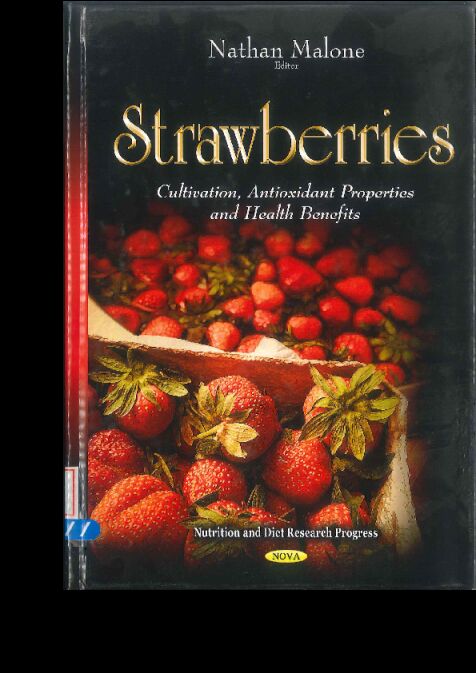
书名:Strawberries
出版时间:2014
出版社:Nova Biomedical,
摘要
The strawberry (Fragaria×ananassa Duch.) is one of the most consumed fruits in the world and its worldwide production ranks second after the grape. Besides being an attractive fruit due to its color and flavor, strawberries have large consume both as fresh fruit as processed, being an important source of health by having antioxidants compounds, including anthocyanins, flavonoids, phenolic compounds and nutrients. Many researches have been realized to evaluate effect of different factors on sensory and nutritional characteristics of the fruits and their products. Size, firmness, colour, pH, sugar/acid ratio, taste and aroma are parameters physical and sensory that indicates quality of fruits where color plays a major role, indicating freshness and high quality fruits being the main attribute determining in consumers’ choice. The brilliant colour of fresh strawberries is due to anthocyanins. The major anthocyanins are pelargonidin-3-glucoside, pelargonidin-3-malonyl glucoside, pelargonidin-3-rutinoside and cyanidin-3-glucoside, but the composition varies with genotype. However, the red colour of fresh strawberries is usually not retained after processing and storage due anthocyanins being highly susceptible to heat, pH, and oxygen. Therefore Intensive studies are being performed to avoid pigment loss during processing and storage. The commercialization of the strawberries is a major challenge. They are highly perishable, susceptible to rapid spoilage and have short market shelf-life due their very active metabolism and high physiological post-harvest activities which lead to fast ripening and senescence. The loss of quality is associated with physical injury, water loss and microbiological decay. Reduce the crop losses and maintain the quality of the fresh fruits for a larger period has become a priority. Therefore it is necessary to develop strategies to reduce decay and increase the storage life of the fruit. The food industry is very interested in improving marketability of fresh and processed strawberries. The minimally processed (MP) fruits are products that keep their attributes and quality similar to those of fresh products. These products have a limited shelf life due to processing, which accelerates biochemical reactions and increases the susceptibility of these products to microbial contamination and growth. For extend the shelf life minimally processed fresh fruit it is necessary a combination of appropriate strategies in order to keep its sensory properties and quality. Various technologies can be apply for strawberry preservation as low temperature (refrigeration), widely used to reduce spoilage, controlled atmosphere that helps retarding decay and softening of strawberries and edible coatings that acts as a barrier against gas transport showing similar effects to storage under controlled atmospheres. All of these techniques are not enough if the product don't have an appropriate packaging. The use of an adequate packaging for transport, storage and commercialization for fresh produce is an important tool to maintaining the physical integrity of the fruit, quality of products, gas exchange and increase the shelf life both fresh and minimally processed. In this context, this work aimed to increase the shelf life of minimally processed strawberries using controlled atmosphere and the incorporation of edible coatings for fruits associated with development of packaging designed for strawberries.
查看更多
目录
Preface vii
Chapter 1 Cropping Strawberry for Improving Productivity and Environmental Sustainability 1
Chapter 2 Impact of Processing on Nutritional and Functional Properties of Strawberry 21
Chapter 3 Anthocyanins Constituents, Antioxidant and Anti-Inflammatory Activity of Strawberries: Comparison with Other Berry Fruits 39
Chapter 4 Impact of Minimal Processing and Storage on Strawberry Functional and Nutritional Quality 55
Chapter 5 Traditional and Emerging Technologies for Strawberry Processing 73
Chapter 6 Strawberry Micropropagation and Somaclonal Variation 93
Chapter 7 Epidemiology and Management of Strawberry Fruit Rot Diseases in North America: A Review 109
Chapter 8 Strawberry: Factors of High Yield 121
Chapter 9 Strawberries: Antioxidant Properties, Health Benefits and Innovative Technologies 189
Chapter 10 Wild and Cultivated Strawberries: Diversity, Pigments and Metabolic Changes 215
Chapter 11 Nutrient Management in Strawberry: Effects on Yield, Quality and Plant Health 239
Chapter 12 Effect of Minimal Processing on Bioactive Compounds of Fresh-Cut Strawberries 269
Chapter 13 Postharvest Technologies for Fresh and Minimally Processed Strawberry Conservation 283
Chapter 14 Vertically-Moving Cultivation and Local Environment Control for High Strawberry Yield 309
Chapter 15 Effects of Substrate Medium and Container Type in Hydroponically Grown Strawberries 343
Chapter 16 Strawberries: Antioxidant Properties and Preservation Processes 359
Index 383
查看PDF
查看更多
馆藏单位
中国医科院医学信息研究所