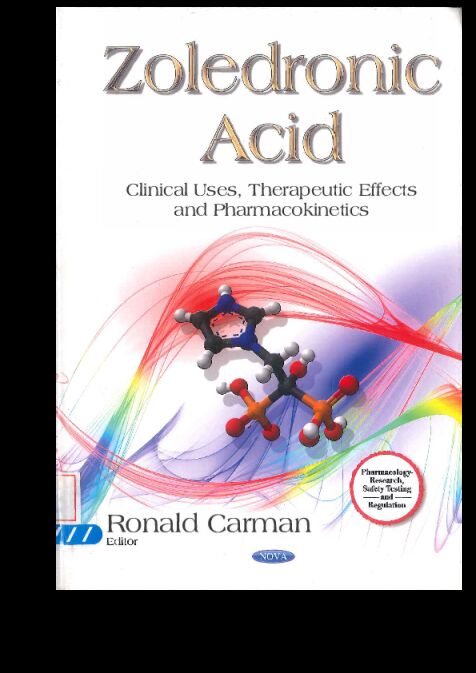
书名:Zoledronic acid
出版时间:2014
出版社:Nova Science,
前言
Zoledronic acid is a third generation bisphosphonate which is administered intravenously once yearly at a dose of 5mg for multiple reasons including the treatment of post-menopausal women with osteoporosis to reduce the incidence of vertebral, hip and non-vertebral fractures and to increase bone mineral density (BMD), the prevention of clinical fractures after hip fracture in women and men, treatment of osteoporosis in men, prevention and treatment of glucocorticoid-induced osteoporosis (GIO), the prevention of post-menopausal osteoporosis (in the US) and the treatment of Paget's disease of the bone. This book discusses the clinical uses, therapeutic effects and pharmacokinetics of zoledronic acid.
Chapter 1 - Zoledronic acid is a bisphosphonate that was approved for the treatment of hypercalcemia of malignancy in 2001. Bisphosphonates are hydrolysis-resistant pyrophosphate derivatives that have a high affinity for bone and inhibit osteoclastic bone resorption. A once yearly infusion of zoledronic acid was approved for the treatment of post-menopausal osteoporosis in 2007; this therapy provides an alternative to oral bisphosphonate treatment of post-menopausal osteoporosis which is associated with an inconvenient mode of administration resulting in poor adherence and compliance. Since that time it has also been approved for the prevention of osteoporosis in post-menopausal women, to increase bone mass in men with osteoporosis, to decrease the incidence of new clinical fractures in patients at high risk of fracture (those with a recent low trauma hip fracture) and to treat and prevent glucocorticoid-induced osteoporosis in women and men who are expected to be on glucocorticoids for twelve months or longer. The data concerning combination use of zoledronic acid with other non-bisphosphonate therapy will be reviewed as will data concerning the long-term safety and head-to-head comparisons with other bone active drugs. The use of zoledronic acid in treating special populations will be discussed and suggestions for future research will be presented.
Chapter 2 - The biphosphonate zoledronic acid is indicated for the treatment of patients with osteolytic lesions from multiple myeloma for the prevention of skeletal related events. In patients with multiple myeloma the clonal expansion of plasma cells in the bone marrow results in the disruption of the homeostasis within the bone marrow microenvironment. Interactions between myeloma cells and bone marrow stromal cells directly increase growth and survival of myeloma cells through the dysregulation of growth factors and cytokines and accelerate the destruction of the bone.
Thus, most of multiple myeloma patients develop osteolytic bone lesions, which are often associated with bone pain and skeletal-related events which include spinal cord compression, pathologic fractures, or the need for surgery or radiation to the bone. Bisphosphonates are effective inhibitors of osteoclastic bone resorption. In-vitro evidences suggest that bisphosphonates may also have an antimyeloma activity.
Furthermore, they may synergize with anticancer agents used in the treatment of myeloma. Recent clinical data show a survival advantage for high-risk patients receiving zoledronic acid concurrently with antimyeloma therapies. This review summerizes the antimyeloma benefits of zoledronic acid combined with new drugs for the treatment of multiple myeloma patients.
Chapter 3 - Zoledronic acid is a bisphosphonate drug administered as an intravenous infusion which is licensed internationally for the treatment of osteoporosis. Pharmacologically, it can slow down bone resorption, potentiates an anabolic effect on bone-forming cells and promotes bone remodelling. Bone and cartilage turnover are affected in other musculoskeletal conditions including osteoarthrm's (OA) and rheumatoid arthritis (RA). OA is the most common arthritic disease worldwide, with an increasing prevalence due to a rising ageing population and the epidemic of obesity worldwide. The most common joints affected in OA include the larger weight-bearing hip and knee joints, the hands and spine. Radiographic examination of affected joints often reveals joint space narrowing, cartilage degradation and bone marrow lesions observed by magnetic resonance imaging (MRI) scans.
Recent interest has focused on evaluating the therapeutic effects of bisphosphonate drugs to target OA pain and structural damage. This chapter presents the results of a systematic review assessing the currently available evidence on zoledronic acid in human and animal studies. In this chapter, the authors report the rationale for using zoledronic acid for OA from animal model data in the studies so far reported, discussing the effects of this drug on bone remodelling and inhibition of cartilage degradation.
The authors discuss how zoledronic acid could target lesions observed in the pathophysiology of ОA, which include damage to the components of cartilage extracellular matrix (ECM) and peri-articular bone. The authors then report the effect of zoledronic acid in the clinical studies published so far for people with OA, including data on the use of this bisphosphonate as an adjunct to high tibial osteotomy surgery. The authors also discuss the impact of the use of zoledronic acid on improving knee pain in clinical trials and its effect on reducing the size of bone marrow lesions detected by magnetic resonance imaging (MRI) scans in the same studies.
In summary, this chapter outlines emerging data on the use of the bisphosphonate drug zoledronic acid in OA. Clinical trials published to date have shown an improvement in OA pain in the short term, coupled with an effect on the size of bone marrow lesions following infusion of zoledronic acid. It is possible that treatment with bisphosphonate drugs at earlier stages of the condition, as suggested by animal models of OA, may have a greater impact on modulating disease activity in this chronic, common arthritic disease.
Chapter 4 - Paget's disease of bone (PDB) is characterized by an increase in bone turnover located at one or more foci of the skeleton. The initial pathophysiological mechanism is the increase in osteoclastic bone resorption and bisphosphonates are the most commonly used treatments for PDB. The new bisphosphonates with greater potency and binding affinity to hydroxyapatite, like zoledronic acid, are very useful for short and long-term control of disease activity. Zoledronic acid is indicated for PDB in Europe and America at dose of 5 mg given intravenously. In 2005, a risedronate-controlled trial, showed that zoledronic acid, administered as a single 15 minute infusion is highly effective in controlling metabolic activity in PDB after 6 months of administration. Therapeutic response occurred in 96% of patients (normalization of alkaline phosphatase in 89% and a 75% reduction in 1% of patients), which is significantly superior to the results obtained by the other bisphosphonates, including risedronate, and also improved physical function and overall evaluation (measured by the SF-36 questionnaire). Other studies have demostrated similar results in terms of effectiveness of bone turnover control with a single 5 mg infusion of zoledronic acid. This drug has also proven effective in patients with active PDB that had not responded to other bisphosphonates in the previous 6 months. Regarding duration of response, zoledronic acid was still effective 75 months after a single infusion in most of the patients during the follow-up, with loss of therapeutic response in only 12.5 % of patients. Recently it has been reported that patients who had a relapse after a first dose of zoledronic acid may respond to a new 5 mg intravenous infusion. All these results make zoledronic acid the most effective therapy for the treatment of PDB to date, and the treatment of choice due to its efficiency, adherence and duration of response. The accepted indications for treatment of PDB include bone pain and neurological compression syndromes. Treatment before bone surgery is also recommended to prevent excess bleeding or hypercalcemia. Patients with high metabolic activity (alkaline phosphatase level more than twice the upper limit of normal) should also be treated. A controversial indication is treatment with bisphosphonates in asymptomatic PDB patients to prevent progression or complications. Zoledronic acid has changed the management of PDB. Currently, a 15-minute intravenous zoledronic acid infusion is able to maintain biochemical control of the disease for at least 6.5 years. This has important practical implications in the clinical management of PDB patients. Long-term control of metabolic activity will probably reduce the risk of complications such as deformity, fracture, deafness and degenerative joint disease.
Chapter 5 - Since their introduction to clinical practice more than 3 decades ago, bisphosphonates have been increasingly used for a wide range of skeletal disorders and other conditions including heritable skeletal disorders in children, postmenopausal and glucocorticoid-induced osteoporosis (GIO), and bone metastases in patients with malignancies. Bisphosphonates of first generation have side chains minimally modified (clodronate or etidronate) or a chlorophenyl group (tiludronate). Bisphosphonates of second generation (alendronate or pamidronate) have a nitrogen group in the side chain and their power is 10 to 100 times greater than the first generation compounds. Finally, among third-generation of bisphosphonates (ibandronate, risedronate and zoledronate), the two last with the N atom included in a heterocyclic ring, are 10,000 times more potent than first generation agents. Their main therapeutic use is as antiosteolitic agent in patients with pathologies with increased bone resorption including Paget disease, osteoporosis and tumoral osteolysis and as inhibitors of ectopic calcifications and ossifications. Although bisphosphonates are generally well tolerated, the adverse effects are not rare, and they often produce the interruption of treatment. The adverse effects on the upper gastrointestinal tract are common with oral bisphosphonates, especially if taken incorrectly, so benefits and risk should be weighed. Oral absorption of bisphosphonates is very poor, as they are only absorbed between 1-3%, being higher when administered fasting. Between 20-80% of the absorbed dose is taken up by the bone tissue, and the remaining dose is eliminated unchanged by the kidney. Protein plasma binding is variable between bisphosphonates (50-90%). This chapter describes and discusses the most important therapeutic effects together with the most relevant side-effects associated to the use of bisphosphonates.
Chapter 6 - In the recent decades, evidence has been accumulating concerning in vivo and in vitro anti-cancer activity of bisphosphonates. These effects are achieved through microevironmental changes, inhibition of tumor cell adhesion, invasion, neoangiogenesis and apoptosis induction. Zoledronic acid is known for its high potency with regard to antitumoral activity and has been to date studied in numerous clinical trials. In the adjuvant setting, postmenopausal patients benefit from zoledronate treatment; in the metastatic situation, zoledronate improves progression-free interval in patients with bone metastasis. Several authors hypothesized that bisphosphonates exhibit their oncologic effects through changes of bone marrow microenvironraent making it less suitable for disseminated tumor cells; the presence of such cells in secondary sites is associated with higher risk of relapse and impaired prognosis. In the present review, the authors discuss experimental activity of bisphosphonates and review current data on the use of zoledronate acid in breast cancer patients.
Chapter 7 - Chronic inflammatory rheumatic diseases (CIRD) constitute a heterogeneous group of disorders that include rheumatoid arthritis (RA), systemic lupus erythematosus (SLE), ankylosing spondylitis (AS), psoriatic arthritis (PsA) and other diseases that affect a multiplicity of organs. Currently, it has been well recognized that a close link exists between the immune system and bone tissue, particularly in these disorders. CIRD have a high prevalence of osteoporosis (OP), observed between 25-59% in RA, 20-48% in SLE, 15-60% in AS and around 16% in PsA. Factors associated with OP in CIRD include the over-activation of osteoclasts by inflammatory cytokines, mainly tumor necrosis factor-alpha, and other interleukins (IL) including IL-1beta and IL-6, as well as other mechanisms such as impairment in joint function, and utilization of therapies that increase bone loss, mainly corticosteroids. OP is frequently underdiagnosed in CIRD; therefore, the onset of anti-osteoporotic therapy is delayed. Additionally, these patients have a high frequency of vertebral and non-vertebral fractures, with vertebral fractures being frequently asymptomatic or with non-severe symptoms leading to delays in treatment. Frequencies for vertebral fractures may vary; in RA around 21.7%, in SLE between 20-50%, in AS 19-65% and for PsA around 13%. According to the National Osteoporosis Foundation guidelines, adults with RA or any patient taking prednisone ≥5 mg/day or equivalent for ≥3 months should be evaluated for bone mineral density (BMD), and strategies to prevent fractures are required. Zoledronic acid (ZA) has been approved for the prevention and treatment of osteoporosis in patients expected to be on corticosteroid therapy for at least 12 months, as well as for the prevention of new clinical fractures. This review describes the current evidence of ZA to improve the BMD and as adjuvant therapy for controlling clinical inflammation in CIRD. In collagen-induced arthritis models, a combination of ZA plus methotrexate (MTX) prevents bone erosion, radiological damage and systemic bone loss, whereas clinical studies in patients with early RA suggest that this combination prevents bone erosions. On the other hand, the benefits of ZA in patients with established RA to prevent generalized bone loss are now recognized. Most of the evidence of ZA for OP is in postmenopausal women. Case reports in young patients and children with SLE describe how ZA decreases the incidence of bone fractures, although it is important to take into account the potential effects on growth. In animal models for AS, ZA prevents joint ankylosis; however, these preliminary data need to be evaluated in clinical studies. Patients with PsA treated with ZA have shown a decrease in the progression of bone edema, suggesting a suppression of osteitis that correlates with the improvement of disease activity in clinical measures. In tophaceous gout ZA increases BMD of the spine, neck of femur, total hip and total body, but does not influence bone erosions. In conclusion, ZA decreases generalized bone loss and focal bone damage, as well as improving some inflammatory parameters in some of the CIRD. The potential properties as immunomodulating need to be considered to define its possible role as adjuvant therapy directed against the mechanisms of inflammation in CIRD.
Chapter 8 - Bisphosphonates such as alendronate, risedronate and zoledronate have revolutionised the treatment of benign bone disease. Zoledronate (ZLD)/zoledronic acid is a nitrogen containing intravenous (IV) bisphosphonate which is a potent inhibitor of osteoclast mediated bone resorption via several possible mechanisms, but especially by inhibition of the enzyme farnesyl pyrophosphate synthase. Annual administration has been shown to increase bone mineral density at all sites measured, with a concomitant reduction in the risk of vertebral and hip fracture in patients with osteoporosis. Interestingly, IV ZLD has also been shown to lower mortality following hip fracture. The mechanism for this remains unclear, but may be related to a reduction in cardiovascular events. One of the main advantages of ZLD is the convenient annual IV dosing which improves patient compliance. This is of particular importance in the field of osteoporosis where poor compliance with bone protective therapy is well described. However, the long in vivo half-life and high potency of ZLD may be responsible for the reported association with delayed dental healing (DDH) and the rare, but potentially devastating complication of osteonecrosis of the jaw (ONJ). The possible association with atypical femoral fractures will also be discussed. This chapter will discuss the clinical use and therapeutic effects of ZLD in benign bone disease, focusing on the treatment of osteoporosis and Paget's disease. The advantages and disadvantages of ZLD relative to the other treatments for osteoporosis will be reviewed. A practical approach to the contentious issue of DDH and ONJ will also be discussed.
Chapter 9 - Zoledronic acid is the most potent bisphosphonate (BP) currently available for use in various clinical conditions. This increasing use of the high potency drug has led to an elevated incidence of a unique but well-documented oral adverse effect termed "bisphosphonate-related osteonecrosis of the jaws (BRONJ)".
BRONJ, as a clinical entity, is classically described as a non-healing ulcer on the jaw bone (maxillae or mandible) in a patient with a history of BP use. in the absence of radiotherapy. Initially, the aetiology of BRONJ was considered to be related to direct suppression of osteoclastic activity in the jaw bone. However, recent literature suggests that a host of factors are involved in the pathogenesis of this complex condition and a wide variation exists in its occurrence, mainly based on the potency of the BP used. BRONJ is specifically reported in jaw bones and zoledronic acid, due to its high potency is the most commonly implicated drug. A thorough knowledge of BRONJ is important for a dental surgeon as it is essential for initial identification, prompt diagnosis and successful management of this unique condition.
This chapter comprises an overview of BRONJ as a clinical entity, classification and staging, various etio-pathological theories, and general guidelines in management of zoledronic acid induced BRONJ.
Chapter 10 - Zoledronic acid (ZA) is a potent nitrogen-containing bisphosphonate that was the first in its class to demonstrate efficacy in patients with bone metastases from solid tumors other than breast cancer. It is also used in multiple myeloma as well as non-malignant diseases associated with high bone turnover. This chapter focuses on the biology, pharmacokinetics, and toxicities of ZA and reviews efficacy data that lead to registration for its current clinical use.
查看更多
目录
Preface vii
Chapter 1 Use of Zoledronic Acid in Men and Women with Low Bone Mass 1
Chapter 2 Clinical and Experimental Evidences of Anti-Myeloma Activities of Zoledronic Acid 27
Chapter 3 The Use of Zoledronic Acid in Osteoarthritis: From Animal Models to Clinical Studies 53
Chapter 4 Treatment with Zoledronic Acid in Paget's Disease of Bone 71
Chapter 5 Bisphosphonates: Pharmacokinetics, Clinical Uses and Safety 83
Chapter 6 Clinical Role of Zoledronic Acid in Adjuvant and Metastatic Breast Cancer 97
Chapter 7 Zoledronic Acid in Chronic Inflammatory Rheumatic Diseases: A Critical Evidence of Its Antiresorptive and Immunomodulating Effects 107
Chapter 8 Zoledronic Acid and Benign Bone Disease: Clinical Uses, Therapeutic Effects and Pharmacokinetics 149
Chapter 9 Zoledronic Acid and Bisphosphonate Related Osteonecrosis of the Jaw 173
Chapter 10 Clinical Uses of Zoledronic Acid 193
Index 219
查看PDF
查看更多
馆藏单位
中国医科院医学信息研究所