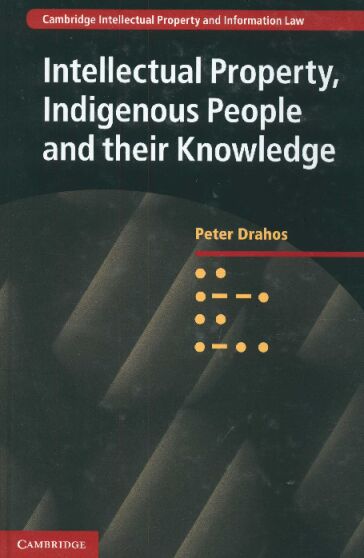
书名:Intellectual property, indigenous people and their knowledge
责任者:Peter Drahos | Drahos, Peter
出版时间:2014
出版社:Cambridge University Press
摘要
1.1. Extractive property
Economically successful states can be non-developmental for indigenous people. It may be that the state is always non-developmental for indigenous people. The pages of this book offer some reasons for formulating this strong claim, but they do not contain the data needed to test it. One would have to examine the history of many states. My case studies are mainly based on fieldwork carried out in Australia between 2008 and 2011,although I do draw on the literature that examines the experience of indigenous groups with state property orders in other countries, such as Canada and India. The case studies reveal a property order that remains extractive for Aboriginal and Torres Strait Islander people, albeit one that is masked by the complexity of property law.
查看更多
前言
We were sitting outside of a pub in Cooktown. Located in Queensland's far north, it is one of those places where a river meets the sea, offering the calmness of refuge from ocean storms. The place was named after Captain Cook, the explorer who filled in the bits of the Australian continent still missing from the maps drawn by European cartographers. Cook spent seven weeks there repairing his damaged ship. We had spent the day speaking to indigenous people about the possibilities for them in the bush food business. Tropical heat makes market gardening seem like too much hard work, but it does make the beer taste good. Squawking seagulls drifted in, keeping a sharp eye for the chance to steal a chip. ‘Do you know what indigenous people around here call whitefellas?'asked one of the people who had arranged the meetings for us. Knowing I wouldn't know, he went on to answer the question. ‘Seagulls.''Why?' I asked. ‘Well,'he said, ‘they fly in, create a lot of noise, make a mess and then fly out.' We flew out of Cooktown the next day.
After the visit to Cooktown I tried to make sure we didn't hire white four-wheel-drive vehicles. It proved surprisingly difficult. Flying in Qan- tas'white planes took on a different meaning.
We were in Cooktown as part of a project funded by the Australian Research Council. I was doing the project with my then colleague at RegNet, Luigi Palombi. We had become interested in examining the economic uses that indigenous people might make of their knowledge using intellectual property rights. Initially, establishing contact with indigenous groups proved difficult. Our first real break came when a member of a group we had been trying to see for weeks drove into Broome and got a flat tyre. We received a phone call asking if we wanted to meet with him. Tumbling out of our caravan we rushed to see him and that led to an invitation to visit his community. Over the course of the three years of the project we became smarter about finding ways to make contact with indigenous groups and things got progressively easier. Luigi and I have more than fifty years of experience in intellectual property issues between us. Perhaps word got about that we were useful seagulls. My lasting impression of the many indigenous people we met was their basic kindness and gentleness,something remarkable given the horrors of colonization.
My thanks go to Luigi for his company on the road,as well as for the discussions we had about this project. There is not the space to thank everyone by name but, for conversations which acted as lightning strikes to illuminate my way,I thank David Claudie, Nick Smith, Miranda Forsyth, Jen Cleary and Richard Jefferson. I owe special thanks to Susy Frankel. Together we co-edited in 2011 a special issue of the journal Prometheus, as well as a book published by ANU E Press in 2012 on the topic of indigenous knowledge and intellectual property. She has made a huge contribution to this field of research both through her publications and her work with New Zealand's Waitangi Tribunal. Despite her many commitments, she found the time to read and comment on all the chapters, helping me to rethink my ideas and arguments. Finally, I thank my wife Julie Ayling who, amidst her own research in the fields of organized crime and transnational environmental crime,found the time to extend the patient support I needed to finish the book.
查看更多
目录
Preface page ix
List of Abbreviations xi
1. The non-developmental state 1
1.1 Extractive property 1
1.2 Extractive intellectual property 6
1.3 Extractive property and autonomous law 11
1.4 Data gathering 14
1.5 Ancestral systems and customary law 18
1.6 The quicksands of definition 23
1.7 Innovation and useful knowledge 28
2. Cosmology's country 31
2.1 Cosmology and Plato's Dreaming 31
2.2 Cosmologies and Countries 33
2.3 Communicating with ancestors 37
2.4 Cosmological connectionism 39
2.5 'Elders with big brains' 42
2.6 Observing and burning Country 44
2.7 Cosmological connectionism and innovation 48
2.8 Humiliation and pride in innovation 52
3. Loss 56
3.1 The first pistol 56
3.2 The loss of knowledge 59
3.3 Loss of Country 62
4. Symbolic recognition 69
4.1 ‘Savages' 69
4.2 Recognition and ritualism 71
4.3 Journeys to treaties 72
4.4 Treaties and indigenous knowledge 76
4.5 The International Labour Organization 77
4.6 Folklore in Tunis 79
4.7 The Convention on Biological Diversity 80
4.8 World Intellectual Property Organization 84
4.9 Farmers, food and agriculture 85
4.10 Dialogue, dialogue everywhere, nor any property to be seen 88
4.11 UN Declaration on the Rights of Indigenous Peoples 92
5. Rules and the recognition of ancestors 94
5.1 Be careful what you wish for: when rules rule 94
5.2 Getting what you wish for: the recognition of ancestors 98
6. The Kimberley: big projects, little projects 108
6.1 Big projects 108
6.2 A little project 109
6.3 Trust and smoke 110
6.4 A crocodile's bite 115
6.5 Once bitten twice shy 119
6.6 Patents, territory and Country 123
7. Secret plants 127
7.1 Keeping quiet 127
7.2 Smart plays and losing games 129
8.Paying peanuts for biodiversity 138
8.1 Law, ethical codes and instructions to applicants 138
8.2 Collectors and peanuts 143
9. Gentle on Country, gentle on people 154
9.1 The network option 154
9.2 Where have the neem trees gone? 156
9.3 The constraint of gentieness 164
9.4 Regulatory bricolage 168
10. Protecting Country's cosmology 175
10.1 Options 175
10.2 The secret of the Mars Bar 176
10.3 The plant variety rights option 178
10.4 Signs 182
10.5 Moral action at a distance 190
10.6 Place and products: geographical indications 194
11.Trust in networks 202
11.1 Payment for ecosystem innovation: Waiting for Godot 202
11.2 The new voyage of the Beagle 205
11.3 De-routinization: irregular paths to knowledge 207
11.4 Beyond instrumental trust 210
11.5 Where are the really poisonous snakes? 214
11.6 Distrusting the state 216
References 221
Index 238
查看PDF
查看更多
馆藏单位
中国标准化研究院国家标准馆