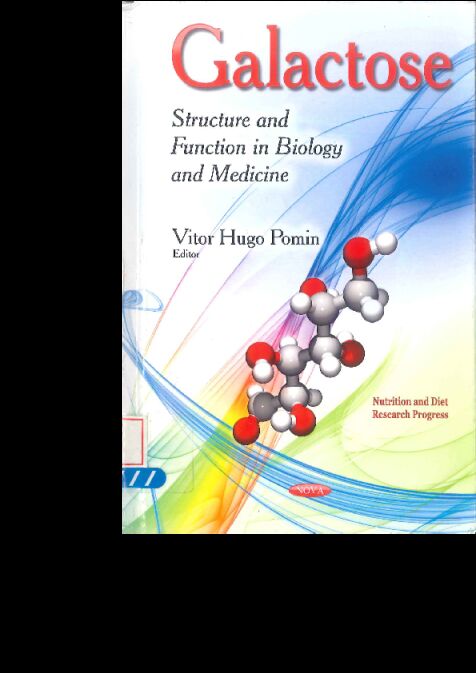
书名:Galactose
出版时间:2014
出版社:Nova Science Publishers, Inc.,
前言
Galactose (from the Greek galakt which means milk), a C4 epimer of glucose, is a hexose widely used to build up biologically functional glycoconjugates in living organisms. When combined with glucose through covalent bonds, it makes the widely known lactose, a disaccharide largely found in milk. Besides participating in metabolism, galactose also has multiple clinical roles. This book aims to report most of the science concerning the sugar type, galactose. The content of this book is heavily based on scientific results from renowned research groups of different countries. This contributes to the high-quality of this collection. Novelty and updated content are also features of this publication. The six containing chapters discuss: 1) the structure, dietary sources and clinical significance of galactose; 2) clinical relevance of galactose; 3) diet and implications of galactose in galactosemia; 4) recent advances in the science of galacto-oligosaccharides as prebiotics; 5) the structural configuration of galactose and its role in glycan biosyntheses; and 6) regulation of galactose operon in Escherichia coli. This book is recommended to anyone involved or interested in the science of galactose.
Chapter 1 - Galactose, just like its C-4 epimer glucose, is one of the most common aldohexose. Natural galactose is mostly D-family aldose and often found in the forms of galactan and gum, such as the galactan carrageenan and agaran, which are composed of β-D-galactose and 3,6-anhydro-α-D/L-galactose, and larch gum (arabinogalactan), locust bean gum and guar gum (galactomannan) etc, which are made up of galactose, arabinose and mannose. The galactose is rarely existe in free form but in glycoconjugates. In mammal milk, galactose mainly exists in the form of lactose, human milk contains 5.5±8.0% lactose by weight and cow milk 4.5±5.5%. In the IgG, ceruloplasmin, sialyl Lewis a/x, lectins, keratan sulfate and other important biological molecules, galactose is the essential monosaccharide. Foods such as beans, peas, figs, grapes and dairy products remain the most common source of galactose in the diet. The development of infant's brain cells and the nervous system needs an enormous amount of lactose, and galactose can promote the cerebroside lipids and mucopolysaccharides generation. In the intestine, galactose is beneficial for the growth and reproduction of lactobacillus and the vitamin K and B synthesis. Many diseases are associate with galactose, including its metabolism, content and the corresponding antigen, antibody and galectins. Galactosemia is a hereditary disease of galactose metabolic abnormalities, and the cause of the illness is due to the 1-phosphate galactose uridine to acyI transferase defect, which results in the deposition of galactose 1-phosphate and galactitol. The human blood type is determined by the terminal monosaccharide of the blood group antigen. Blood types A and B only differ from blood type 0 by the presence of an additional monosaccharide, N-acetylgalactosamine for type A and galactose for type B. α-Galactose antigen (Ga1α1-3Ga1β1-4GlcNAc-R) on the surface of mammalian cells is the main antigen which causes the hyperacute rejection (HAR) for xenotransplants. Although free D-glactose is often used to make aging models, the galacto-oligosaccharides (Ga1-(Ga1)n-G1c/Ga1, n= 0-6) are though as functional food additive.
Chapter 2 - D-galactose induced memory dysfunction, mito-oxidative damage and apoptosis via activation of PPAR-gamma receptors. D-galactose-induced aging in mice.Terminal galactosylation of transferrin may be a biomarker of healthy ageing. A 6% gallactose drink does not enhance performance time during a self-paced cycling performance trial in highly trained endurance cyclists compared with a formula typically used by endurance athletes but may improve the ability to produce intermediate self-paced efforts. Glucose and galactose regulate intestinal absorption of cholesterol. Galactose malabsorption complicated with rickets and nephrogenic diabetes insipidus has been. Galactose accelerates cataract development. Feeding dogs a diet containing 30% galactose induces experimental galactosemia and results in the formation of diabetes-like microvascular lesions of the retina. The galactose-fed beagle develops diabetes-like microvascular changes that are histologically and clinically similar in appearance to all stages of human diabetic retinopathy. Expression of an endogenous galactose-binding lectin correlates with neoplastic progression in the colon. Identification and upregulation of galactose/N-acetylgalactosamine macrophage lectin in rat cardiac allografts with arteriosclerosis has been demonstrated. Uridine diphosphate galactose-4-epimerase deficiency has been detected by neonatal screening for galactosaemia which has a variety of symptoms.Delayed hypersensitivity reactions to mammalian meat mediated by IgE antibodies to galactose-alpha 1,3-galactose (alpha-gal), an oligosaccharide,has been reported.
Chapter 3 - The goal of this chapter is to update recent developments in the Galactosemia field and offer new perspectives into the as yet unknown. Galactose is an energy-providing nutrient and also a necessary basic substrate for the biosynthesis of many molecules in body, where it forms part of glycolipids and glycoproteins in several tissues. Galactose is found in dairy products, sugar beet, and others gums and mucilage and also in some meats, legumes and fruits, but in lesser amount. It is a monosaccharide which when combined with glucose, through a dehydration process, results in lactose, the milk sugar. In galactose metabolism, the liver plays an essential role. Carbohydrates derived from the diet as disaccharides or polysaccharides are broken down into simpler monosaccharides, which reach the liver via the portal blood system. The primary sugars in newborns and infants come from breakdown of disaccharide lactose in milk; lactose is broken down to glucose and galactose and when it reaches the hepatocytes, galactose is converted to glucose by a series of enzymatic reactions. Galactosemia is a relatively rare inherited enzyme deficiency with variable worldwide incidence. The pathogenic potential of ingested galactose results from a defect in the galactose metabolic pathway, the Leloir pathway, which consists of three enzymes, the galactose specific kinase (Galactokinase/GALK), galactose-1-phosphate uridyltransferase (GALT) and uridine diphosphate galactose - 4'-epimerase (GALE). The most common cause of the failure to convert galactose to glucose results from the deficit of galactose-1-P-uridyltransferase (GALT), the second enzyme of the pivotal Leloir pathway, and is known as classical galactosemia (OMIM 230400), a severe genetic disease of the newborn, an autosomal recessive condition that give an acute toxicity syndrome. In this disease, galactose-1-phosphate accumulates inside hepatocytes and causes rapid liver failure with all the common symptoms associated: nausea, vomiting, hepatomegaly, jaundice, hypoglycemia and cataract. The clinical significance of establishing a diagnosis is clear: galactosemia could be fatal if undiagnosed, however, the treatment, that consists in a severe restriction of dietary lactose/galactose and is considered life-saving, is not fully effective since long term follow-up of patients has shown that they may develop chronic complications, such as retarded mental development, verbal dyspraxia, motor abnormalities and in young women hypergonadotrophic hypogonadism and premature ovarian failure.
Chapter 4 - Prebiotic oligosaccharides have attracted an increasing amount of attention because of their physiological importance and functional effects on human health, as well as their physico-chemical properties, which are of interest for various applications in the food industries. Galacto-oligosaccharides (GOS), one of the major groups of prebiotic oligosaccharides, are formed via the transgalactosylation reaction from lactose. This reaction is catalysed by a number of β-galactosidases (lactases) in addition to their hydrolytic activity. GOS are complex mixtures of different oligosaccharides, and the spectrum of the oligosaccharides making up these mixtures strongly depends on the source of the enzyme used for the biocatalytic reaction as well as on the conversion conditions used in their production. These oligosaccharides are of great interest because of their proven prebiotic (bifidogenic) characteristics. A plethora of GOS is also found in human milk, and these differently substituted oligosaccharides are associated with a number of beneficial effects for the breast-fed infant. This chapter reviews the production, the properties, the biological effects as well as the applications of galacto-oligosaccharides as prebiotics. The chapter also includes emerging trends in the production of novel, galactose-containing hetero-oligosaccharides, which are structurally more closely related to human milk oligosaccharides.
Chapter 5 - Glycosylated D-galactose is widely distributed in nature. Less common, L-galactose was found in snail and plant galactans. At difference with the most abundant monosaccharide, D-glucose, D-galactose may be found in pyranosic and furanosic configurations. In the animal kingdom, free D-galactose is not present but is a common constituent of glycoproteins and glycolipids, always as pyranose. In fact, D-galactose is incorporated into human milk oligosaccharides in larger quantities than glucose. The (3-1,4-galactosyltransferase links galactose to glucose to form lactose, the core for human milk oligosaccharides (HMO). Interestingly, the furanose form has been identified in important human pathogens like Mycobacterium tuberculosis, Aspergillus fumigatus and Trypanosoma cruzi, the agent of Chagas disease. In both configurations, the β-anomer predominates in the glycans. The absence of galactofuranose (Galf) in mammals and the important role that Galf-containing molecules play in host cell recognition led to the enzymes involved in the Galf metabolic pathways as targets for the development of drugs. Both, Ga1p and Galf must be activated as the nucleotides UDP-Ga1p and UDP-Galf for their incorporation into glycans. The nucleotide precursor for L-galactose is GDP-L-galactose, which is formed from GDP-mannose by the action of a 3',5'-epimerase. Also, whereas UDP-Ga1p may be synthesized from the free monosaccharides galactose or glucose, in the latter case through the action of a UDP-G1c-4-epimerase, UDP-Galf is produced from UDP-Galp by the action of a unique enzyme, UDP-Galp mutase (UGM), which catalyzes its conversion into UDP-Galf. In the last two decades several laboratories have been committed to understand the mechanism of action of UGM and its properties. The achievements in this area are presented in this chapter.
Chapter 6 - The galactose (gal) operon of Eschericha coli consists of four structural genes, E, T, K, and M, that respectively code for Epimerase, Transferase, Kinase and Mutarotase enzymes, needed for D-galactose metabolism. In addition to galactose being an energy source, galactose metabolites are anabolic substrates. The absence of either the galE or galT gene results in the accumulation of galactose intermediates, leading to multiple metabolic disorders. The gal genes are transcribed from two overlapping promoters, P1 and P2 that have transcription start points (tsp) 5-bp apart. Both promoters are typically regulated by the repressor (Ga1R) and cyclic adenosine 3':5'-monophosphate (cAMP) receptor protein (CRP). Ga1R binds at two operators, O_E (external operator) located at position -60.5, and O_1 (internal operator) located at +53.5 with respect to the tsp of P1 The binding of GalR to O_e alone represses P1 and stimulates P2, while binding to O_1 blocks transcription from both P1 and P2. The cAMP and CRP acting as a complex (CCC) activates P1 and represses P2. A histone-like protein, HU, binds to position +6.5, is also a key player in gal regulation by GalR. In this chapter, we will describe the key components of the regulation of the gal operon at the level of transcription.
查看更多
目录
Preface vii
Chapter 1 Galactose: Chemical Structure, Dietary Sources and Clinical Significance 1
Youjing Lv and Guangli Yu
Chapter 2 Clinical Relevance of Galactose 25
Tzi Bun Ng and Charlene Cheuk Wing Ng
Chapter 3 Galactose: Diet and Its Implication in Galactosemia 47
Ana C. Ribeiro, Maria J. Silva and Maria E. Figueira
Chapter 4 Galacto-Oligosaccharides Recent Progress on Research and Application As Prebiotics 75
Sheryl Lozel Arreola, Montira Intanon, Ngoc Hung Pham, Dietmar Haltrich and Thu-Ha Nguyen
Chapter 5 Galactose Configurations in Nature with Emphasis on the Biosynthesis of Galactofuranose in Glycans 107
Carla Marino and Rosa M. de Lederkremer
Chapter 6 Regulation of the Galactose Operon in E. coli 135
Dale E. A. Lewis and Amlanjyoti Dhar
Editor Contact Information 175
Index 177
查看PDF
查看更多
馆藏单位
中国医科院医学信息研究所